How to Calculate Car Depreciation: A Step-by-Step Guide
Learn how to calculate car depreciation with a step-by-step worked example, then verify figures with a vehicle history check before buying or selling.

How to Calculate Car Depreciation: A Step-by-Step Guide
A car loses value the moment you drive it off the forecourt, and it keeps losing value every year after that. If you're trying to work out how to calculate car depreciation, you're probably either budgeting for a future purchase, checking whether a used car is fairly priced, or working out what your own vehicle is actually worth right now. Guessing gets you nowhere here, and the numbers matter more than most buyers realise.
This guide gives you a straightforward method for calculating depreciation yourself, using the same logic dealers and valuation firms rely on. You'll learn how much cars depreciate each year, how to apply those percentages to your car's original price, and how factors like mileage, condition, and brand reputation shift those figures up or down.
We'll walk through the calculation step by step with real examples, then show you how to sense-check your result against a car's actual history. Before you commit to any used car, running a full vehicle history check on the registration plate tells you about past owners, mileage records, and outstanding finance, all of which affect true value alongside age-based depreciation.
Why car depreciation matters for buyers and sellers
Money changes hands based on a number nobody prints on the windscreen: what the car is actually worth today. What car depreciation is matters because it's the single biggest cost of car ownership for most drivers, often outweighing fuel, insurance, and servicing combined over a typical ownership period. A car that cost £20,000 new might be worth £8,000 after three years, and that £12,000 gap is money you've spent even if you never noticed it leaving your account. Understanding this figure protects you whether you're signing a cheque or handing over the keys.
The biggest expense of owning a car isn't fuel or insurance, it's the value the car loses while you're not looking.
What it means if you're buying
Buyers who understand how to work out car depreciation avoid overpaying for cars already priced above their real market value. Knowing roughly where a car should sit on its depreciation curve gives you a benchmark for negotiation, and it flags cars that hold their value unusually well, often a sign of desirability, or unusually badly, often a sign of hidden problems. Checking a used car's history alongside its depreciation figure helps you spot the difference between a genuine bargain and a car quietly losing value faster than it should.
What it means if you're selling
Sellers benefit just as much from doing the maths. Pricing a car too high based on sentimental value or what you originally paid means it sits unsold for weeks, while pricing it too low leaves money on the table. Working out an accurate depreciation-adjusted value before you list the car gives you a defensible asking price, one you can back up with figures rather than guesswork, which makes negotiations faster and less stressful for everyone involved. Getting this number right, using a proper car depreciation calculation, turns a vague hunch into a price you can actually stand behind.
Step 1. Gather your car's key details
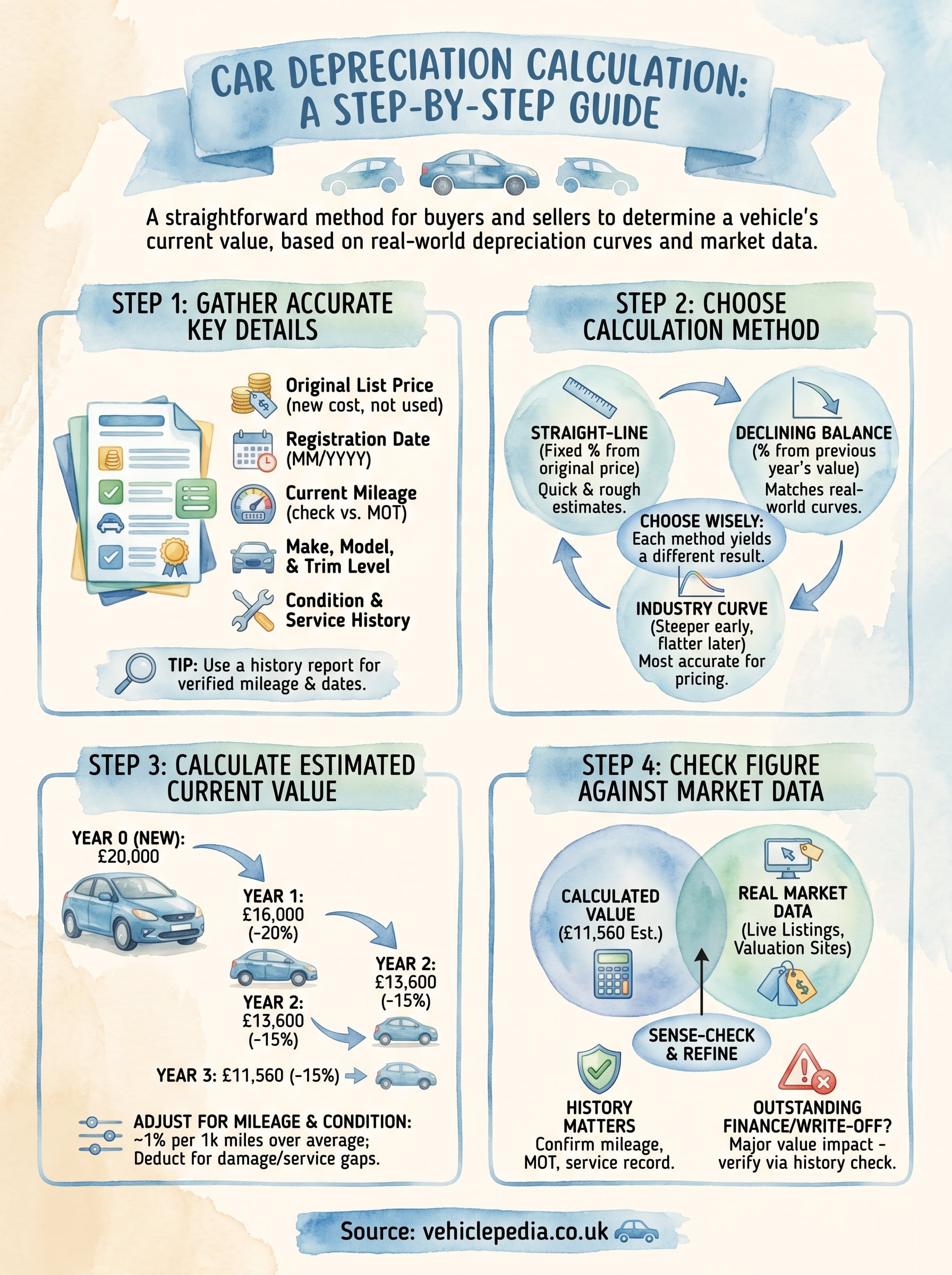
Before you can run any car depreciation calculation, you need accurate source data. Guessing at the original price or rounding the mileage throws the whole result off, sometimes by thousands of pounds. Pull together the figures below before moving to the maths.
- Original list price (what the car cost new, including factory options, not what you paid second-hand)
- Registration date (the exact year and month, not just "a few years old")
- Current mileage, checked against the MOT history for consistency
- Make, model, and trim level, since depreciation rates vary sharply between them
- Condition and service history, including any accident repairs or missing stamps
A depreciation figure is only as reliable as the data you feed into it.
If you're checking a used car rather than your own, most of this sits behind the registration plate. A history report on the registration plate pulls the DVLA-verified registration date, MOT records, and mileage history in one search, which saves you chasing a seller for details they might not volunteer accurately. Missing or estimated figures at this stage compound into a badly skewed valuation later, so treat this groundwork as non-negotiable rather than optional.
Once you've got solid numbers for each of these, you're ready to pick a method and start calculating actual depreciation.
Step 2. Choose a depreciation calculation method
Several methods exist for working out car depreciation, and picking the right one depends on how precise you need to be. Most private buyers and sellers use one of three approaches, each trading simplicity for accuracy in a different way.
Choose your method before you touch a calculator, because each one gives a genuinely different answer from the same starting figures.
Declining balance calculations mirror how cars actually lose value, fast in the first year, then slower each year after. Straight-line methods are easier to do in your head but overstate value in year one and understate it by year five. The industry standard curve used by valuation firms like CAP HPI and Glass's Guide blends both, applying steeper drops early and flattening out later.
| Method | How it works | Best for |
|---|---|---|
| Straight-line | Fixed % deducted each year from original price | Quick, rough estimates |
| Declining balance | % deducted from the previous year's value, not the original | Matches real-world depreciation curves |
| Industry curve | Variable rates by year, steeper early, flatter later | Most accurate for used car pricing |
Understanding how to calculate car depreciation properly means matching the method to your purpose. If you just want a ballpark figure, straight-line works fine. If you're pricing a used car to sell or buy, the declining balance or industry curve method gets you much closer to what the market will actually pay.
Step 3. Calculate your car's current value
With your data gathered and a method chosen, run the actual sums. The declining balance method works best for most used cars, since it applies each year's percentage drop to the previous year's value, not the original list price. This mirrors how depreciation really behaves: steep in year one, gentler afterwards.
Take a car with a £20,000 original list price, now three years old. Using typical industry percentages of 20% in year one, then 15% for each following year, the car depreciation calculation looks like this:
Year 0 (new): £20,000
Year 1: £20,000 - 20% = £16,000
Year 2: £16,000 - 15% = £13,600
Year 3: £13,600 - 15% = £11,560
That £11,560 is your car's estimated current value based purely on age. Adjust it further for mileage (deduct roughly 1% for every 1,000 miles above the UK average of 10,000 a year) and for condition, knocking off a few hundred pounds for cosmetic wear or unresolved service history gaps.
A depreciation calculation gives you a starting figure, not a final price, real-world adjustments always follow.
Write this estimated value down before moving on. You'll need it to compare against what similar cars are actually selling for, which is where the next step comes in.
Step 4. Check your figure against real market data
Your estimated value from Step 3 is a mathematical model, not a guarantee that anyone will pay it. Real cars sell for what buyers actually offer, and that number gets pulled around by local demand, colour, spec, and how desperate the seller is to move it. Cross-check your figure against listings for the same make, model, age, and mileage on major marketplaces and the UK's most accurate valuation sites, then adjust if your number sits well outside that range.
A calculation tells you what a car should be worth, the market tells you what it actually is.
History matters here too. A car with a clean service record and no accident record will sit at the top of its depreciation band, so it pays to know how to verify a car's service history, since gaps, high mileage, or a poor MOT history drag the real-world price below your calculated figure regardless of the maths. Checking for outstanding finance before you buy matters because finance or a previous write-off pushes value down further still, sometimes drastically, and these details rarely show up in a simple price comparison.
Running a vehicle history check alongside your market comparison closes this gap. It confirms the recorded mileage matches what's advertised against MOT records, flags import or export history, and checks for finance or write-off markers that would otherwise blindside you after you've already agreed a price based on depreciation alone.
Putting your depreciation figure to use
You now have a calculated value backed by a proper method, not a guess pulled from thin air. That number gives you real leverage, whether you're negotiating a purchase price down, justifying an asking price to a buyer, or simply deciding whether now is the right time to sell before the next steep drop in value hits. Depreciation maths only tells half the story, though. The other half sits in a car's actual history: its mileage records, MOT results, and whether it's carrying finance or a write-off marker that no formula can spot.
Before you finalise any deal, run the registration plate through a proper check to confirm the history matches the price you've calculated. See exactly what a Vehiclepedia report reveals about any car, then use those details to back your depreciation figure with confidence rather than crossed fingers.