12-Point Used Car Buying Checklist to Print and Take Along
Looking for a used car buying checklist PDF? Print this 12-point list covering history, paperwork, bodywork, engine and test drive checks.
12-Point Used Car Buying Checklist to Print and Take Along
You do not need a used car buying checklist PDF to buy safely. You need a list you follow in the same order every time: history checks from your sofa, paperwork at the seller's address, then the car itself, from bodywork to engine to test drive. This page gives you that list in 12 parts, laid out so you can print it or keep it open on your phone. If you are short on time, do parts 1 to 3 before you travel. First-time buyers get the most from parts 2, 10 and 12. Experienced buyers can skim to the red flags at the end of each part.
Most printable checklists stop at "check the tyres" or "check the engine". They never say how to check, or what result should make you walk away. A tick box without a threshold is not much use when a seller is standing next to you. So each part here gives you what to check, how to check it and the red flag that ends the viewing. Together they work as a free used car inspection checklist for any petrol, diesel, hybrid or electric car.
Vehiclepedia is a UK vehicle history check service, which is why part 1 starts with the number plate and official records. The rest needs only a torch, a small magnet and your phone.
1. Run a vehicle history check from the number plate
Start with the number plate, before you book a viewing. A history check takes seconds and answers what you cannot see by looking at the car: whether it is on finance, has been written off or reported stolen, and whether the records match the advert. It is the one check that can save you a wasted journey.
What to check
Vehiclepedia's free check returns MOT status, history and expiry, road tax status and yearly cost, registration and age, make and model, outstanding recall, export status, CO2 emissions and engine size. The £6 Premium Check adds finance, police, written-off and scrapped checks, plus ownership history, plate and colour changes and technical details.
- Make, model, engine size and age match the advert
- MOT is valid and the expiry date is not days away
- Road tax status and yearly cost fit your budget
- No outstanding recall left unrepaired
- Export or import status makes sense for the car
- No finance, police or write-off marker (premium check)
- Plate and colour changes match what the seller tells you
How to check it
Ask the seller for the registration before you travel, then enter it into the free check. Compare the result with the advert line by line. The data comes from official feeds, including the DVLA for vehicle details, the DVSA for MOT history, Experian for finance and stolen-vehicle data, and MIAFTR for insurance write-offs. It is updated nightly.
The free check cannot see finance or write-offs, and that is where the expensive surprises sit. If the car passes the free check and you still like it, run the premium check. It carries a data guarantee of up to £30,000 for non-trade users. No database holds every record, so treat the report as one layer of protection and still do the physical checks below.
Check the records before you travel, so you only spend time on cars that survive them.
Red flags to walk away from
Any of these should end the viewing, or at least force a hard conversation about price:
- Outstanding finance, because the lender may still own the car
- A stolen marker on the police or insurance records
- A write-off the seller has not mentioned
- A mismatch in make, model, colour or engine size
- Plate or colour changes the seller cannot explain
Write-offs need a closer look. Since 2017 the categories are A, B, S and N. Categories A and B must never return to the road. Categories S (structural) and N (non-structural) can be repaired and sold, but they deserve a lower price and an expert inspection.
2. Check the V5C and the seller's identity
Ask to see the V5C registration certificate at the seller's home, and make sure the keeper's name and address match the seller's photo ID. The V5C is the most important document in the sale. It names the registered keeper, but it is not proof of ownership.
What to check
The V5C should agree with the car in front of you and with the record you pulled in part 1. Read every field before you talk price.
- Registered keeper's name and address match the seller and the property
- Registration, make, model and colour match the car
- VIN (chassis number) on the V5C matches the one on the car
- Date of first registration and number of previous keepers fit the story
- The new keeper slip is attached, so you can tax the car
- Proof of purchase, such as an invoice or receipt from the seller's own buying
How to check it
View the car at the seller's home, never in a car park. The address on the V5C should be the place you are standing. Ask to see photo ID, and compare the name. The VIN is usually visible at the base of the windscreen on the driver's side. It is often repeated on a door pillar or under the bonnet, so check at least two places against the paper.
Then look at the document itself. Smudges, alterations or correction fluid are reasons to stop. If the seller says they are selling for a friend, ask to speak to the registered keeper before you hand over anything. A seller who is not the keeper cannot answer questions about the car's past.
The V5C proves who the keeper is, so make sure the person in front of you is that keeper.
Red flags to walk away from
- No V5C, or "it's in the post"
- Seller's name or address differs from the V5C
- VIN mismatch between paper and car
- Several keepers in a short period with no explanation
- Seller insists on meeting somewhere other than their address
- A "private" seller who has several cars for sale, which can signal an unregistered trader
3. Read the MOT history and service record
The MOT history shows what testers found in previous years, and the service record shows whether anyone looked after the car in between. Read both before you inspect the car. Any car more than three years old needs an annual MOT, and the history is free to view on GOV.UK.
What to check
An MOT is a snapshot on the test day, not a guarantee. The useful information is in the pattern across years.
- Current expiry date and the result of the last test
- Failures, and whether they were fixed straight away
- Advisories that repeat year after year, such as corrosion or worn suspension parts
- Gaps between tests
- Stamped service book or invoices, with dates and mileage
- Evidence of the cam belt or chain, brake fluid and, on automatics, gearbox oil service
How to check it
Pull the MOT record on GOV.UK or from the free Vehiclepedia check. Note every advisory, then ask the seller whether each one was fixed. Look at the part yourself where you can. An advisory for "slight corrosion on sill" repeated three years running is worse than a single new advisory for a tyre.
For the service record, ask to see the invoices behind the last two services. They should show the registration or VIN, date and mileage. Vehiclepedia's free service history check also shows whether a car has a complete, partial or missing history, with the date and mileage of every recorded service. It draws on manufacturer and dealer networks and covers brands such as Audi, BMW, Mercedes-Benz, Ford, Volkswagen and Kia.
A repeated advisory tells you more than a single pass, because it shows what nobody fixed.
Red flags to walk away from
- Failures for corrosion or structural parts
- Advisories ignored year after year
- Servicing that stops after the first few years
- "I lost the book" with no invoices at all
- A very long gap between MOTs
- A seller who promises a fresh MOT "next week" on a car about to expire
4. Check the mileage against the wear
Mileage is believable when the MOT readings rise steadily and the wear on the car matches the number on the dash. Check the numbers first, then confirm with your eyes and hands.
What to check
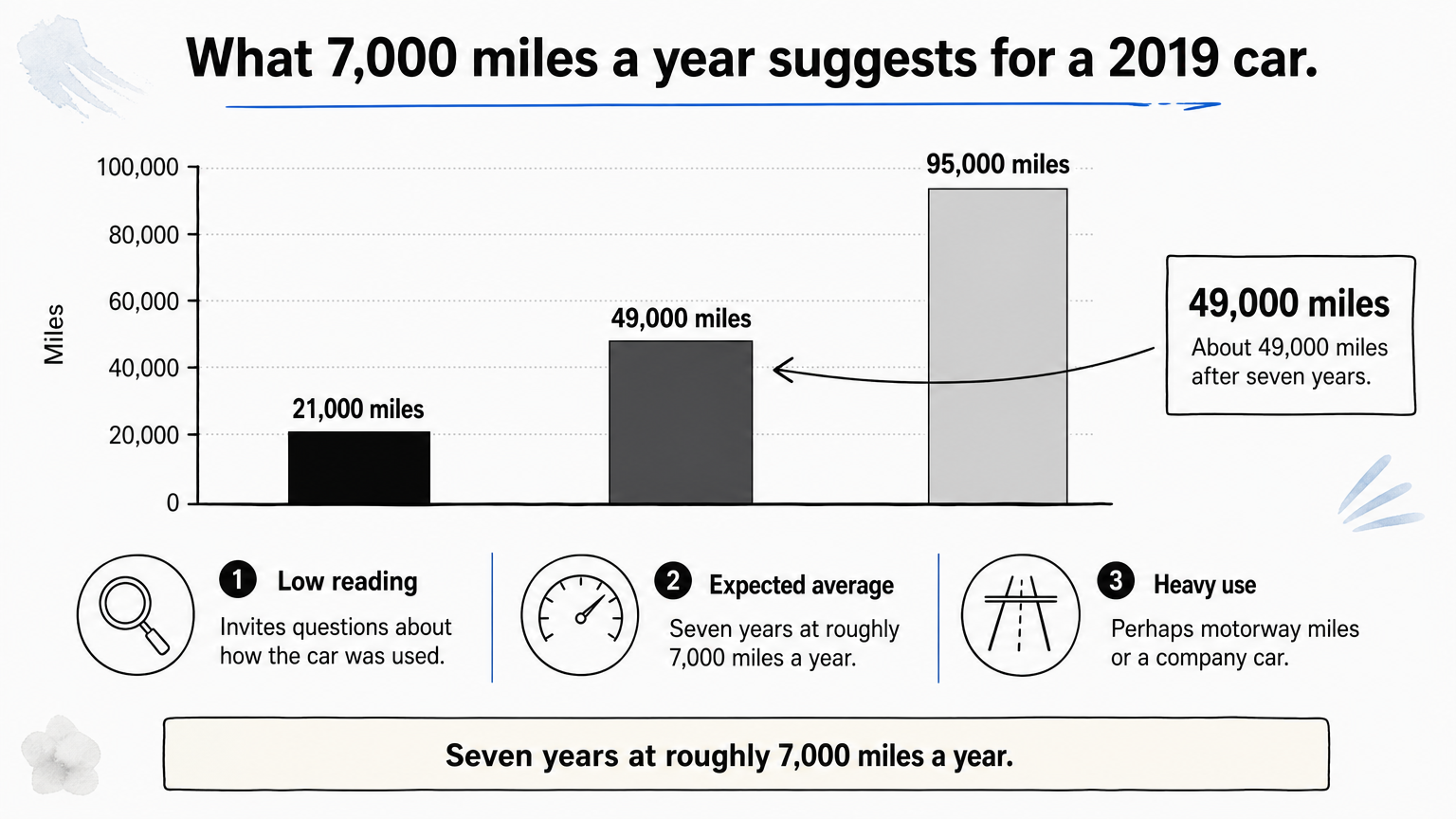
Roughly 7,000 miles a year is a commonly quoted average for UK cars. Use it as a rough benchmark, not a rule.
- MOT readings rise each year with no drops
- Service stamps and invoices agree with the MOT readings
- Wear on the driver's seat bolster, steering wheel, gear knob and pedal rubbers matches the mileage
- Wear on tyres, brakes and key fobs is consistent
- Advert photos match the car you see
How to check it
Work a quick example. A car first registered in 2019 has had about seven years of use by now. At around 7,000 miles a year, that is roughly 49,000 miles. A reading of 21,000 invites questions. A reading of 95,000 points to heavy use, perhaps motorway miles or a company car, which is not bad if the servicing is complete.
Vehiclepedia's Genuine Mileage Check compares the recorded mileage against official records, including DVLA data and MOT history, to flag discrepancies and tampering. Low mileage is not automatically better. A car that sat for months can have tired seals, a weak battery and flat-spotted tyres.
Mileage is only believable when the paperwork, the wear and the number all tell the same story.
Red flags to walk away from
- A reading that falls between two tests
- Mileage that barely moves for years, then jumps
- Heavily worn seat, wheel and pedals on a "low mileage" car
- Fresh scratches or misaligned trim around a digital dash
- A seller who cannot explain a mileage gap
Altering a mileage reading is fraud, so do not accept a vague answer.
5. Inspect bodywork, panels and paint
Walk slowly around the car in daylight and dry weather, looking for mismatched paint, uneven gaps and rust. These are the signs of accident repair and neglect. Rain and low light hide most of what you need to see.
What to check
Start at one corner and work around the car twice, once standing and once crouching.
- Panel gaps even on both sides of the car
- Paint colour and texture the same on every panel
- Overspray on rubber seals, trim or lights
- Ripples or waves along the sides
- Rust at wheel arches, sills, door bottoms and boot edges
- Dents and scratches, noting which are cosmetic
- Missing badges or trim that the model should have
How to check it
Bring a small magnet wrapped in a soft cloth. Filler is not magnetic, so a magnet that will not stick on a patch of steel panel suggests filler underneath. Some panels are aluminium and will never attract it, so use it as a prompt for questions, not a verdict.
Open every door, the bonnet and the boot. Look at the hinge bolts and shut lines for chipped paint or paint on the bolts, which suggests panels have been removed. Crouch and look along the side of the car for waves. If the colour differs from the V5C, ask why, and check whether the history report shows a colour change.
Even gaps and one consistent colour are the quickest sign that a car has not been in a serious crash.
Red flags to walk away from
- One panel that looks newer than the others
- Overspray on seals or trim
- Bubbling paint, which means rust is working from underneath
- Wavy panels or visible filler
- Gaps wide at one end and tight at the other
- Rust on structural areas such as sills
Small dents and scratches are normal. Use them in negotiation instead of treating them as a reason to leave.
6. Check tyres, wheels and brakes
Tyres need at least 1.6mm of tread across the central three-quarters of the tyre, around its whole circumference. Below that the car is illegal, so either walk away or price in a full set. Tyres, wheels and brakes also show how the car was maintained.
What to check
Check all four tyres and the spare, not just the front two.
- Tread depth on each tyre, inside edge included
- Even wear across the tread
- Matching brand and type on each axle
- Age code on the sidewall, four digits for week and year
- Bulges, cuts or cracking on the sidewalls
- Kerb damage on alloy wheels
- Brake discs for deep scoring or a pronounced lip
- Spare wheel or inflation kit, jack and locking wheel nut key
How to check it
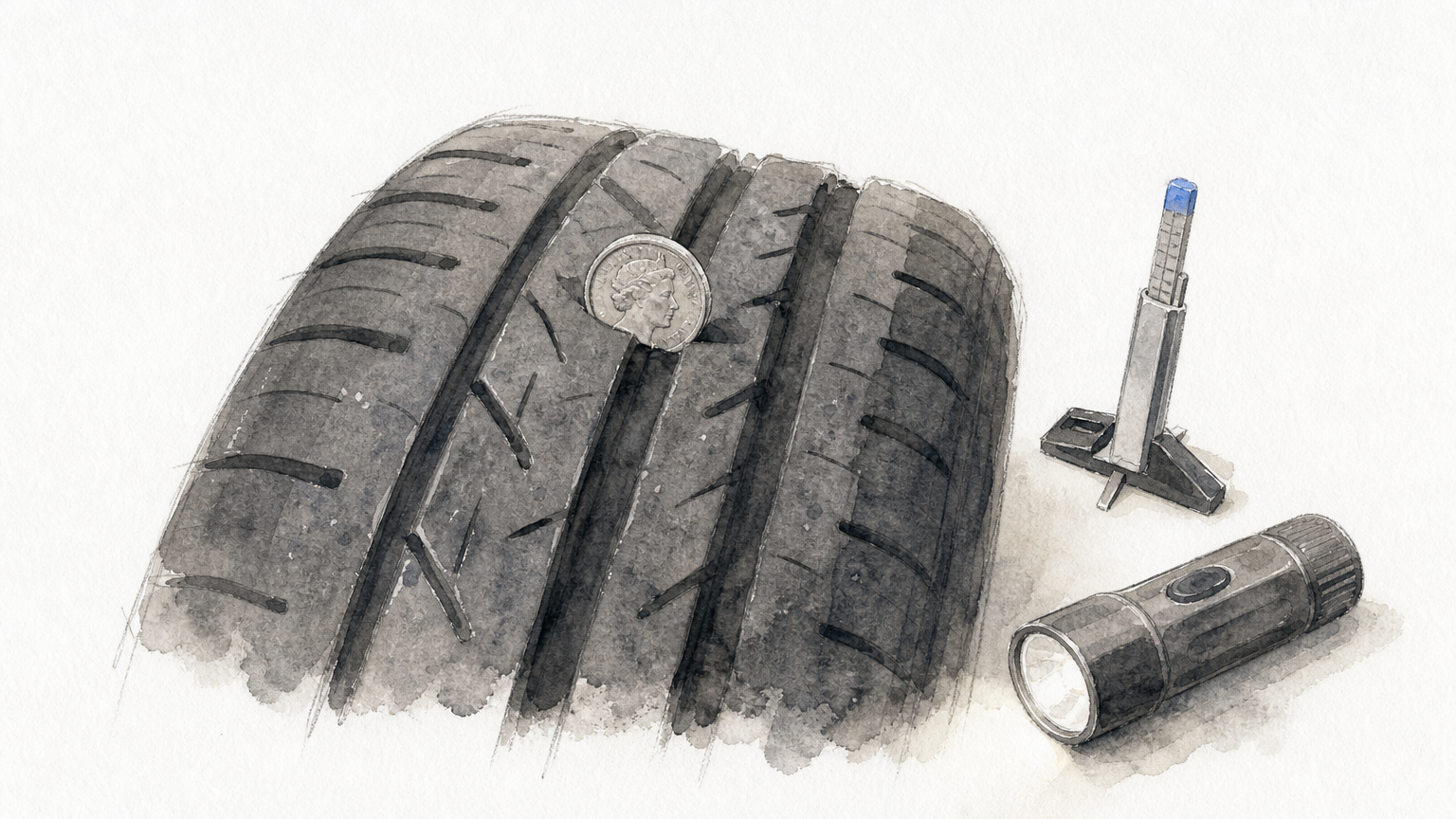
Use a tread depth gauge, or push a 20p coin into the main grooves. If the coin's outer band is hidden, the tread is above 1.6mm. Treat anything near 3mm as due for replacement soon and use that in your offer. Wear on the inner edge points to alignment or suspension faults, while wear down the centre suggests over-inflation.
Read the four-digit date code on the sidewall. A code of 2319 means week 23 of 2019. Tyres degrade with age even when the tread looks fine, so factor in replacement for tyres more than about six years old. Look through the wheel spokes at the disc surface and pad thickness with your torch.
Tyres are the cheapest part of the car to inspect and one of the best bargaining points.
Red flags to walk away from
- Tread below 1.6mm on any tyre
- Uneven wear that suggests suspension or alignment trouble
- Bulges or cracks in the sidewall
- A mix of budget tyres on a car that cost serious money
- Deep disc scoring with worn pads
- A missing jack or locking nut key, which is a small cost but worth asking about
7. Check glass, lights and mirrors
Every lamp, mirror and pane of glass should be intact and working. These are cheap MOT failures, but they also show how carefully the car has been kept. A chip in the driver's direct view larger than 10mm can fail an MOT.
What to check
Test everything with the ignition on, before the test drive.
- Windscreen for chips and cracks, especially in the driver's eyeline
- Wiper blades and washer jets
- Headlight lenses for cloudiness, cracks or internal moisture
- Dipped beam, main beam, fog lights, indicators, brake lights, reverse and number plate lights
- Mirrors for cracks and working electric adjustment or folding
- Rear window heater lines
- Sunroof operation and drain staining
How to check it
Run through the lights in sequence while you stand outside, or ask the seller to press the brake pedal while you look at the rear. Look at the markings on each window. Most glass carries the manufacturer's logo, and one window with different markings can mean it was replaced. That is not a fault in itself, but ask why.
Check the headlights as a pair. A new unit beside an old one suggests front-end damage. Windscreens crack quickly in winter once a chip spreads, so a chip is both a fault to fix and a negotiating point. Replacement is a cost to include in your offer, not a surprise after you buy.
Working lights and clean glass are small things, but a neglected one usually has company.
Red flags to walk away from
- A crack or large chip in the driver's view
- Moisture inside a headlight
- Lights that "just need a bulb" on several corners
- Mismatched headlights
- Sunroof staining on the headlining
- Cracked mirror housings combined with fresh paint nearby, which can hint at a side impact
8. Inspect the interior, electrics and warning lights
Sit in every seat and test every control. The interior shows how the car was used, and electrical faults are slow and costly to chase. Warning lights deserve special attention.
What to check
Take your time. This is the one part of the viewing where nobody minds you pressing buttons.
- Warning lights come on at ignition, then go out after the engine starts
- Seatbelts retract smoothly and latch securely
- Seats adjust and show wear that fits the mileage
- Carpets, mats and boot floor are dry and smell clean
- Windows, central locking and mirrors all work
- Air conditioning blows cold and heating blows warm
- Infotainment, parking sensors, cameras and USB ports work
- You are given every key and fob
How to check it
Turn the key or press start without the engine running. The engine, ABS, airbag and tyre pressure lights should all come on briefly. A warning light that never comes on may mean its bulb was removed to hide a fault, which is a classic trick with the airbag light. Then start the engine and confirm they go off.
Pull back the mats and press the carpet in the footwells, and lift the boot floor. Dampness, silt or rust under the seats can mean leaks or flood damage. Run the air conditioning on maximum cold with the engine running. Check the sat nav, screen and driver aids, because modern touchscreens and sensors are expensive to repair.
A warning light that never comes on is as suspicious as one that never goes off.
Red flags to walk away from
- Any warning light that stays on
- An airbag light that does not illuminate at ignition
- Damp footwells or a musty smell
- A strong air freshener hiding smoke or damp
- Air conditioning that only blows warm
- Heavy wear that contradicts the displayed mileage
- Only one key supplied when the car should have two
9. Look under the bonnet and underneath
Check fluids, leaks, belts and the battery with the engine cold, then look underneath for drips and corrosion. A cold engine matters because a warm one can hide start-up problems. Put your hand on the bonnet when you arrive.
What to check
Open the bonnet and work through the engine bay in the same order every time.
- Oil level on the dipstick, and oil colour
- Underside of the oil filler cap for white, creamy residue
- Coolant level and colour in the expansion tank
- Brake fluid and power steering fluid levels
- Drive belts and hoses for cracks, fraying or bulges
- Battery terminals for corrosion, and the age of the battery
- Leaks on the engine and on the ground where the car was parked
- Exhaust, suspension parts and undertray for corrosion or damage
How to check it
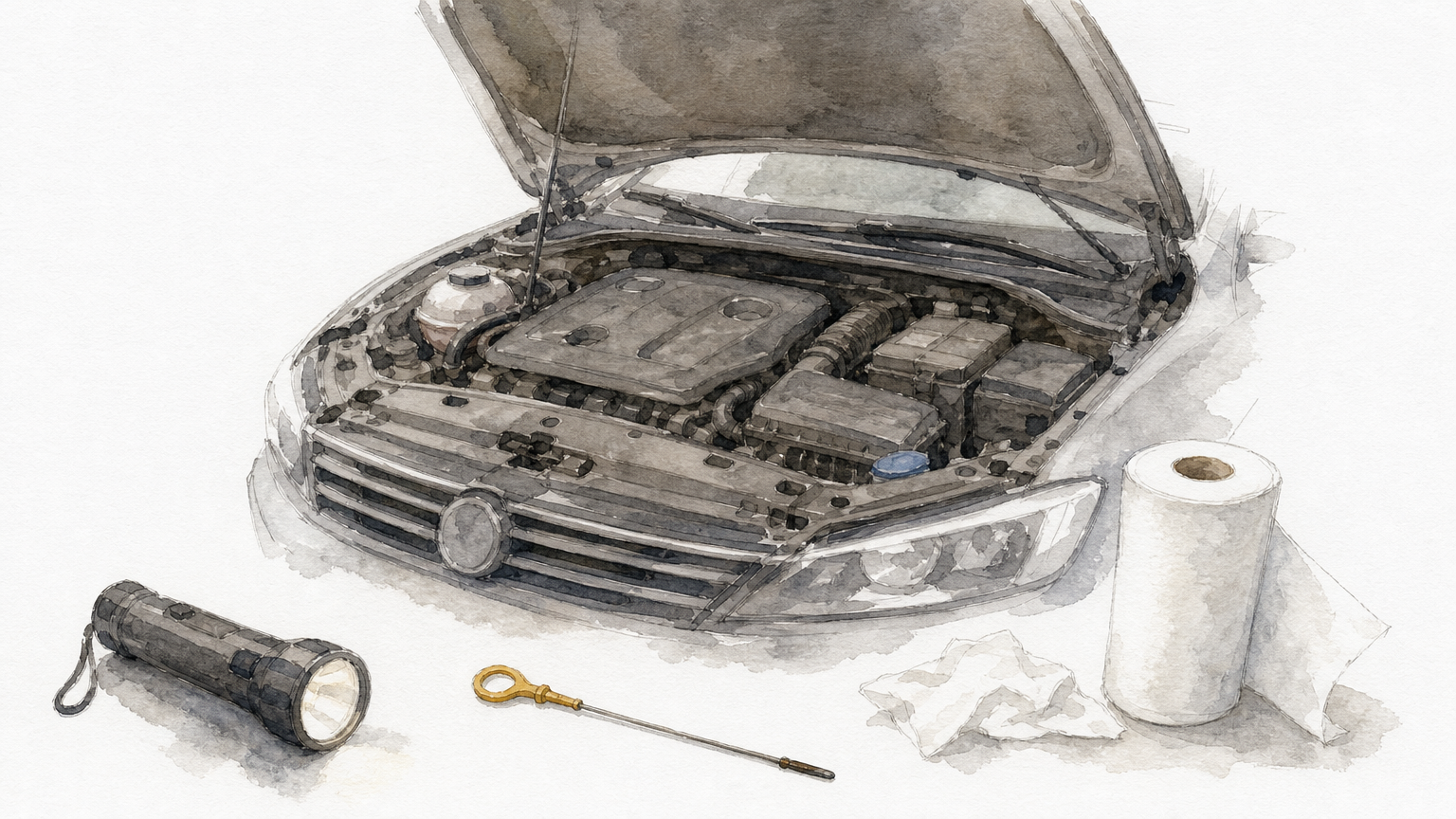
Bring a torch and a rag or kitchen roll for the dipstick. Oil should be smooth and amber to dark brown, not gritty, sludgy or milky. A mayonnaise-like residue under the oil cap can mean coolant mixing with oil, which can point to head gasket failure. Never open a hot radiator or expansion tank cap.
Ask when the timing belt or chain was last changed, and check the interval for that model. On many engines a missed belt change can destroy the engine, so get a replacement quote if it is due or unknown. If the car is a hybrid or electric, ask for a battery health report, and check the charging port and cable instead of the oil. An engine bay that has just been steam cleaned on an old car is worth a question.
Look at the engine cold and the ground beneath it, because leaks and warm-ups tell the truth.
Red flags to walk away from
- Milky or sludgy oil
- Oily coolant
- Fresh oil or coolant leaks
- A burning smell
- An engine already warm when you arrive
- Frayed belts or soft hoses
- Heavy corrosion on the underbody or suspension mounts
10. Start the engine cold and test the gearbox
Start the car from cold and listen before the seller starts talking. It should fire quickly and idle steadily. Exhaust smoke, rough running and gearbox problems are far easier to hear and see in the first few minutes.
What to check
Do this part with the radio and air conditioning off so you can hear the engine.
- Engine starts promptly and settles into a steady idle
- No warning lights after start-up
- Exhaust: blue smoke suggests burning oil, thick white smoke suggests coolant, black smoke suggests a fuelling or filter problem
- Temperature gauge reaches normal operating temperature within roughly 10 minutes of driving and stays there
- Manual clutch bite point not too close to the top of the pedal
- Gears engage cleanly with no crunching
- Automatic changes smoothly, with no jerks or slipping
- No knocking, ticking or rattling that persists
How to check it
Ask the seller not to start the car before you arrive. Stand behind it while they start the engine and watch the exhaust. Thin white vapour on a cold morning is normal. Then listen for ticking, knocking or a chain rattle in the first 30 seconds.
Before you drive off, confirm who insures the test drive. The seller's policy must cover you, or you should arrange short-term cover. Do not assume your own policy applies to another car. To check a manual clutch, climb a hill in a high gear at low revs. The engine should pull cleanly, not rev while the car slows. Try a quick pull-away to check for judder.
If the seller has warmed the car up before you arrive, ask why, and treat the cold start as unproven.
Red flags to walk away from
- Engine already warm
- Reluctance to start the car cold
- Blue smoke or persistent white smoke
- Stalling, hesitation or a rough idle
- A clutch that bites high or slips
- Crunching gears
- A seller who turns the radio up during the drive
11. Test steering, brakes and suspension on the road
Drive for at least 20 to 30 minutes over a mix of roads, including bumps, a hill and a faster stretch. Check how the car steers, brakes and rides. A short drive around the block will not reveal most faults.
What to check
Pay attention to what the car does, not what the seller says.
- Car tracks straight on a level road with light hands on the wheel
- Steering returns to centre without vibration at motorway speeds
- No clunks or knocks over bumps
- Brakes pull up straight, with a firm pedal and no pulsing or grinding
- Parking brake or electronic handbrake holds on a hill
- No clicking on full-lock turns, which can mean worn driveshaft joints
- Wind noise and vibration at speed
- Driver aids such as cruise control and lane assist work
- Driving position, seat and visibility suit you
How to check it
Choose a route that includes a roundabout, a rough surface and a stretch above 50mph. Perform one firm stop only when the road behind you is clear. The car should stop in a straight line. Listen for knocking or squeaking from the suspension on poor surfaces, and feel for vibration through the steering wheel and seat.
When you finish, park, leave the engine idling for a few minutes and watch the temperature gauge. Then look under the car again for new drips. This is also your chance to ask whether you could live with it. Check the seat, mirrors and visibility for your own routes. A car that is right on paper but uncomfortable will annoy you every day.
Twenty minutes of varied driving will tell you more than any amount of walking around the car.
Red flags to walk away from
- Pulling to one side under braking
- Shuddering or grinding when stopping
- Knocks over bumps
- Overheating
- Vibration at speed
- A new leak after the drive
- A seller who refuses a test drive or limits you to a very short route
12. Get it inspected, then close the deal safely
Before you pay, get an independent inspection if the car is worth it, negotiate using the faults you found, pay by a traceable method and sort tax and insurance. This last stage protects your money after all the checking is done.
What to check
A professional pre-purchase inspection is the used car mechanic inspection checklist that goes beyond what you can do on a driveway. Many breakdown and inspection providers offer it. Fees vary by provider and depth, so ask for the price before you book.
- Underside inspection on a ramp
- Diagnostic read for stored fault codes
- Suspension bushes, steering joints and brake measurements
- Signs of accident repair and fluid leaks
- A written report you can use in negotiation
A good inspection is most useful on a higher-value car or one you cannot judge yourself.
How to check it
Use your findings in the price. Say the car is advertised at £6,000, and quotes show two tyres at £300 and an overdue service at £150. That is £450, so a fair offer is £5,550. Be polite, show your evidence and be ready to walk away.
Pay by bank transfer or another traceable method only after the checks, and avoid large cash payments. Get a written receipt that records the seller's name and address, your details, registration, VIN, mileage, price, date and any promised work. Insure the car before you drive away. Vehicle tax does not transfer to you, so tax the car in your own name first. Make sure the seller notifies the DVLA and gives you the new keeper slip.
Your rights depend on who sells. A dealer must supply a car that is of satisfactory quality, fit for purpose and as described under the Consumer Rights Act 2015, with a short-term right to reject, as GOV.UK explains. A private seller must describe the car accurately and have the right to sell it, but your protection is much weaker.
Pay only after the checks are done, in a way you can trace, and get it in writing.
Red flags to walk away from
- A request for a deposit or cash before you have seen the car
- Refusal to allow an independent inspection
- Pressure such as "another buyer is on the way"
- Payment requested into an account that does not match the V5C name
- No written receipt
- Reluctance to let you run a history check
Take the list with you
A good used car buying checklist does three jobs. It checks the records before you travel, tests the car in a fixed order, and tells you when to leave. Work through the 12 parts in sequence, tick what passes and negotiate on what does not. Any red flag in the history, the V5C or the VIN is a reason to walk away, however good the car looks.
Print this page or keep it open on your phone at the viewing. If a seller tries to rush you, that is information too, because there will always be another car.
Before you book your next viewing, enter the registration into Vehiclepedia's free check. If you want to know what the finance, stolen and write-off sections look like first, see a sample premium report.