Used Car Test Drive Checklist: 15 Things To Check UK
Follow our used car test drive checklist covering 15 checks, from cold starts to steering, brakes and warning lights, before you agree a price.
Used Car Test Drive Checklist: 15 Things To Check UK
A test drive is your last real chance to catch problems before you hand over a deposit. Yet most buyers spend ten minutes driving round the block, listen for anything obviously wrong, then sign the paperwork. Following a proper used car test drive checklist stops you missing the small warning signs, a slipping clutch, a pull to one side, a knock over bumps, that turn into expensive repairs a month later.
This guide gives you exactly what to check, in order, from the moment you approach the car cold to the final walk-round after the drive. You'll cover cold start behaviour, dashboard warning lights, brakes, steering, gearbox, suspension, and how the car performs at both low speed and motorway pace. Nothing here needs specialist tools, just your eyes, ears, and a bit of patience.
Before you even book the viewing, though, it pays to check the car's paper trail. A vehicle history check flags outstanding finance, previous write-offs, mileage discrepancies, and stolen reports that no test drive will ever reveal. Pair that background check with the 15 physical checks below and you'll walk into any viewing with a genuinely informed view of what you're buying.
1. Check the car's history before you even start the engine
Before you touch the door handle, pull up the car's registration on your phone and run a vehicle history check. This single step belongs at the top of any serious used car test drive checklist because it tells you things a walk-round simply can't, like whether the car has outstanding finance, a hidden write-off record, or a mileage that doesn't add up against its MOT history.
What to check
Use a free registration lookup to confirm the basics match what the seller told you, then dig into the details that matter most:
- MOT history and expiry date, including any advisories from the last few tests
- Mileage progression across previous MOT entries, checking for drops or unexplained jumps
- Number of previous keepers and how long each one owned the car
- Road tax status, so you know it's actually legal to drive on the test
- Import, export, or colour change records, which can hint at a more complicated history
- Outstanding finance, write-off status, and stolen reports, all covered in a premium check
Why it matters
A car can look immaculate in a driveway and still be carrying serious problems on paper. Finance checks exist because thousands of used cars in the UK are sold every year while still owed on by a previous owner, and that debt can follow the vehicle, not the person, meaning you could lose the car even after paying for it. Write-off checks matter just as much: an insurer's Category S or N record doesn't always show up in a casual inspection, especially after cosmetic repairs.
A five-minute history check before you drive can save you from buying someone else's finance debt or a poorly repaired write-off.
Warning signs to watch for
Treat any of these as a reason to ask direct questions or walk away entirely:
- Mileage on the clock doesn't match the last recorded MOT mileage
- Multiple keepers in a short space of time, especially under a year each
- MOT advisories for the same fault repeated year after year without repair
- Seller can't explain a colour change or import record on the vehicle
- Any hit on outstanding finance, theft, or write-off status
A vehicle history check won't tell you how the clutch feels or whether the steering pulls left, but it does tell you whether the car is even worth driving in the first place. Get this right first, and every check that follows carries far more weight.
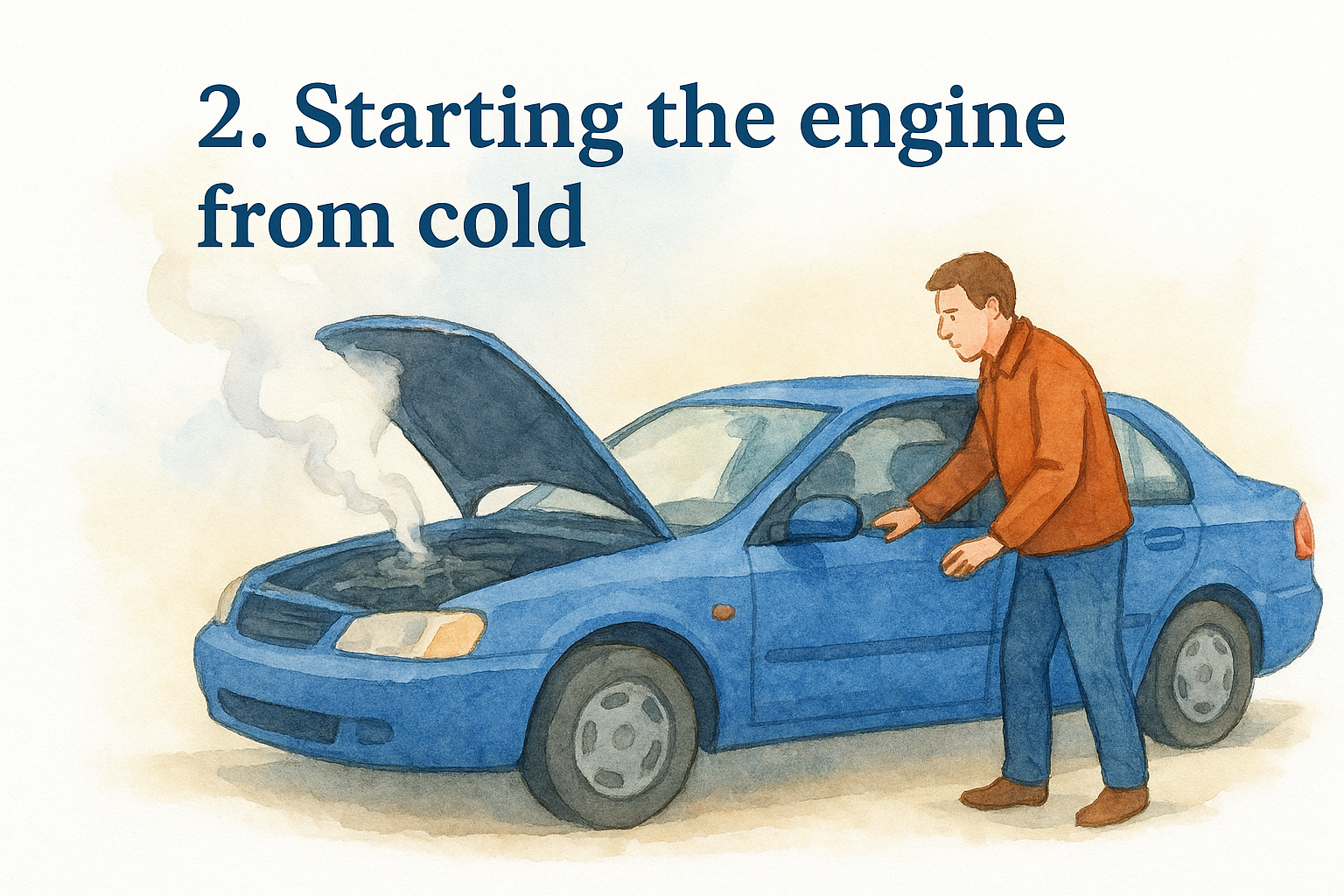
2. Starting the engine from cold
Ask to see the car before the seller has warmed it up. A cold start tells you far more than an engine that's already been running for twenty minutes, because problems that hide once everything's up to temperature show themselves clearly in those first few seconds. If the seller says "I already started it to warm it up for you", treat that as a reason for suspicion rather than a courtesy.
What to check
Stand back and use your senses before you even sit in the driver's seat:
- Exhaust smoke colour on start-up, white, blue, or black
- How long the engine takes to fire, cranking should be quick, not laboured
- Idle behaviour for the first minute, listening for rattles or an uneven note
- Any warning lights that flash briefly then stay lit, or stay lit longer than they should
- Unusual smells from the engine bay as it warms through
Why it matters
A cold start puts more strain on worn components than a warm one, because oil hasn't fully circulated and metal parts haven't reached their normal operating clearances. Blue smoke on cold start almost always points to worn valve seals or piston rings letting oil into the combustion chamber, a repair that can run into four figures on some engines. White smoke that clears within a few seconds is usually just condensation and nothing to worry about, but white smoke that persists, especially with a sweet smell, suggests a head gasket problem.
Judge a used car by its cold start, not its warm idle, because that's where hidden engine wear shows itself first.
Warning signs to watch for
Walk away from the checklist and reconsider the purchase if you notice:
- Thick blue or black smoke lasting more than a few seconds
- Persistent white smoke with a sweet or burning smell
- Excessive cranking before the engine catches
- A knocking or tapping noise that fades once the engine warms
- The seller insisting the car was already running before you arrived
3. Dashboard warning lights and instrument readings
Once the engine's running, sit in the driver's seat before you move an inch and give the whole dashboard a proper look. Any used car test drive checklist worth following treats this as a separate step from the cold start check, because warning lights that clear after a few seconds behave very differently from ones that stay lit once you're actually driving.
What to check
Work through the dashboard methodically rather than glancing at it once:
- Every warning light on ignition, confirming each one illuminates then goes out as expected
- Engine management light, which should never stay on once the car's running
- Battery, oil pressure, and coolant temperature gauges as the engine warms
- ABS and airbag lights, both safety-critical if they stay lit
- Speedometer and odometer accuracy against what you'd expect from the road
Why it matters
A persistent warning light almost always points to a fault the seller hasn't disclosed, whether that's a failed sensor, a fuel system problem, or something more serious with the ABS or airbag circuit. Garages sometimes disconnect the battery to reset the dashboard before a viewing, which can temporarily hide a stored fault code, so don't assume a clean dashboard on start-up means a clean bill of health.
A dashboard that stays quiet for the whole test drive tells you more than one that lights up and clears itself.
Warning signs to watch for
Treat any of these as reasons to ask the seller for a straight answer:
- Engine management light staying on once the car's moving
- ABS or airbag light illuminated at any point
- Coolant temperature gauge climbing higher than normal during the drive
- Any warning light the seller dismisses as "it's always done that"
- Gauges that behave erratically, jumping or flickering without cause
4. Steering feel and response
Once you're moving, the steering wheel tells you more about a car's front-end health than almost anything else on your used car test drive checklist. Find a straight, flat stretch of road early in the drive and pay close attention to how the wheel feels in your hands, both at low speed manoeuvring and once you're up to 40 or 50mph.
What to check
Work through these on a quiet stretch of road where you can safely take both hands off briefly:
- Straight-line tracking, letting go of the wheel for a second on an empty road to see if the car pulls left or right
- Steering weight, checking it feels consistent rather than suddenly heavy or light
- Play in the wheel, turning it slightly before the front wheels respond
- Vibration through the wheel, especially at motorway speed
- Return-to-centre behaviour after a roundabout or tight bend
Why it matters
Wandering steering usually points to worn track rod ends, a damaged wheel bearing, or incorrect wheel alignment, all of which cost more to fix the longer they're ignored. A wheel that vibrates at speed often means unbalanced tyres, but it can also signal a bent wheel or worn suspension component, so don't dismiss it as a quick fix without checking further. Excessive play before the wheels respond suggests wear in the steering rack itself, a repair few sellers mention upfront.
If the car doesn't track straight with your hands off the wheel, something in the steering or suspension needs looking at before you buy.
Warning signs to watch for
Any of these justify a closer inspection or a second opinion from a mechanic:
- The car pulls noticeably to one side on a flat, straight road
- More than an inch of play before the wheel engages the front tyres
- Vibration or wobble through the wheel above 50mph
- A grinding or clicking noise when turning at low speed
- The wheel doesn't return to centre naturally after a turn
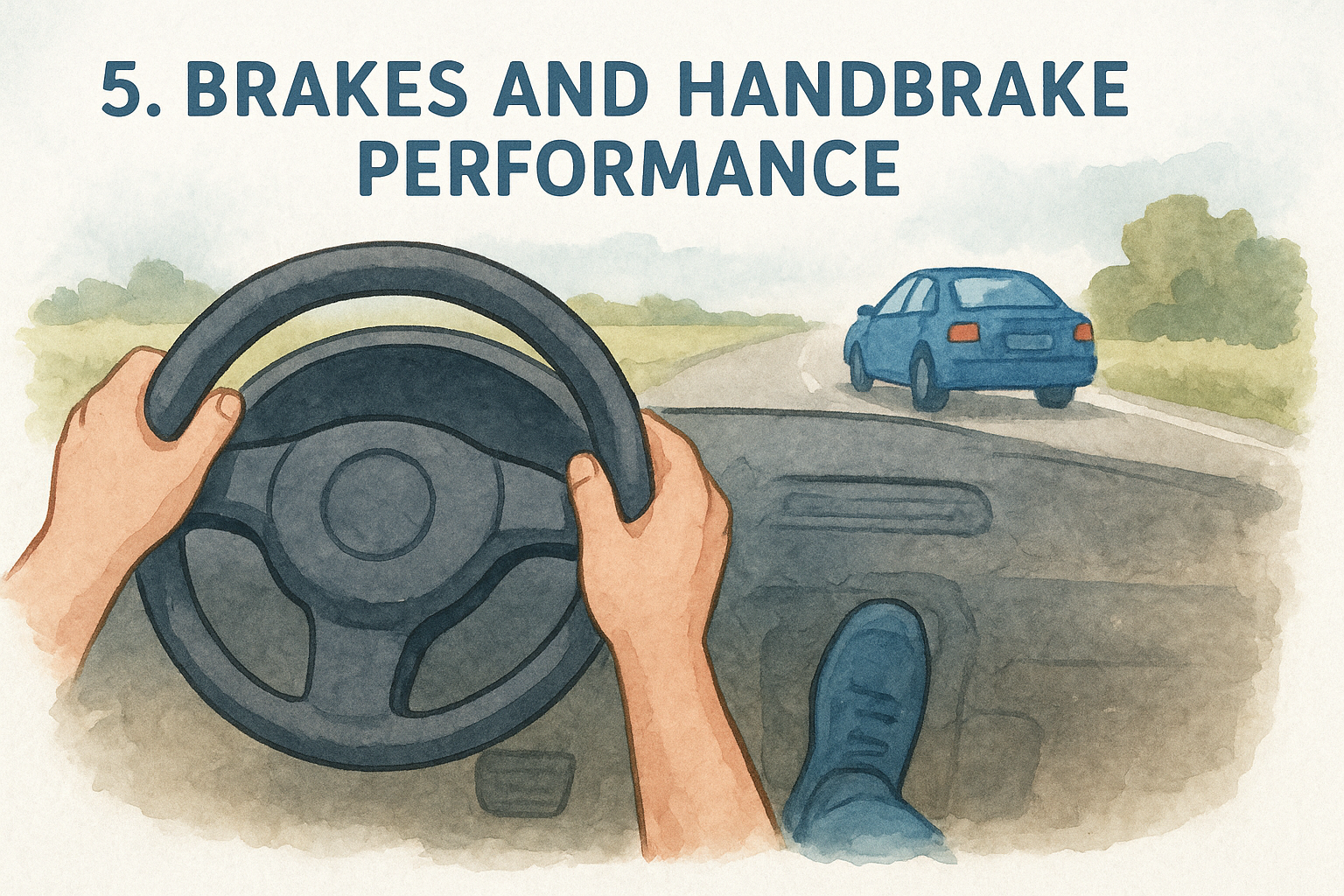
5. Brakes and handbrake performance
Brakes rarely fail outright, they wear gradually until the day they don't stop you in time. Find a quiet, empty road and test them properly rather than just tapping the pedal on the way back to the seller's driveway. This is one of the most safety-critical parts of any used car test drive checklist, so don't rush it.
What to check
Run through these on a stretch of road where a hard stop won't surprise another driver:
- Pedal feel, firm and progressive rather than spongy or sinking to the floor
- Braking in a straight line, checking the car doesn't pull left or right under hard braking
- Handbrake hold on a slope, or a firm pull-up with minimal travel on flat ground
- Judder through the pedal or wheel, which points to warped discs
- Noise under braking, particularly grinding or high-pitched squealing
Why it matters
A spongy brake pedal usually means air in the brake lines or a failing master cylinder, both of which need sorting before the car's safe to drive daily. Pulling to one side under braking suggests a sticking caliper or uneven pad wear, a fault that gets worse the longer it's left. A handbrake that doesn't hold on a hill is an MOT failure waiting to happen, and it's a cheap check that too many buyers skip entirely.
A brake pedal that feels soft or a handbrake that slips on a hill should end the test drive until a mechanic's looked at it.
Warning signs to watch for
Treat any of the following as reasons to walk away or insist on a full brake inspection first:
- Pedal sinking towards the floor under sustained pressure
- The car pulling to one side during hard braking
- Grinding or metallic squealing when you brake
- Judder or pulsing felt through the pedal
- Handbrake failing to hold the car on even a gentle slope
6. Clutch and gear changes
On a manual car, the clutch is one of the most expensive things to get wrong after you've handed over the money, so give it proper attention on the test drive rather than just working through the gears once and moving on. Automatics need their own checks too, and this part of the used car test drive checklist covers both.
What to check
Work through the gearbox deliberately rather than just driving normally:
- Biting point on the clutch, checking it engages roughly halfway through the pedal travel rather than right at the top or bottom
- Smoothness of gear changes, with no crunching or resistance between gears
- Slipping under load, accelerating hard in a higher gear to see if the revs rise faster than road speed
- Automatic gearboxes, checking for hesitation, jerky changes, or delayed engagement when you select drive or reverse
- Clutch pedal feel, making sure it doesn't feel unusually heavy, light, or inconsistent
Why it matters
A high biting point often signals a worn clutch nearing the end of its life, and replacement on many cars costs upwards of £500 once labour's included. Clutch slip under load is a clear warning sign because it means the clutch can't fully transmit engine power to the wheels, and it only gets worse from there. Crunching between gears usually points to worn synchromesh, while jerky automatic changes can mean anything from a software fault to a failing torque converter.
A clutch that bites high or slips under hard acceleration is close to needing replacement, and that's not a cheap repair.
Warning signs to watch for
Ask questions or reconsider the purchase if you notice:
- The clutch biting right at the top of pedal travel
- Revs climbing without matching road speed under acceleration
- Crunching or grinding when changing gear
- An automatic that hesitates or jolts between gears
- A burning smell after normal driving, suggesting clutch wear
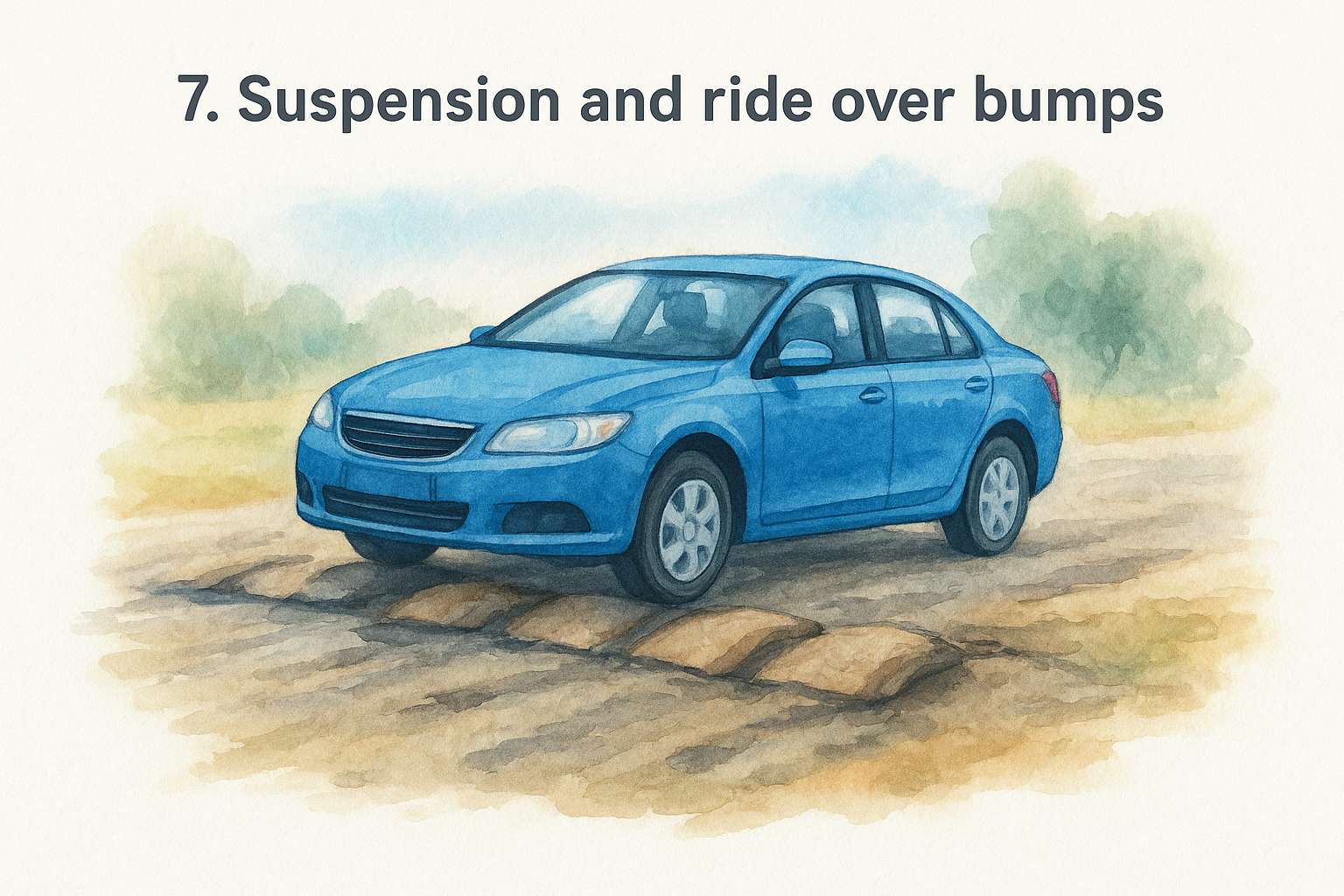
7. Suspension and ride over bumps
Find a road with some rough patches, potholes, speed bumps, or a badly maintained surface, because smooth tarmac tells you almost nothing about a car's suspension health. Good suspension should absorb bumps without transmitting every jolt into the cabin, and it should settle quickly rather than continuing to bounce after you've passed over an obstacle. This part of the used car test drive checklist often gets skipped because sellers steer you towards the smoothest roads nearby, so make a point of asking to include a rougher stretch.
What to check
Pay attention to how the car behaves both over single bumps and through a series of them:
- Bounce after a bump, the car should settle within one or two movements, not keep bobbing
- Clunks or knocks from underneath when you go over potholes or speed bumps
- Body roll through corners, checking it feels controlled rather than excessive
- Uneven ride height, comparing one corner of the car against the others
- Noise from the rear over bumps, which can point to worn bushes or a failing shock absorber
Why it matters
Worn shock absorbers let a car continue bouncing after a bump instead of settling immediately, which affects both comfort and, more importantly, how well the tyres stay in contact with the road under braking. A clunking noise from the front or rear usually points to worn anti-roll bar links or bushes, parts that are cheap individually but add up if several need replacing at once.
If the car keeps bouncing after a pothole instead of settling straight away, the shock absorbers are on their way out.
Warning signs to watch for
- Continued bouncing for more than two cycles after a bump
- Clunking or knocking from underneath the car
- Noticeable lean or roll through corners
- One corner of the car sitting visibly lower than the others
- A harsh, crashing ride that feels far worse than expected for the car's class
8. Engine noise and vibrations
Listen past the road noise and radio for what the engine itself is telling you, both at idle and while you're driving at varying speeds. This step in the used car test drive checklist works best if you turn the radio off completely for at least part of the drive, because a rattle or tick that's obvious in silence can vanish under music or wind noise.
What to check
Give the engine your full attention across a range of conditions:
- Idle smoothness, checking for a steady note rather than a rough, uneven rhythm
- Ticking or tapping noises, particularly from the top of the engine
- Rattling on acceleration, which can point to exhaust or heat shield problems
- Vibration through the pedals or seat, especially at idle or under load
- Whining or belt noise, which often gets louder as the engine revs
Why it matters
A rattling timing chain is one of the more expensive noises you can hear on a test drive, and ignoring it risks a snapped chain that can destroy an engine entirely. Excessive vibration at idle often points to worn engine mounts, a fault that's cheap to fix but gets dismissed by sellers as normal. Whining that rises with engine speed usually means a failing belt tensioner or alternator bearing, both parts that fail without much warning once they start making noise.
A ticking or rattling engine noise that the seller calls "normal" is exactly the sort of thing worth getting a mechanic to check before you commit.
Warning signs to watch for
- A persistent tapping or ticking from the top of the engine
- Rattling that gets louder under acceleration
- Vibration through the seat or pedals at idle
- A whining noise that rises and falls with revs
- Any knock that wasn't present on the cold start check earlier
9. Acceleration and power delivery
Once you've got a feel for the smaller details, take the car onto a road where you can safely accelerate properly, ideally a slip road or a longer straight with no traffic behind you. This part of the used car test drive checklist is where you find out whether the engine actually delivers the power it's supposed to, rather than just ticking over nicely at a steady 30mph.
What to check
Push the car a bit harder than you would on a normal commute:
- Response to throttle input, checking there's no delay between pressing the pedal and the car reacting
- Power delivery through the rev range, listening for flat spots where acceleration seems to stall
- Turbo lag, if applicable, and whether it feels excessive compared to what's normal for that model
- Overtaking acceleration, using a safe stretch to see how quickly the car picks up from motorway speed
- Engine sound under load, watching for strain or laboured notes that don't match the revs shown
Why it matters
A hesitant throttle response can point to a dirty mass airflow sensor, a failing fuel pump, or blocked injectors, faults that often get worse gradually until the car struggles to keep up with traffic. Flat spots in the rev range sometimes signal ignition coil problems on petrol engines, while diesels with poor pick-up often have a clogged particulate filter, a repair that isn't always cheap to sort properly.
Sluggish acceleration on a test drive rarely fixes itself, it usually points to a fuel, ignition, or filter problem building underneath.
Warning signs to watch for
- A noticeable delay between pressing the accelerator and the car responding
- Flat spots where power seems to disappear mid-range
- Excessive turbo lag compared to what's typical for the model
- Struggling to overtake or merge at motorway speed
- Straining engine noise that doesn't match the actual acceleration
10. Air conditioning, heating and electrics
Before you park up and start negotiating, spend a few minutes testing every electrical system in the car rather than assuming it all works because the dashboard looks modern. This part of the used car test drive checklist gets skipped more than almost any other, yet electrical faults on used cars can be some of the most frustrating and expensive to trace once you own the car.
What to check
Cycle through every switch and button while you're stopped safely, not while concentrating on traffic:
- Air conditioning, checking it blows genuinely cold within a minute or two
- Heater output, confirming it switches between cold and hot properly
- Electric windows and central locking, testing every window and door individually
- Infotainment screen and reversing camera, if fitted, checking for freezing or blank screens
- Heated seats, mirrors, and rear windscreen, along with indicators and headlights
Why it matters
Faulty air conditioning almost always needs a regas or a compressor replacement, and the latter can run into several hundred pounds once fitted. A dead window motor or central locking fault rarely fixes itself, and diagnosing intermittent electrical gremlins can eat hours of a mechanic's time, which you'll end up paying for. Screens that freeze or reset randomly often point to a wiring or software fault that's cheaper to walk away from than repair.
Electrics that misbehave on a five-minute test almost always get worse, not better, once you own the car.
Warning signs to watch for
- Air conditioning blowing warm or making a rattling compressor noise
- Windows that move slowly, jerkily, or not at all
- Central locking failing to lock or unlock every door
- An infotainment screen that freezes, resets, or stays blank
- Warning lights appearing on the dashboard as you test each system
11. Visibility, mirrors and windscreen
Good visibility affects every decision you make behind the wheel, yet it's easy to overlook on a test drive because you're focused on how the car drives rather than what you can actually see. This step in the used car test drive checklist takes two minutes but reveals problems that are cheap to fix now and expensive to ignore once you're driving in poor weather or low sun.
What to check
Work through the glass and mirrors before you pull away, then again once you're moving:
- Windscreen chips or cracks, especially anything within the driver's direct line of sight
- Wiper performance, checking they clear the screen fully without smearing or juddering
- Mirror adjustment, confirming electric mirrors move smoothly in every direction
- Rear visibility, checking the rear windscreen, parcel shelf, and any tinting don't obstruct your view
- Blind spot coverage, particularly on cars with thick rear pillars
Why it matters
A windscreen chip sitting in the driver's line of sight is an MOT failure in the UK, and left untreated it often spreads into a full crack that needs a costly replacement rather than a simple repair. Worn wiper blades matter more than most buyers realise, because smeared visibility in rain at motorway speed genuinely compromises safety, not just comfort.
A chip on the windscreen might look minor, but in the wrong spot it's an MOT fail waiting to happen.
Warning signs to watch for
- Any chip or crack within the swept area of the driver's side
- Wipers that smear, judder, or skip across the glass
- Mirrors that don't hold their position or won't adjust electrically
- Excessive tinting that limits rear visibility, especially at night
- Condensation or misting that clears slowly compared to what you'd expect
12. Interior comfort and driving position
Spend a few minutes adjusting the seat, mirrors, and steering wheel before you even pull away, because you're about to spend years sat in this exact position. This part of the used car test drive checklist matters more than buyers expect, since a driving position that feels slightly wrong on day one only gets more uncomfortable on longer journeys.
What to check
Work through the adjustments methodically, ideally checking both the driver and passenger seats:
- Seat adjustment range, both manual and electric, checking every direction moves freely
- Steering wheel reach and rake, confirming it adjusts enough for a comfortable arm position
- Pedal spacing and footwell room, especially if you're taller or shorter than average
- Seatbelt operation, checking it retracts smoothly and locks properly under a sharp tug
- General noise levels, including road and wind noise at motorway speed
Why it matters
A driving position that forces you to stretch for the pedals or strain to see the dashboard clearly isn't something you'll simply get used to, it's a daily irritation that affects concentration on longer drives. Worn seat bolsters or a seat that won't hold adjustment often point to age and heavy use rather than a genuine fault, but they still affect comfort and resale value down the line.
If the driving position feels wrong on the test drive, it won't feel right after six months of ownership either.
Warning signs to watch for
- A seat that slips out of position while driving
- Steering wheel adjustment that's seized or won't hold
- Excessive road or wind noise that seems unusual for the car's age
- A seatbelt that doesn't retract smoothly or lock under pressure
- Pedals positioned awkwardly close together, suggesting non-standard parts
13. Unusual smells and noises
Your nose and ears pick up problems your eyes will never catch, so spend part of the drive simply paying attention to what the cabin smells and sounds like rather than focusing purely on how the car handles. This step in the used car test drive checklist works best with the windows cracked open and the radio off, giving smells and noises nowhere to hide.
What to check
Run through these at different points in the drive, not just once at the start:
- Burning smells, particularly hot or acrid odours from the engine bay or brakes
- Musty or damp smells inside the cabin, especially from the footwells or boot
- Exhaust fumes leaking into the cabin, which shouldn't be noticeable at any point
- Rattles from trim panels, doors, or the dashboard over rough roads
- Squeaks from seats or suspension that appear only under load or on turns
Why it matters
A burning smell from the brakes usually means a caliper's sticking and dragging constantly, wearing pads and discs far faster than normal, while a burning smell from the engine bay can point to an oil or coolant leak landing on a hot surface. Damp or musty smells inside the cabin often mean a leaking seal or blocked sunroof drain, a fault that leads to rust and electrical problems if it's left unresolved for months.
A musty smell in the footwells today is rust and wiring damage waiting to happen tomorrow.
Warning signs to watch for
- Any burning smell from the engine bay or brakes during the drive
- A musty, damp smell from the footwells, boot, or seats
- Exhaust fumes noticeable inside the cabin at any speed
- Persistent rattles from trim, dashboard, or door panels
- New squeaks or knocks that weren't present earlier in the checklist
14. Low-speed manoeuvring and parking
Find a car park or quiet residential street and put the car through some tight, slow manoeuvres before you finish the drive. Motorway cruising tells you almost nothing about how a car behaves at walking pace, yet this is exactly the speed you'll use every time you park at the supermarket or reverse onto your drive. This stage of the used car test drive checklist exposes steering and clutch faults that simply don't show up once you're moving at 40mph.
What to check
Work through a few realistic parking scenarios rather than one quick reverse:
- Turning circle, checking the steering doesn't strain or make noise at full lock
- Reversing behaviour, using mirrors and any reversing camera or sensors fitted
- Clutch control at very low speed, easing off the pedal smoothly without stalling
- Parking sensors and cameras, confirming they actually work rather than just being fitted
- Turning noise from the front wheels, listening for clicking or grinding at full lock
Why it matters
Clicking noises at full lock almost always point to a worn CV joint, a repair that's straightforward but easy for a seller to ignore since it rarely affects motorway driving. Stalling repeatedly at low speed can mean a worn clutch or a poorly set idle, either of which becomes a daily annoyance in traffic or a tight car park. Faulty parking sensors matter more than buyers expect too, since a false sense of security around obstacles leads directly to expensive bodywork bills.
A clicking sound at full lock during a slow turn is a classic sign of a worn CV joint, not something to shrug off.
Warning signs to watch for
- Clicking or grinding noise from the front wheels at full steering lock
- Repeated stalling when moving off slowly
- Parking sensors that fail to beep or beep inconsistently
- A reversing camera showing a blurry, delayed, or blank image
- Heavy steering resistance at very low speed that shouldn't be there
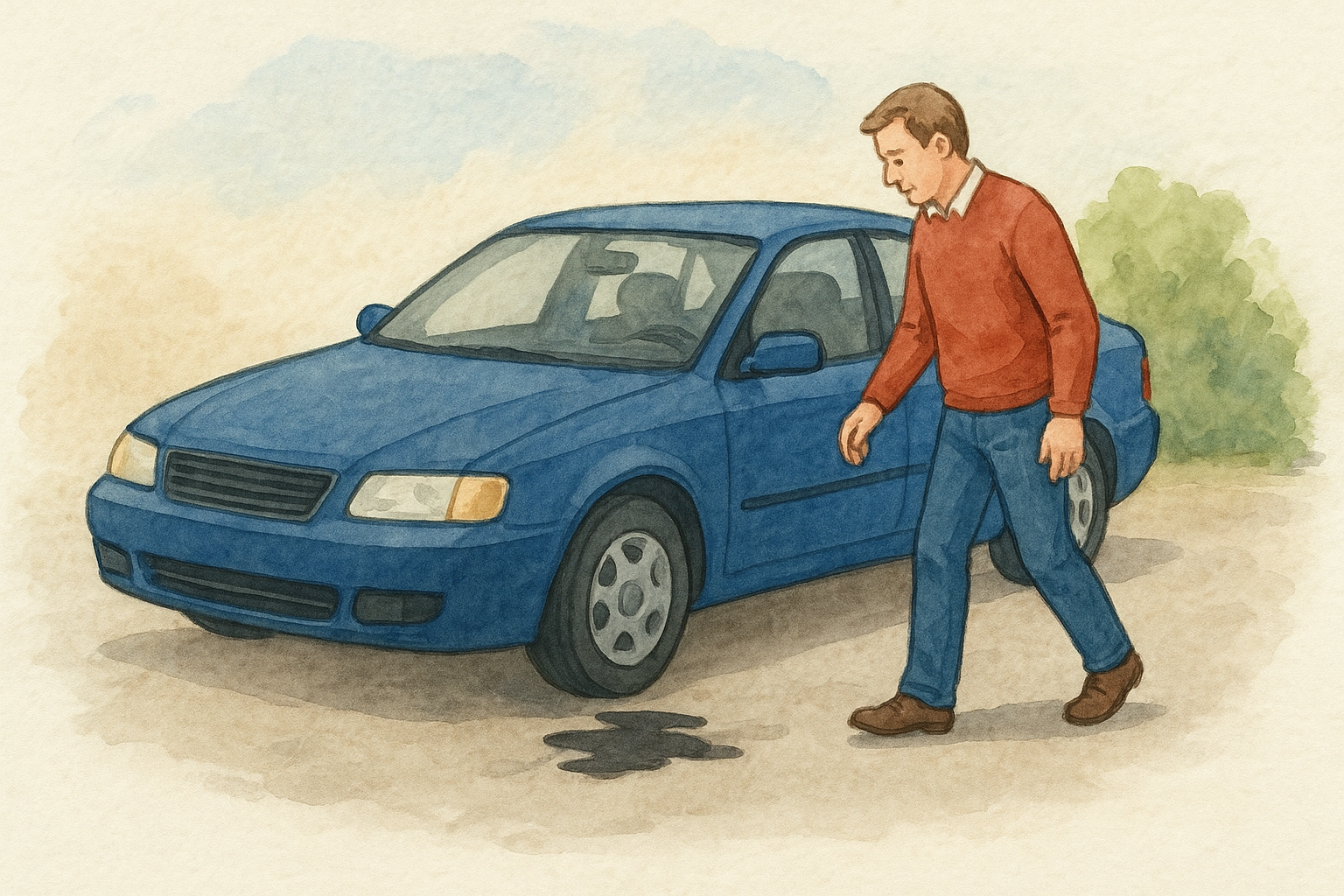
15. Fluid leaks and a final walk-round after driving
Once you're back at the seller's, don't switch off and head straight for a handshake. Park up, wait a minute, then walk round the car properly while the engine's still hot. This last stage of the used car test drive checklist catches leaks and faults that only show up once the car's been driven hard and everything underneath has warmed through.
What to check
Work through the car systematically before any conversation about price:
- Ground beneath the car, checking for drips or stains after the drive
- Engine bay fluid levels, oil, coolant, and brake fluid against their markers
- Oil cap and dipstick, looking for a milky residue that suggests coolant contamination
- Tyre condition and tread depth, including the spare or repair kit
- Exhaust tip colour, sooty black residue can point to a running fault
Why it matters
A fresh oil or coolant leak rarely appears from nowhere, it usually means a perished seal or gasket that's been building towards failure for a while. Checking the ground straight after driving matters more than checking it when you arrive, because a slow drip often only shows once fluids have warmed and thinned out. A milky dipstick is one of the more serious signs on this whole checklist, since it points towards a head gasket letting coolant and oil mix.
Always check underneath the car straight after the drive, not before, because a slow leak often only shows once everything's warmed through.
Warning signs to watch for
- Fresh oil, coolant, or fluid stains on the ground after parking
- Milky or frothy residue on the oil dipstick or filler cap
- Coolant level noticeably low or discoloured
- Tyres worn unevenly, suggesting alignment or suspension issues
- Thick black soot around the exhaust tip
Making your final decision
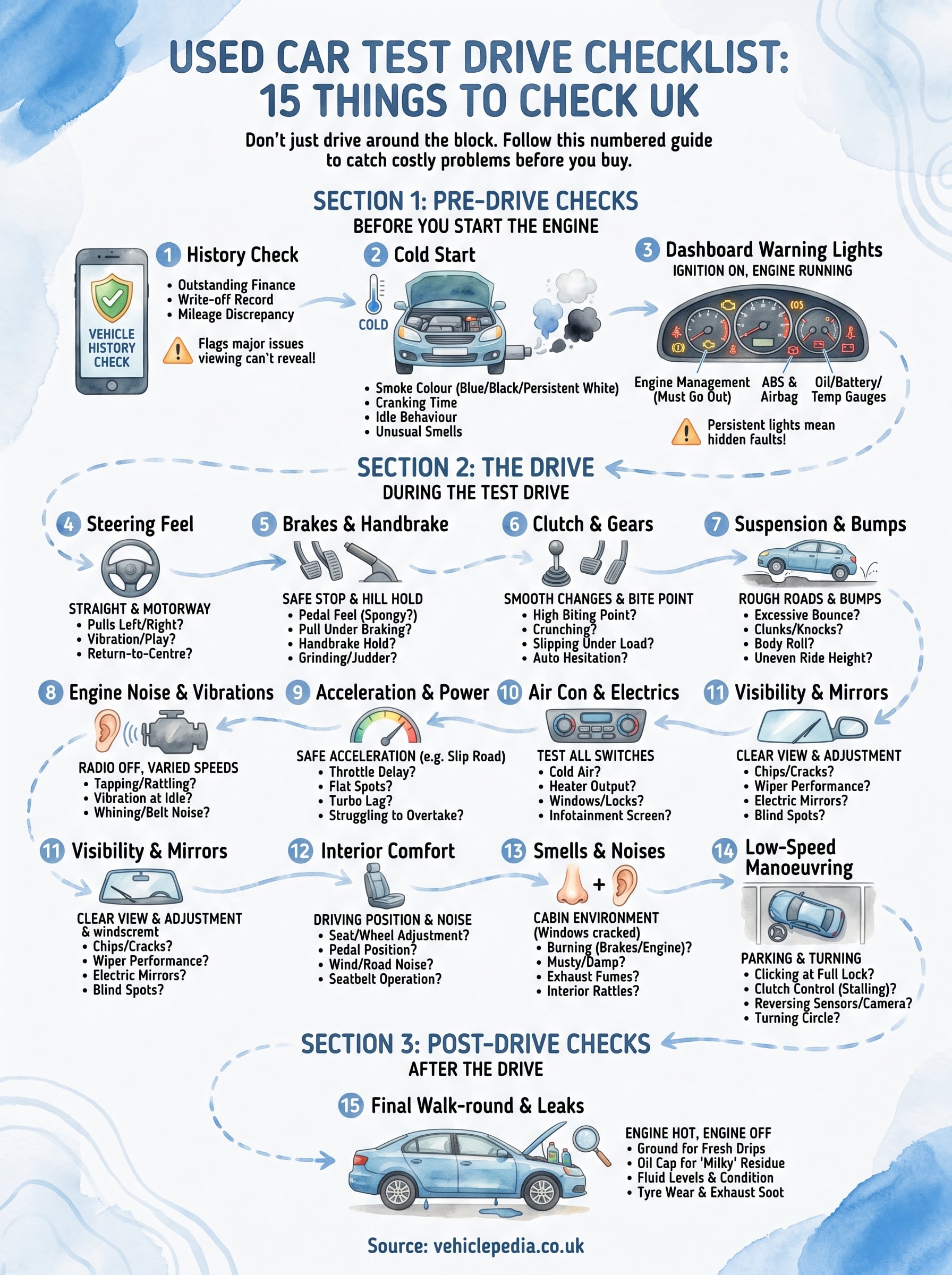
Work through this used car test drive checklist and you'll spot most problems before they become your problem. No car is perfect, and small MOT advisories or cosmetic wear rarely matter much. What matters is whether the faults you find are cheap fixes or genuine reasons to walk away, and whether the seller's honest about them when you ask.
Don't let a good chat or a shiny paint job rush your decision. Trust what your hands, ears, and nose told you during the drive over what the seller tells you afterwards. If several warning signs stacked up across these 15 checks, that's your answer already.
Before you agree a price on anything, run a full vehicle history check and see exactly what a proper report covers by looking at our sample report. It's the one check the test drive can't do for you, and it takes minutes to complete.