What Happens When Insurance Writes Off a Car
Learn what happens when insurance writes off a car: categories, finance payouts, valuation disputes and buy-back rules explained clearly.
What Happens When Insurance Writes Off a Car
Getting the call that your car has been written off feels worse than the crash itself sometimes. You're left with a dozen questions at once: will you get enough money to replace the car, what happens to the finance you're still paying off, and can you even keep the vehicle if you want to. What happens when insurance writes off a car comes down to a few clear steps, and understanding them puts you back in control of a situation that can otherwise feel entirely out of your hands.
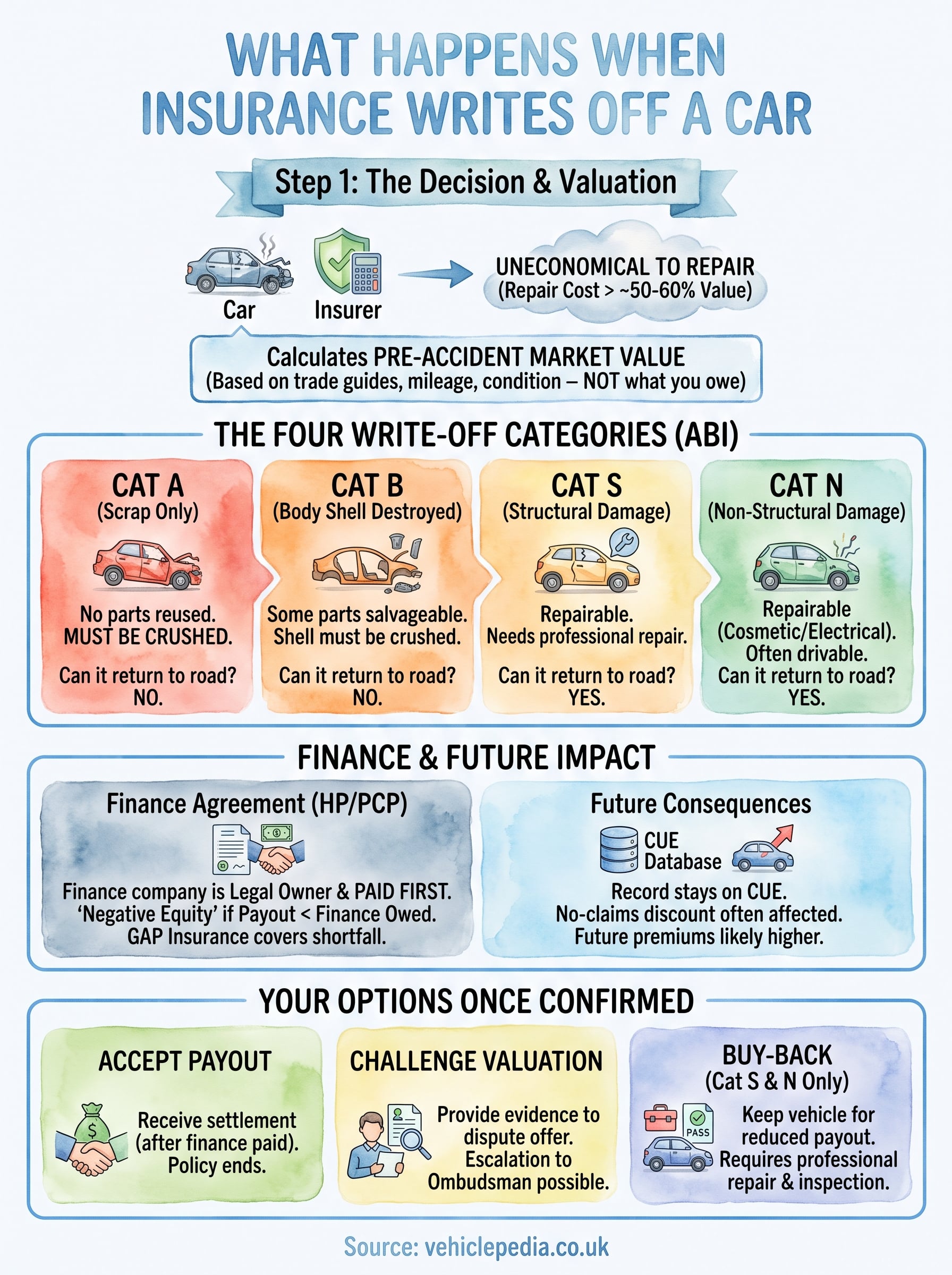
In short, your insurer decides the car is uneconomical to repair, calculates its pre-accident market value, and pays that out rather than fixing it. What happens next depends on the write-off category assigned (A, B, S, or N), whether you still owe money on finance, and whether you want to buy the car back or walk away with a payout.
This article walks through exactly how insurers reach that decision, how the payout figure is worked out, what a write-off means for your finance agreement, and what your options are once the category is confirmed. We'll also cover why checking a car's history before you buy matters just as much as understanding your own write-off.
Why a write-off affects more than just your car
A write-off isn't just a label your insurer slaps on a damaged car, it triggers a chain of consequences that reach into your finance agreement, your insurance record, and even what happens to the vehicle's logbook. Many drivers assume the story ends once they accept the payout, but outstanding finance, future insurance premiums, and the car's legal status on the road all shift the moment the write-off category is confirmed. Knowing what's coming helps you avoid nasty surprises further down the line.
The four write-off categories
Every written-off car in the UK gets sorted into one of four categories set out by the Association of British Insurers, and the category decides what can legally happen to the vehicle next.
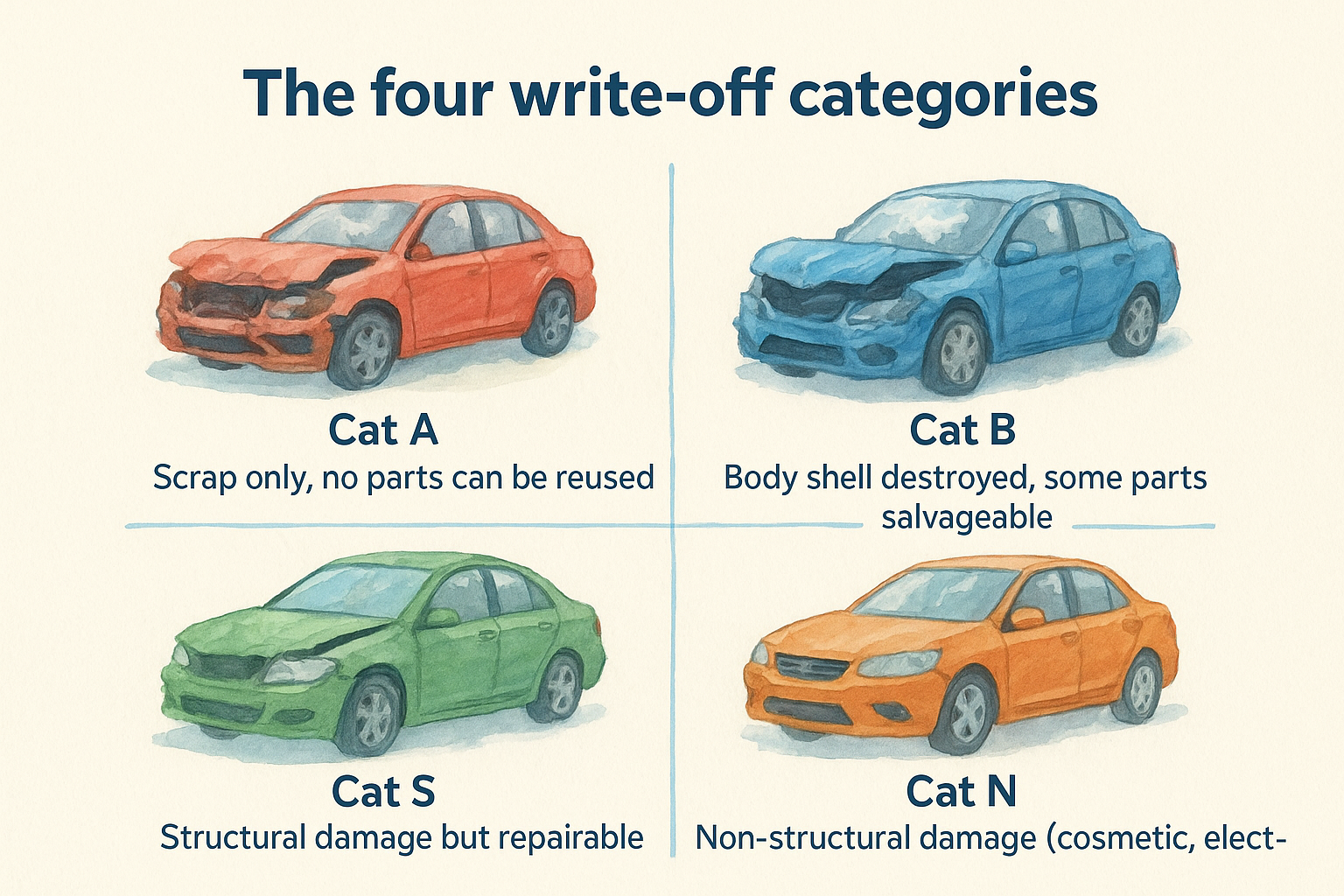
| Category | Meaning | Can it go back on the road? |
|---|---|---|
| Cat A | Scrap only, no parts can be reused | No, must be crushed |
| Cat B | Body shell destroyed, some parts salvageable | No, shell must be crushed |
| Cat S | Structural damage but repairable | Yes, once professionally repaired |
| Cat N | Non-structural damage (cosmetic, electrical) | Yes, often drivable as-is |
The category assigned to your car decides whether it can ever legally return to the road, not just how much money you get.
Cat S and Cat N cars make up the vast majority of write-offs, and both can be repaired and sold on legally, provided the sale is disclosed and the repair is done properly.
Your finance agreement doesn't disappear
Owing money on the car doesn't stop mattering just because it's been written off. If you're paying through hire purchase (HP) or a personal contract purchase (PCP), the finance company is technically the legal owner until the final payment clears, so your insurer pays them first, not you. Whatever's left after the finance is settled comes to you, and if the payout is lower than the outstanding balance, you're left with what's called negative equity, meaning you still owe money on a car you no longer have. GAP insurance, if you had it, covers exactly this shortfall, which is why it's worth checking your paperwork before assuming you're covered.
Your insurance policy and future premiums
Once your car is written off, your existing policy for that vehicle ends, since there's nothing left to insure. That doesn't mean the claim disappears from your record though. A write-off claim, even one where you weren't at fault, typically shows up on the Claims and Underwriting Exchange (CUE) database that insurers check when you apply for new cover. Expect your no-claims discount to be affected unless your insurer confirms the claim was settled as non-fault, and expect quotes on your next car to reflect that history for several years. This is one of the quieter costs of a write-off that rarely gets mentioned upfront, but it shapes what you pay long after the crash itself is forgotten.
How insurers work out your payout
Insurers don't pluck a number out of thin air when they write off your car. They work out its pre-accident market value, meaning what the car was worth on the day before the crash, not what you paid for it or what you still owe. This figure comes from trade guides like Glass's, CAP HPI, and Cazana, which pull data from thousands of actual sales of similar cars matched by make, model, age, mileage, and condition. If your car was a well-kept 2019 Ford Fiesta with 40,000 miles, the insurer looks at what near-identical Fiestas are actually selling for, not what a dealer might advertise one for.
Why the repair estimate decides the category
Before your payout figure even gets discussed, the insurer compares the cost of repairs against a percentage of that market value, usually somewhere between 50% and 60% depending on the insurer's own threshold. Cross that line and the car gets written off regardless of how minor the damage looks from the outside. This is why a car with a cracked windscreen and a dented bumper can still end up as Cat N: labour costs and part prices, especially for newer cars packed with sensors, push the repair bill past the threshold faster than most drivers expect.
Your payout is based on what the car was worth the day before the crash, never what you still owe or originally paid.
What can push the figure up or down
A few details shift the final number more than people realise, and it's worth checking these against your own paperwork before accepting the first offer.
- Service history: a full, documented history can lift the valuation noticeably.
- Modifications: aftermarket parts rarely add value unless declared and insured from the start.
- Mileage and condition: lower mileage and recent MOT passes push the figure up.
- Regional pricing: the same car can value differently depending on demand in your area.
Asking your insurer to show the comparable listings used in their valuation is a reasonable request, and it's often the fastest way to spot if the offer undervalues your car.
How to challenge a write-off decision
Disagreeing with your insurer's valuation doesn't mean you're stuck accepting it. Insurers work from trade guide averages, and averages don't always reflect the specific car you owned, especially if yours had extras, a recent service, or genuinely low mileage for its age. Challenging the offer costs you nothing but time, and plenty of drivers who push back end up with a better settlement than the one first put on the table.
Building your case with evidence
Start by gathering proof that your car was worth more than the insurer's figure, rather than just arguing the number feels low. Concrete evidence carries far more weight than a general complaint about the offer.
- Print listings for three or four comparable cars for sale near you, matched on make, model, age, and mileage.
- Pull together your full service history, MOT certificates, and receipts for any recent work.
- Note any factory-fitted extras or low mileage that the trade guide valuation might have missed.
- Ask the insurer directly which trade guide and which specific comparable vehicles they used.
A written-off car valuation is a starting offer, not a final verdict, and evidence beats argument every time.
Escalating through the right channels
If the insurer won't budge after you've presented your evidence, put your complaint in writing and ask for their final response letter, since you'll need this to escalate further. Every insurer has an internal complaints process, and by law they must issue a final response within eight weeks of your complaint. Once you have that letter, or once eight weeks pass without one, you can take the case to the Financial Ombudsman Service, which reviews disputes between consumers and insurers free of charge. The Ombudsman looks at whether the valuation was fair and reasonable given the evidence, and its decisions are binding on the insurer if it rules in your favour.
Timing matters here too. Most policies give you a limited window, often 30 days, to accept or challenge an offer before it's treated as final, so don't sit on a low valuation hoping it improves on its own. Raise your concerns in writing as soon as you spot a problem with the figure.
Buying back or keeping a written-off car
Accepting the payout doesn't automatically mean the car leaves your driveway. Most insurers offer a buy-back option, letting you keep the vehicle in exchange for a reduced settlement, usually the payout minus the car's salvage value. This route suits owners who want to repair the car themselves or who know a trusted garage that can bring it back to a roadworthy standard cheaper than the insurer's own quoted repair cost.
Working out if buying back makes sense
Doing the sums before you commit saves a lot of regret later. Compare the reduced payout against what you'd actually spend getting the car properly repaired, insured, and back through an MOT.
- Get an independent repair quote, not just the insurer's estimate, before deciding.
- Check whether parts are even available for an older or less common model.
- Factor in the cost of a post-repair engineer's inspection, which some insurers require before reinsuring the car.
- Remember that a Category A or B car can never legally return to the road, so buy-back only applies to Cat S and Cat N vehicles.
Buying back a written-off car only makes financial sense if the repair bill, inspection, and paperwork together cost less than a comparable car on the open market.
Reinsuring and reselling after repair
Once repairs are complete, you'll need an engineer's report confirming the car is safe and legally roadworthy, and most mainstream insurers will ask to see it before offering cover. Shopping around helps here, since some insurers refuse to cover Cat S or Cat N cars outright while others simply charge a bit more. Selling the car later means being upfront about its history, because the write-off marker stays attached to the registration permanently through the DVLA and industry databases, and failing to disclose it to a buyer can expose you to a legal claim for misrepresentation.
Registering the repaired vehicle correctly with the DVLA is a legal requirement, not an optional step, and skipping it leaves you driving a car that's technically still marked as unroadworthy on official records.
Checking a car's write-off history before buying
If you're on the other side of this transaction, buying a used car rather than selling one, everything covered so far becomes your due diligence checklist. A car that's been through a write-off and repair can be a perfectly safe, honest purchase, but only if the seller discloses it and the repair was done properly. Hidden write-off history is one of the most common ways private buyers end up out of pocket, since a car with unresolved structural damage can fail an MOT within months or, worse, fail to protect you in a future crash.
What a history check actually reveals
Running the registration plate through a proper vehicle history check pulls data straight from official sources rather than relying on the seller's word. A decent check tells you whether the car carries a write-off marker, which category it falls under, whether it's still on finance, and whether it's ever been reported stolen. Vehiclepedia's free car check covers MOT history, tax status, and basic registration details at no cost, while the premium report adds the write-off, finance, and stolen-vehicle checks that matter most before you hand over any money.
Never buy a used car without checking its write-off history first, because the seller's word isn't enough to protect you legally or financially.
Questions to ask before you view the car
Beyond the history check itself, a short conversation with the seller before you even arrange a viewing can save you a wasted trip.
- Has the car ever been declared a write-off, and if so, which category?
- Can they produce the engineer's inspection report confirming the repair?
- Is there a full paper trail of invoices for parts and labour used in the repair?
- Does the current insurance quote reflect the car's write-off history honestly?
A seller who hesitates or can't answer these clearly is a red flag worth taking seriously. Combine their answers with an independent history check and, ideally, an in-person inspection by a mechanic before you commit, since a repaired Cat S car with proper documentation can still be a sound buy at the right price.
Getting the right outcome after a write-off
A write-off doesn't have to leave you out of pocket or driving something you don't trust. Once you understand how the category system works, how insurers reach their payout figure, and what rights you have to push back on a low offer, you're no longer at the mercy of whatever number lands in your inbox. The same applies in reverse: if you're buying rather than claiming, a proper history check turns guesswork into an informed decision before money changes hands.
Whether you're negotiating your own settlement or vetting a used car with a repaired write-off in its past, the facts on official records matter more than anything a seller or loss adjuster tells you verbally. Don't take chances on a car's history when the truth is one registration search away. Have a look at a sample report to see exactly what a proper check uncovers before you commit to anything.