What Is a Write-Off Car? Meaning and What Happens Next
Learn what is a write-off car, the four UK damage categories, and how to check a vehicle's history before buying with Vehiclepedia.
What Is a Write-Off Car? Meaning and What Happens Next
You've spotted a car that ticks every box, and then the seller mentions it was once written off. Suddenly you're wondering whether that's a dealbreaker or just insurance jargon. So what is a write-off car, exactly? It's a vehicle an insurer has decided isn't worth repairing after damage, whether that's from a crash, flood, fire, or theft recovery. The insurer pays out the claim rather than fixing the car, and that decision follows the vehicle for the rest of its life.
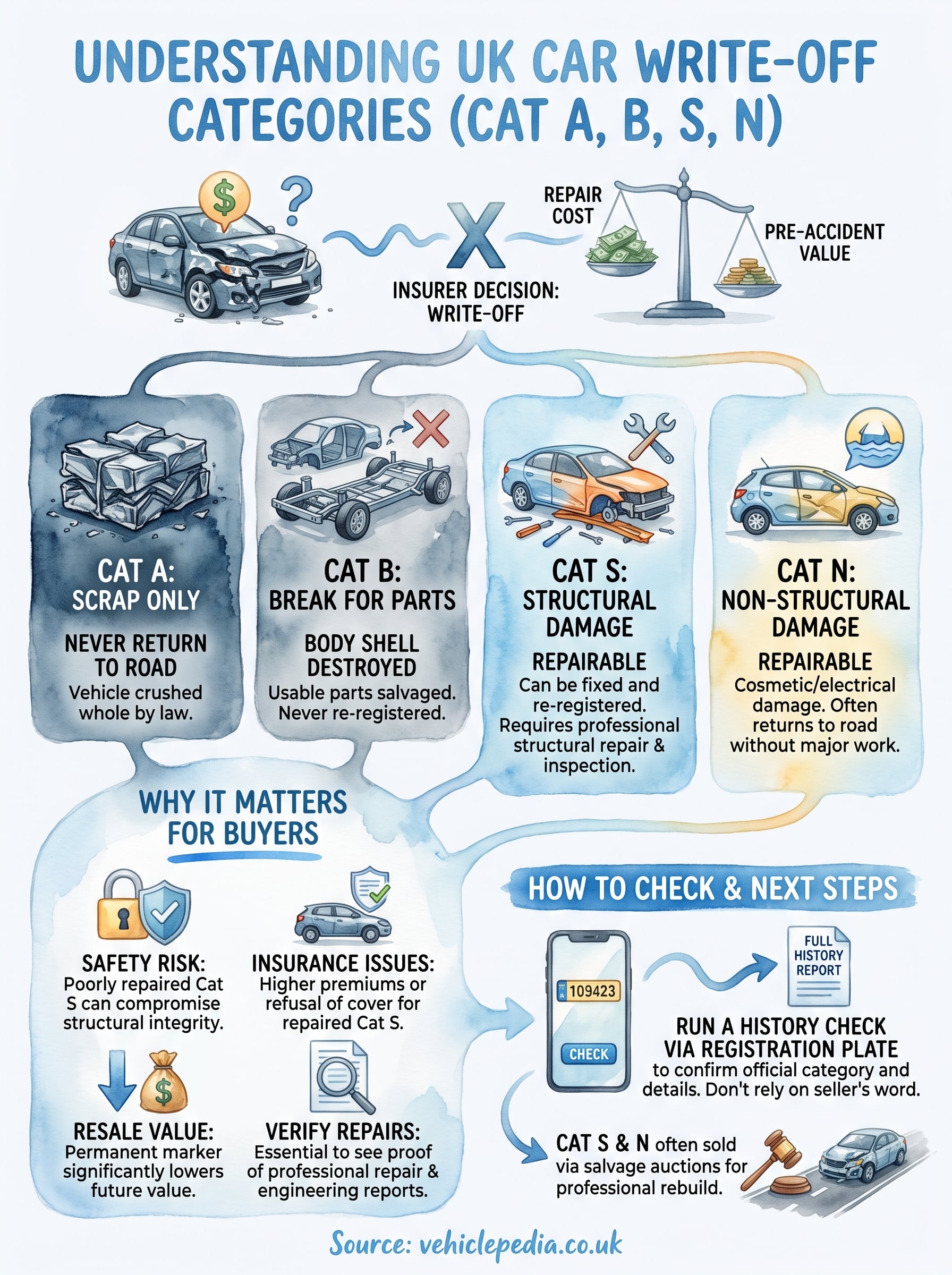
Insurers reach this conclusion by comparing the repair cost against the car's pre-accident value, then assigning a damage category that determines whether it can ever be repaired and driven again, or whether it's fit only for parts or scrap. That category matters enormously if you're buying used, because it dictates the car's legal status, its insurability, and its resale value.
This guide walks through exactly what write-off status means, how insurers make the call, the different categories you'll encounter (A, B, S, and N), and what actually happens to these vehicles afterwards, including whether buying one is ever a sensible move.
Why write-off categories matter for buyers
Not all write-offs are equal, and this is where most buyers get caught out. The UK uses four damage categories, and what Cat A, B, S and N actually mean tells completely different stories about a car's future. A Category N car might drive perfectly fine after a professional repair, while a Category A car should never touch a public road again in any form. Knowing the difference before you view a car, not after you've paid a deposit, saves you from an expensive mistake.
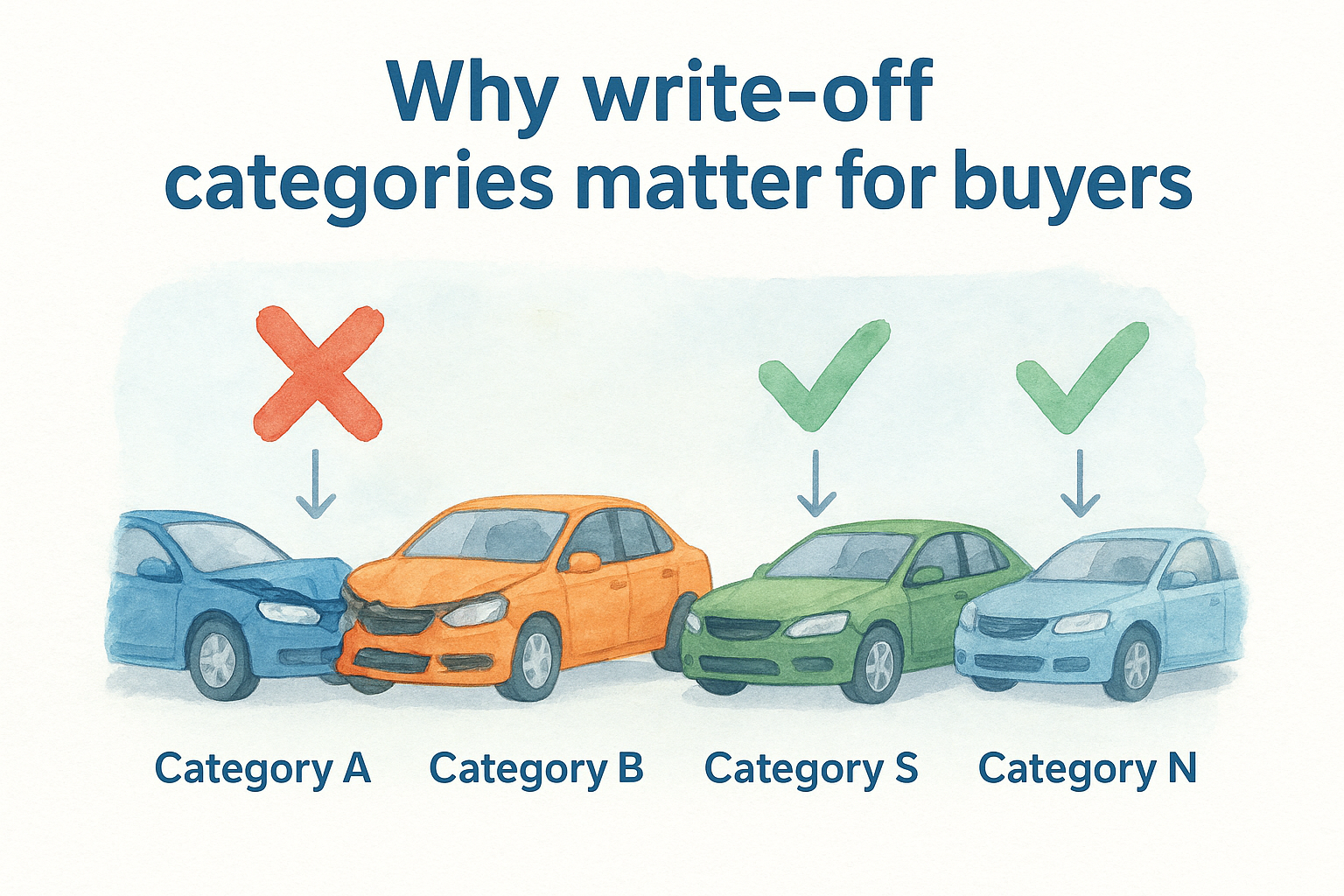
A write-off category tells you what a car can legally become again, not just what happened to it.
These categories replaced the old A, B, C, D system back in October 2017, largely because the previous labels confused buyers about which cars were genuinely repairable. The current framework focuses on both the severity of damage and, crucially, the safety risk if the car were ever rebuilt.
| Category | Meaning | Can it return to the road? |
|---|---|---|
| Category A | Scrap only, crushed by law | Never |
| Category B | Body shell must be destroyed, parts can be salvaged | Never as a whole vehicle |
| Category S | Structural damage, but repairable | Yes, if professionally repaired and re-registered |
| Category N | Non-structural damage (cosmetic, electrical, etc.) | Yes, often without major work |
Here's why this distinction matters so much when you're buying used. A poorly repaired Cat S car could have compromised structural integrity that only shows up in a future collision, when it matters most. A Category N car, on the other hand, might have been written off simply because a flooded interior or a stolen stereo made repair costs exceed the payout threshold relative to the car's value, with no lasting mechanical issue at all. Two cars carrying a write-off history can sit at completely opposite ends of the risk spectrum.
Insurers also treat these categories very differently when you come to insure a repaired write-off yourself. Some mainstream insurers refuse to cover Category S vehicles altogether, while others apply steep premium loadings. Category N cars are usually easier to insure, since the underlying structure was never compromised. If you're weighing up a purchase, checking the exact category isn't optional homework, it's the single fact that determines whether the car is a bargain or a liability. Running a check that confirms a car's write-off category online through a service like Vehiclepedia will show the category on record, alongside the rest of the car's background, before you commit to anything.
How insurers decide to write off a car
Assessing a damaged car isn't guesswork. Once you make a claim, what the insurance company does next starts with sending an approved engineer to inspect the vehicle and estimate the full repair cost, including parts, labour, and paint work. That figure then gets weighed against the car's pre-accident market value, using trade guides like Glass's or CAP HPI as a benchmark rather than what you personally paid for it.
If fixing the car costs more than it's worth, the insurer will always choose to write it off rather than repair it.
Most UK insurers work to a write-off threshold somewhere between 50% and 70% of the car's value, though the exact percentage varies by insurer and by policy wording. A ten-year-old hatchback worth £3,000 needs far less damage to tip into write-off territory than a nearly new car worth £25,000, which is why older, higher-mileage vehicles get written off far more often, even for damage that looks relatively minor.
Several factors feed into that final decision beyond the raw repair figure:
- Parts availability and whether they're on back-order, which drives up costs and repair time
- Structural damage location, since chassis or safety-cage repairs are expensive and heavily scrutinised
- Age and mileage, which lower the car's baseline value and make write-off more likely
- Salvage value, meaning what the wreck itself is worth to a salvage buyer, which the insurer deducts from the payout
Insurers follow guidance from the Association of British Insurers when assigning a damage category, aiming for consistency across the industry, though individual assessors still exercise judgement case by case. That's one reason two seemingly similar accidents can result in different outcomes, and why the category on record matters more than assumptions about what "probably" happened.
How to check if a car has been written off
Guessing isn't good enough here. A seller might genuinely not know their car carries write-off history, especially if it changed hands more than once since the accident. Learning how to check a car's write-off status by registration plate is the only reliable way to confirm whether a write-off car has ever passed through an insurer's books, and it takes seconds rather than a garage visit.
Never take a seller's word for a car's history when a two-minute check can confirm it for you.
Free checks you can run yourself
Start with a free lookup on Vehiclepedia using the number plate. This pulls data straight from official UK sources, including insurance registers and the DVLA, and flags whether the vehicle has a write-off marker on record, along with its MOT status, tax status, and basic registration details. It's the same first step any experienced buyer takes before arranging a viewing, and it costs nothing.
What a full history report reveals
When a free check flags a write-off, a premium report fills in the detail a listing will never mention:
- The exact damage category assigned (A, B, S, or N)
- The date the insurer recorded the write-off
- Whether the car has since been stolen, recovered, or exported
- Any outstanding finance still owed against it
- Previous keeper and plate change history
Requesting this before you view the car, not after you've handed over a deposit, gives you leverage to walk away or negotiate the price down. Vehiclepedia lets you preview a sample report first, so you know exactly what you're paying for before committing to the full check.
What happens after a write-off decision
Once the insurer settles the claim, the car legally becomes theirs. Ownership transfers to the insurance company the moment the payout lands in your account, and what happens to the car after it is written off is that it moves into the salvage system rather than staying in your driveway. This is why you can't simply keep a written-off car and drive it away unless you strike a separate deal with the insurer to buy back the wreck yourself, which some owners do when they want to attempt their own repair.
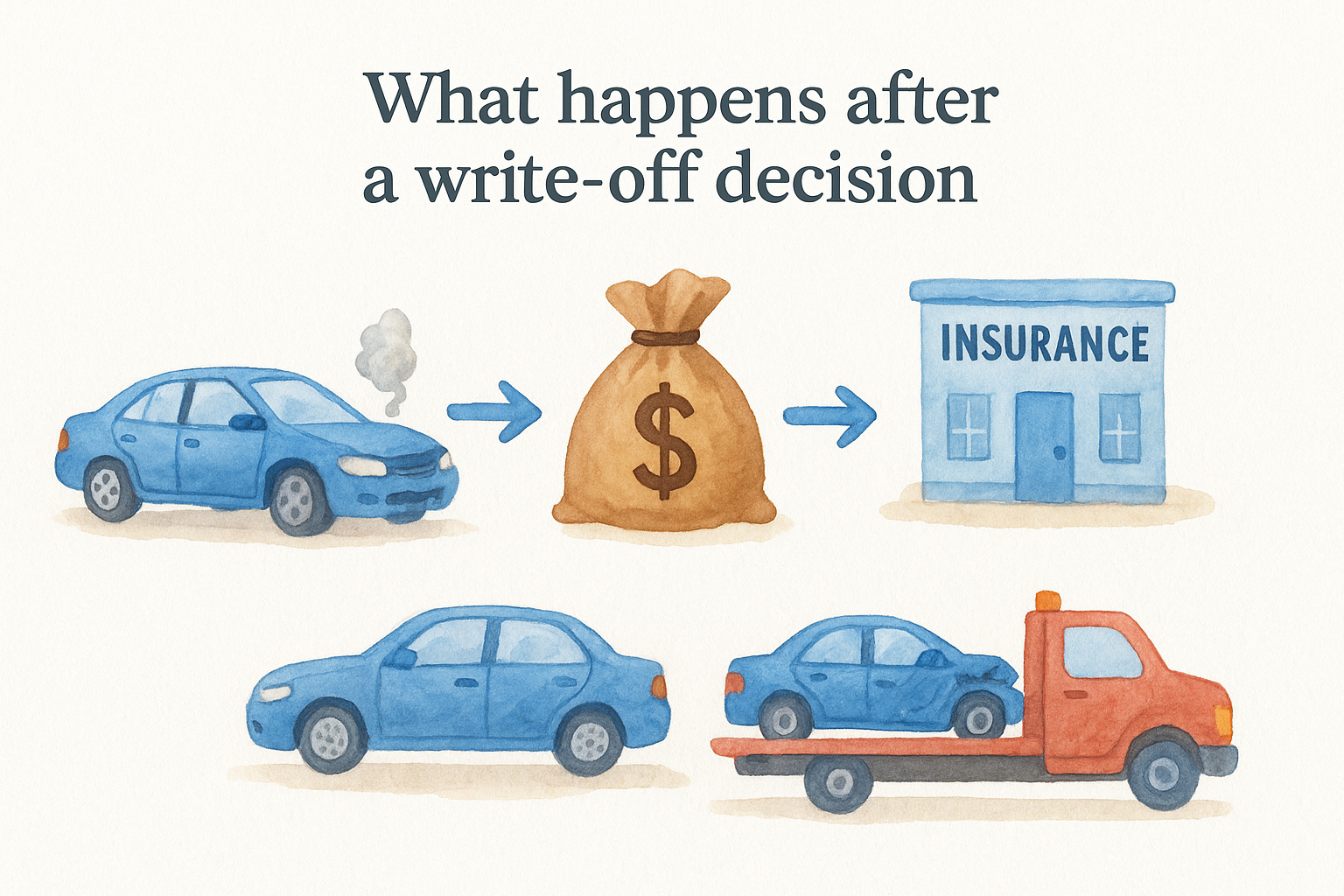
Once an insurer writes off a car, its history is permanently recorded, no matter how many times it changes hands afterwards.
The DVLA record gets updated
The insurer notifies the DVLA, and the write-off marker gets attached to the vehicle's record alongside its registration plate. That flag stays there for good. Even if the car passes through five different owners over the next decade, anyone running a check will still see the original write-off category and date. Selling a written-off car without disclosing this to a buyer is a serious problem, since the history is public through official channels regardless of what the seller chooses to mention.
The salvage route depends on the category
What happens physically to the car depends entirely on which category it was assigned:
- Category A vehicles get crushed whole, no exceptions
- Category B vehicles have their body shell destroyed, though usable parts get stripped and sold separately
- Category S vehicles go to salvage auctions where buyers can repair and re-register them for the road
- Category N vehicles often need minimal work and return to driveable condition quickly
Salvage auction houses handle most of this trade, buying damaged stock from insurers in bulk before reselling to repairers, breakers, or exporters depending on the category attached, which is why a salvage history check is worth running on any ex-auction car.
Buying or keeping a written-off car
Plenty of buyers dismiss any write-off car on sight, but whether you can buy a written off car deserves a closer look than that. A well-repaired Category N or properly rebuilt Category S vehicle can offer genuine savings, sometimes 20% to 40% below the price of an equivalent car with a clean history. The trade-off is risk, and how much of it you're willing to accept depends entirely on the quality of the repair work and how thoroughly you verify it before handing over money.
A written-off car isn't automatically a bad buy, but an unverified repair always is.
Questions to ask before you commit
Before agreeing a price, insist on answers to these:
- Who carried out the repair, and do they have trade credentials or an insurance-approved status?
- Is there an engineer's report or inspection certificate confirming structural integrity?
- Does the car have a valid MOT since the repair, and does the history match what you'd expect?
- Will a mainstream insurer actually cover this specific category at a reasonable premium?
Skipping these steps is how buyers end up with a car that looks fine but hides a bent chassis rail or a poorly welded sill.
Keeping your own written-off car
Sometimes the car in question is yours, and the insurer has offered a salvage buy-back rather than crushing it outright. This can make sense for a Category N vehicle with only cosmetic damage, since the repair might genuinely be straightforward. For Category S or B vehicles, though, the paperwork and engineering sign-off required to legally re-register it are substantial, and the resulting car will still carry a permanent write-off marker that limits its resale value for good. Weigh the repair cost against that ceiling before deciding it's worth the hassle.
Knowing where you stand with write-offs
A write-off marker isn't a red flag you should panic over, but it's also not something to shrug off. What matters is the damage category attached, the quality of any repair, and whether the seller has been straight with you about the car's past. Category A and B cars have no business back on the road. Category S and N vehicles can be perfectly sound, provided the work was done properly and the paperwork backs it up.
Before you view anything, run the plate through a proper history check so you know exactly what you're dealing with, not what a seller hopes you'll assume. It takes two minutes and could save you thousands. See what a premium write-off report shows before you decide whether the full check is worth it.