Used Car Buying Tips UK: A Step-by-Step Checklist
Follow our used car buying tips UK checklist: budgeting, history checks, test drives, paperwork and safe payment to buy with confidence.

Used Car Buying Tips UK: A Step-by-Step Checklist
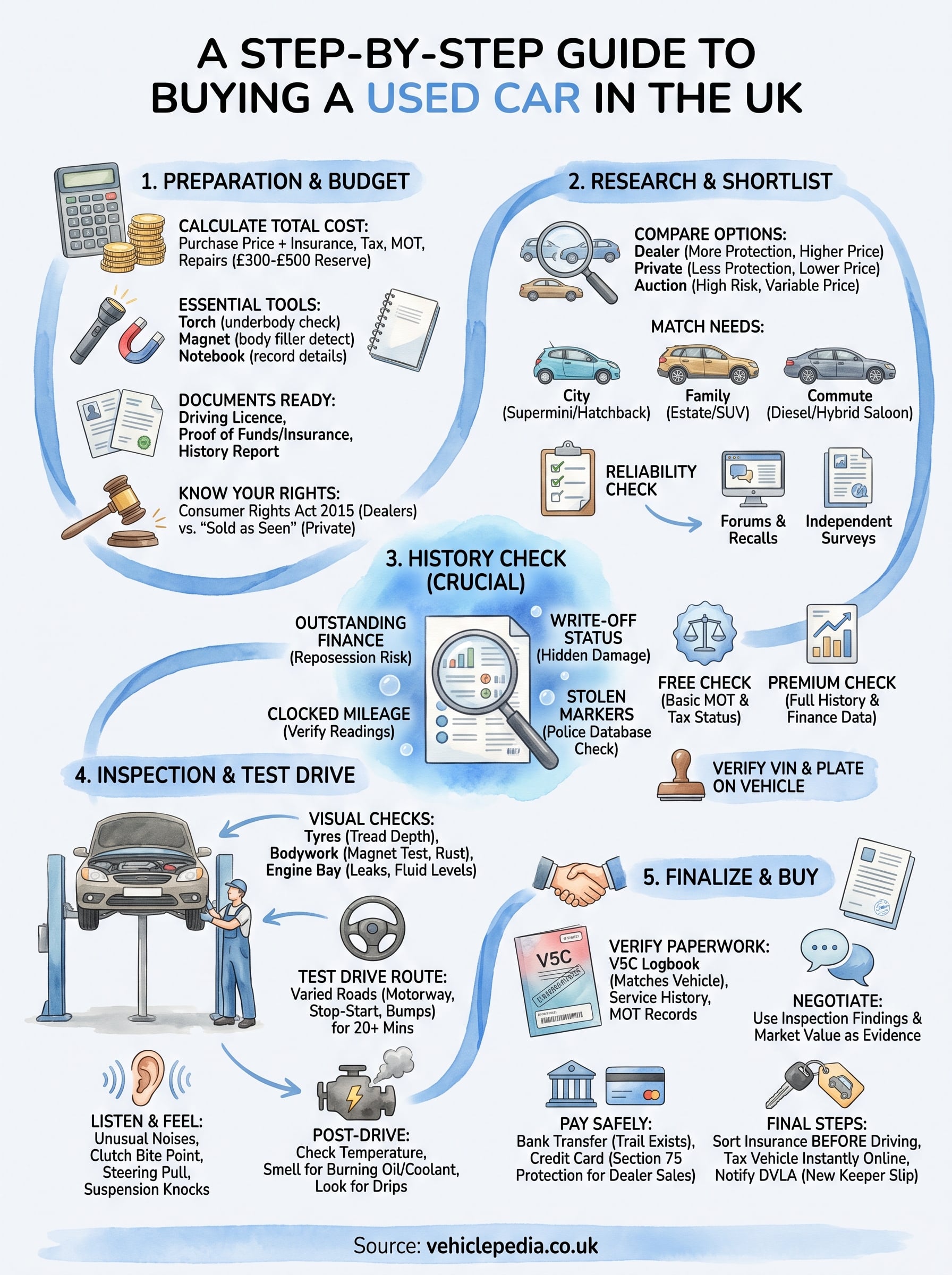
Buying a used car in the UK can go wrong fast if you skip the groundwork. One minute you're viewing a tidy-looking hatchback, the next you're stuck with a car that's got outstanding finance, hidden crash damage, or a clocked odometer. Searching for used car buying tips uk usually means you've either had a scare already or you're determined not to become another cautionary tale on a car forum.
This guide gives you a practical, step-by-step checklist rather than vague reassurances. You'll learn how to set a realistic budget that accounts for insurance, tax, and repairs, not just the sale price, and how to work through a proper physical inspection before you even think about test driving. We'll also cover what a vehicle history check actually reveals, from MOT records to write-off status, and why that single step catches problems a visual inspection never will.
By the end, you'll have a clear sequence to follow: research, inspect, check the history, negotiate, and complete the paperwork properly. No guesswork, no relying on a seller's word, just a method that puts you in control of the purchase.
Before you start: what you need to buy a used car safely
Before you contact a single seller, get your paperwork and tools sorted. Rushing into viewings without preparation is how buyers end up handing over cash for a car they can't properly assess. Treat this stage as non-negotiable groundwork, not an optional extra.
Documents and information you need on hand
Gather these before you leave the house, because scrambling for details mid-viewing makes you look unprepared and weakens your negotiating position. You'll need your driving licence for identification and test drives, proof of your budget or finance approval, and your own insurance details sorted in advance so you're covered the moment you drive away. If you're buying from a private seller, bring a printed copy of a vehicle history check so you can cross-reference the registration plate, VIN, and mileage against what's advertised.
- Valid UK driving licence (photocard and paper counterpart if issued before 2015)
- Proof of address, in case a dealer asks for it during finance checks
- A pre-arranged insurance quote or temporary cover note
- A printed or saved vehicle history report for the car you're viewing
- A notebook or phone to record the VIN, engine number, and mileage on-site
Tools to bring for a proper inspection
Sellers rarely mention faults themselves, so you need the means to spot them. Pack a small kit rather than relying on eyesight alone. A torch lets you check under the car and inside wheel arches for rust or fresh underseal hiding damage. A magnet (a fridge magnet works fine) helps you detect filler on the bodywork, since it won't stick to areas repaired with plastic filler over rust or crash damage.
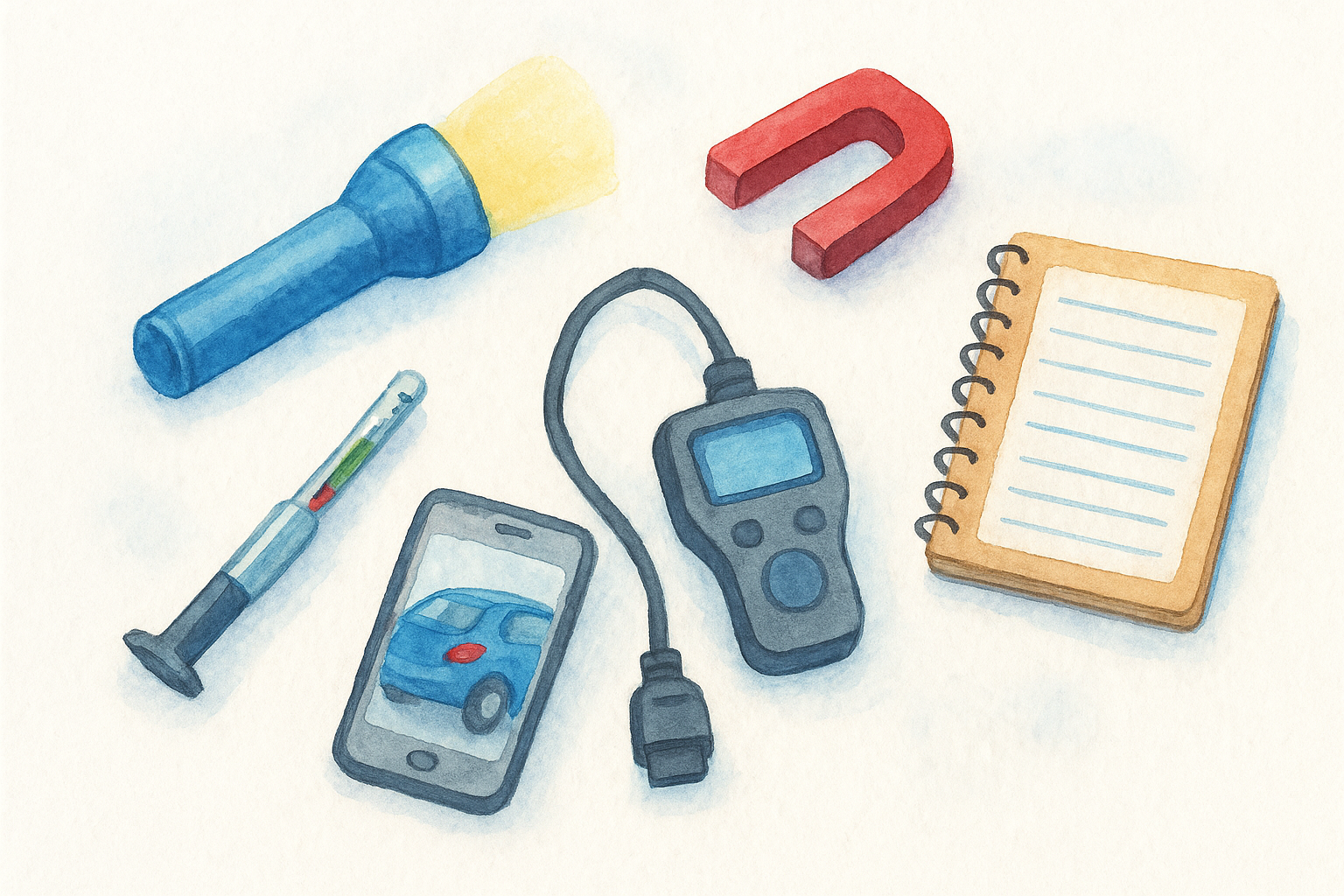
| Item | Why you need it |
|---|---|
| Torch | Inspect underbody, wheel arches, and engine bay in poor light |
| Small magnet | Detect body filler hiding rust or accident repairs |
| Tyre tread depth gauge | Confirm tyres meet the 1.6mm legal minimum |
| Phone with camera | Photograph damage, mileage, and paperwork for your records |
| OBD2 code reader (optional) | Check for stored fault codes on newer cars |
Know your legal position before you view
Understanding your rights changes how you negotiate and what you're willing to accept. If you're buying from a registered dealer, the car must be of satisfactory quality, fit for purpose, and as described, under the Consumer Rights Act 2015. Private sales work differently: the legal standard is simply that the car matches the seller's description, so "sold as seen" doesn't protect a seller who's lied about the mileage or history. The government's own guidance on buying a used car sets out these distinctions clearly, and it's worth five minutes of reading before you commit real money (see the official buying a used vehicle guidance from GOV.UK).
Buying from a dealer gives you legal protection a private sale never will, so factor that difference into your price expectations.
Getting this groundwork right doesn't guarantee a perfect purchase, but it removes the excuses that let dodgy sellers off the hook. Every document, tool, and bit of legal knowledge you bring to a viewing shifts the balance of information back towards you. That's the entire point of preparing properly: sellers who have nothing to hide won't mind the scrutiny, and those who do will often reveal themselves before you've even opened the bonnet.
Step 1. Set your budget and check finance options
Getting your numbers right before you start looking saves you from falling for a car you can't actually afford to run. Most buyers fixate on the sale price and forget the ongoing costs that follow it home. Work out your total budget first, then figure out how you're paying for it, and only then start browsing listings.
Work out the true cost of ownership
Jenny might have £8,000 to spend on the car itself, but if she hasn't budgeted for insurance, tax, and the first MOT, she's in for a shock within weeks. Add these costs together before you set a maximum purchase price, not after.
- Purchase price: what you'll actually pay the seller
- Insurance premium: get quotes for specific models before you buy, not after
- Road tax: check the DVLA vehicle tax rates for the car's emissions band
- MOT and servicing: budget for an upcoming test if the current one expires soon
- Repairs reserve: keep at least £300 to £500 aside for anything the inspection missed
Your budget isn't the sale price, it's the sale price plus everything that keeps the car legal and insured.
Compare finance options properly
Deciding how you'll pay changes what you can negotiate on the day. Cash buyers have more room to haggle because sellers like a quick, guaranteed sale. If you need finance, compare Hire Purchase (HP) against a Personal Contract Purchase (PCP) or a personal loan before you walk into a dealership, because dealer finance isn't always the cheapest route.
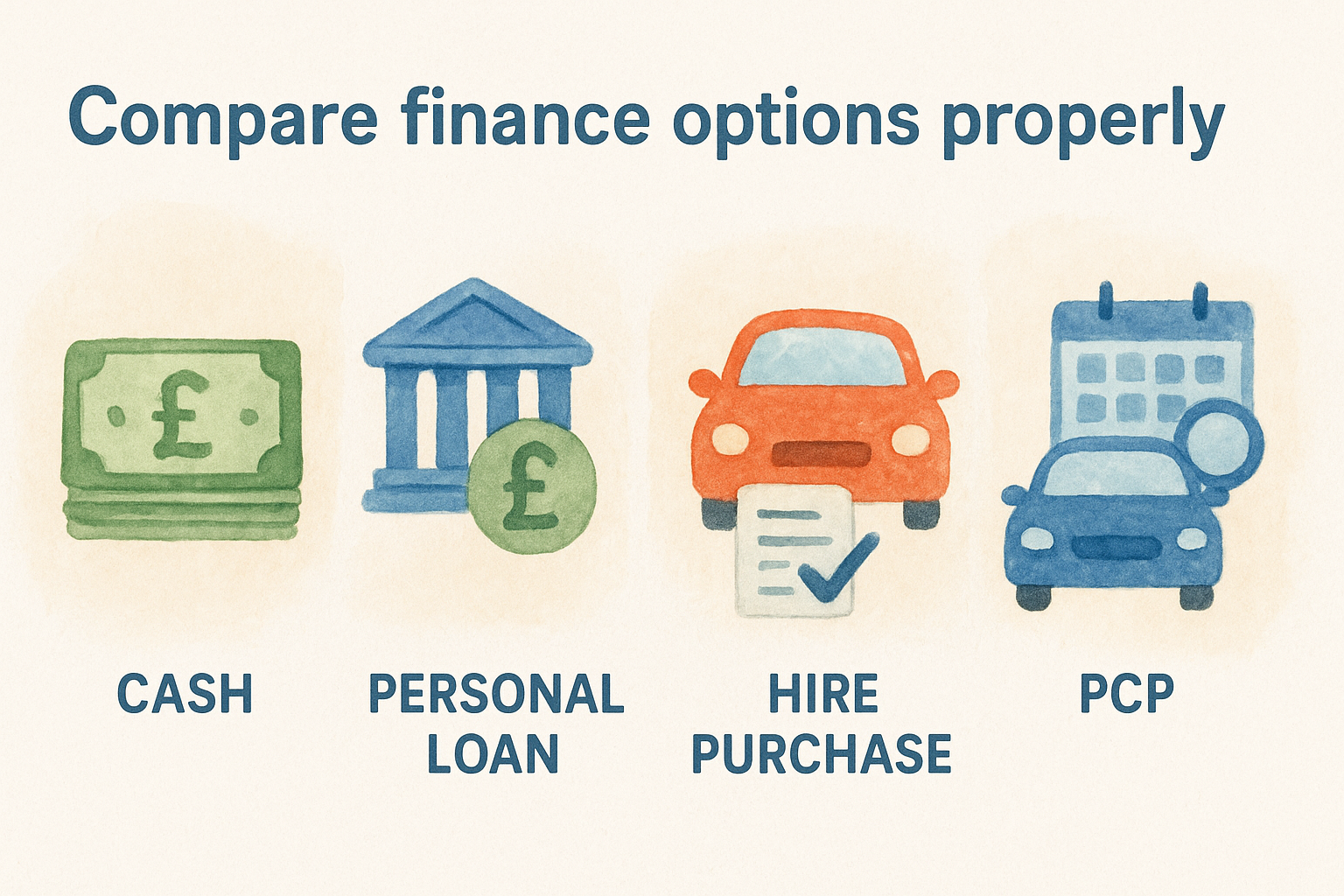
| Finance type | How it works | Best for |
|---|---|---|
| Cash/savings | Full amount paid upfront | Buyers wanting full ownership and negotiating leverage |
| Personal loan | Fixed monthly repayments from a bank | Buyers who want to own the car outright from day one |
| Hire Purchase (HP) | Pay in instalments, own the car at the end | Buyers who want ownership without a lump sum |
| PCP | Lower monthly payments, optional final balloon payment | Buyers who might upgrade or return the car later |
Once you've picked a route, get an agreement in principle before you view any cars. Turning up with finance already sorted, or cash ready, signals to the seller that you're a serious buyer, and it stops you falling for a car that's slightly out of reach once the paperwork lands. Sellers notice hesitation, and a buyer who's still "just checking what I can afford" rarely gets the best price on the table.
Step 2. Decide where to buy your car from
Where you buy matters as much as what you buy, because each route carries a different level of protection and a different price tag. Franchised dealers, independent garages, online car supermarkets, and private sellers all operate under different rules, and knowing those rules before you commit changes how hard you can push back if something goes wrong. Match the source to how much risk you're willing to carry.
Compare your buying options
Dealers cost more but hand you legal cover under the Consumer Rights Act 2015, while private sales are cheaper but leave you with almost no comeback if the car turns out to be faulty. Auctions sit somewhere in between: bargains exist, but you're usually buying without a test drive or a proper inspection window.
| Source | Typical price | Buyer protection | Best for |
|---|---|---|---|
| Franchised dealer | Highest | Strong, Consumer Rights Act applies, often includes warranty | Buyers wanting peace of mind and aftercare |
| Independent garage | Mid-range | Consumer Rights Act applies, warranty terms vary | Buyers wanting a balance of price and protection |
| Online car supermarket | Mid-range | Consumer Rights Act applies, remote inspection period | Buyers happy to view a car via video first |
| Private seller | Lowest | Minimal, car must only match its description | Confident buyers who can inspect thoroughly themselves |
| Auction | Variable, often lowest | Very limited, usually no return rights | Experienced buyers comfortable with risk |
The cheaper the source, the more inspection and history-checking work falls on you.
Vet the seller before you vet the car
Anyone can post a glossy advert, so look past the photos and check who's actually selling. For private sellers, ask why they're selling, how long they've owned the car, and whether they're the registered keeper shown on the V5C. Genuine sellers answer these questions without hesitation; evasive answers or a rushed sale are warning signs worth taking seriously.
- Search the seller's name or phone number online for repeat adverts on other sites, a sign they may be a trader posing as a private seller
- Ask to view the car at the address on the V5C logbook, not a random car park
- Check dealer reviews on independent platforms rather than testimonials on their own website
- Confirm the dealer is registered with Trading Standards if anything about the listing feels off
Once you've settled on a source you trust, stick with your plan rather than getting swept up by a tempting advert from an unverified seller. A slightly higher price from a dealer with proper protections often works out cheaper than a private bargain that turns into a legal headache.
Step 3. Shortlist the right make and model for your needs
Narrowing your search before you start browsing listings saves hours of wasted viewings. Too many buyers scroll through adverts without a clear idea of what they actually need, then fall for the first car that looks tidy in photos. Match your daily driving needs against the practicalities of ownership, and let that shape your shortlist, not the other way round.
Match the car to how you actually live
Think about your commute, your family size, and where you park before you fall for a particular badge. A two-seat sports car looks great on a forecourt, but it's useless if you're doing the school run with three kids and a dog. Consider your annual mileage too, since high-mileage motorway driving suits a diesel or hybrid, while short urban trips favour a petrol or full electric car.
- Daily mileage and journey type: motorway commuter, city runabout, or occasional weekend use
- Passenger and luggage space: number of seats, boot capacity, ISOFIX points if you've got children
- Parking situation: tight street parking favours a smaller car, regardless of how much you like a larger SUV
- Running costs: fuel type, insurance group, and road tax band all vary hugely between models
Research reliability before you fall in love with a model
Every make has weak spots, and finding them before you buy beats discovering them on the hard shoulder. Owner forums, manufacturer recall notices, and independent reliability surveys reveal patterns that a single test drive never will. Vehicles built after certain dates sometimes carry manufacturer recalls for safety-related faults, so check the official DVSA vehicle recalls checker before you commit to a specific model.
The best time to learn about a car's common faults is before you own one, not after.
Narrow your list to two or three cars
Settling on a shortlist rather than one dream car gives you room to negotiate and somewhere to fall back if your first choice doesn't check out. Once you've picked your shortlist, keep it to two or three models with similar age, mileage, and price so you're comparing like for like when you start viewing.
| Priority | Model type to consider |
|---|---|
| Low running costs | Small hatchback, hybrid |
| Family use | Estate, mid-size SUV |
| Motorway miles | Diesel saloon, hybrid |
| City parking | Supermini, small hatchback |
Going into viewings with a defined shortlist keeps you focused and stops sellers steering you towards something that doesn't actually suit your needs.
Step 4. Run a vehicle history check
Narrowing your shortlist means nothing if you skip the one check that catches problems no test drive ever will. A vehicle history check cross-references the registration plate against DVLA records, insurance databases, and police registers to flag issues the seller might not mention, whether that's deliberate or simply because they don't know themselves. Run this before you travel to view a car, not after you've already fallen for it in person.
What a proper check actually reveals
A thorough report goes well beyond confirming the car exists. It tells you whether the mileage lines up with MOT history, whether the car has ever been marked as written off, and whether there's outstanding finance still owed on it that could see the car repossessed from under you after you've paid for it.
- MOT history and advisories: past failures and recurring issues flagged by testers
- Mileage records: cross-checked against previous MOT readings to catch clocking
- Write-off status: whether an insurer has ever declared the car a total loss
- Outstanding finance: loans still registered against the vehicle
- Stolen vehicle markers: checked against the police database
- Import/export and colour change history: useful for spotting inconsistencies with the advert
A five-minute history check can save you thousands, because a clean-looking car can still be hiding a финансе agreement or a write-off record.
Free versus premium checks
Start with a free check for the basics, then upgrade if anything looks worth digging into further.
| Check type | What it covers | When to use it |
|---|---|---|
| Free check | MOT status, tax status, basic vehicle details | First pass on any car you're considering |
| Premium check | Write-off, stolen, and finance status, ownership history | Before you hand over any money |
Vehiclepedia's free check gives you the MOT and tax picture immediately, and you can preview a sample premium report before deciding whether the extra detail is worth it for a particular car.
Match the report to the car in front of you
Once you've got a report, verify it against the actual vehicle rather than trusting it blindly. Check the VIN stamped on the chassis matches the one on the report and the V5C logbook, and confirm the number plate hasn't been swapped from another vehicle. Sellers occasionally advertise one car and hand over documents for another, so this final cross-check closes that gap before you move on to the physical inspection.
draft
Step 6. Take the car for a test drive
Driving the car yourself is where most of the earlier groundwork pays off, because a test drive exposes faults that a static inspection simply can't reach. Insist on at least 20 minutes behind the wheel, covering a mix of roads, not just a slow crawl around the block that the seller suggests. If a seller resists a proper drive or tries to limit you to their preferred route, treat that as a red flag rather than a minor inconvenience.
Plan a route that stresses the car properly
Asking to drive on varied roads is one of the most useful used car buying tips you can act on, because a five-minute loop around quiet streets hides almost everything worth finding. Cover motorway or dual carriageway speeds to check for vibration, wind noise, and how the car settles once it's up to speed. Include a slow, bumpy section too, since suspension knocks rarely show up until the car's working over a rough surface.
- A short motorway or dual carriageway stretch, if speed limits allow
- A stop-start section to test the clutch, gearbox, and brakes under load
- A rough or potholed road to check suspension and steering response
- A reverse and full-lock turn to listen for CV joint clicks
What to listen and feel for while driving
Keep the radio off and the windows cracked, because sound tells you more than the dashboard ever will. Listen for unusual noises from the engine bay, exhaust, or wheel arches, and pay attention to how the steering feels when you brake hard from a safe speed. A car that pulls to one side under braking often needs new discs or pads, and a clutch that bites right at the top of the pedal can mean expensive wear you'd otherwise miss until it failed on your own drive home.
A test drive isn't about enjoying the car, it's about trying to make it fail safely while you're still in control.
After the drive: final checks
Stopping the car doesn't end the test. Check the temperature gauge hasn't crept up, and pop the bonnet again straight after driving to smell for burning oil or coolant, which often only shows once the engine's properly warm. Also glance underneath for fresh drips on the ground where the car was parked, since a cold engine bay can hide leaks that only appear under load.
Step 7. Verify the paperwork and ownership
Getting the drive and inspection right counts for nothing if the paperwork doesn't stack up, because a car with dodgy documents can leave you with no legal owner status at all. Paperwork verification is one of those used car buying tips UK buyers skip when they're excited about a car that's driven well, and that's exactly when mistakes happen. Treat this step as mandatory, not a formality you rush through at the kitchen table before handing over cash.
Check the V5C logbook matches the car
Holding the V5C registration certificate doesn't prove ownership on its own, but it's your starting point for cross-checking everything else. Confirm the VIN printed on the document matches the plate stamped on the car's chassis, usually found under the bonnet or in the door sill, and check the registration number, make, model, and colour all line up with what's parked in front of you. A genuine V5C has a watermark and a DVLA reference number in the top corner; anything photocopied, altered, or missing that detail should stop the sale immediately.
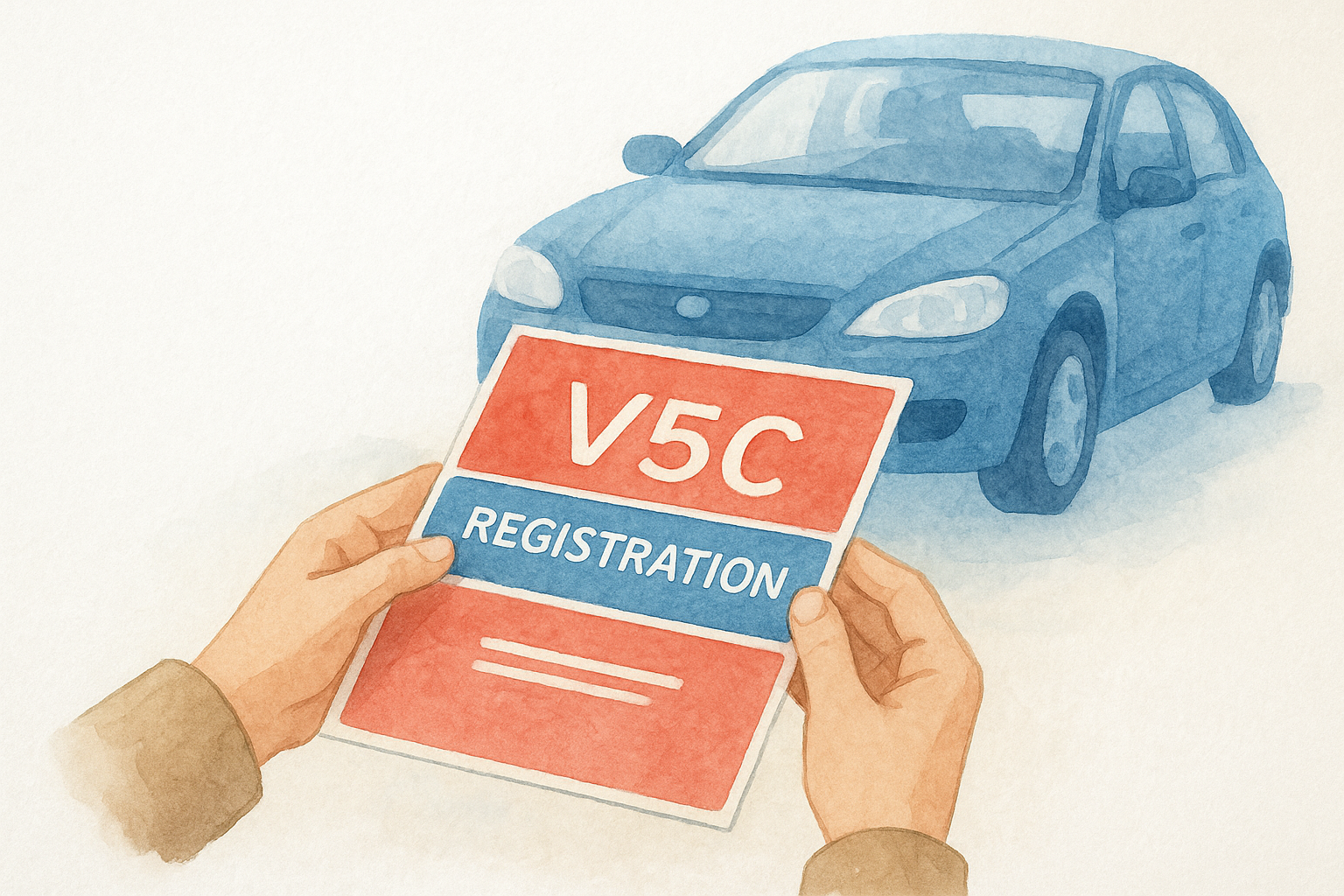
If the V5C doesn't match the car in every detail, walk away, because no discount is worth buying a vehicle you can't legally register.
Confirm service history and MOT records
Owners who genuinely care for a car usually keep proof of it, so ask for the full service history, including receipts, stamps, and any invoices for major work like cambelt replacement. Cross-reference the mileage recorded at each service against the MOT history you pulled earlier, since gaps or inconsistencies often point to clocking or undisclosed work.
- Service book stamps or digital service records from a main dealer or garage
- Receipts for parts and labour, especially timing belts, clutches, and brakes
- MOT certificates going back several years, not just the current one
- Any warranty documents still valid on the vehicle
Watch for red flags in the documents
Question anything that doesn't add up before you get further into negotiations. A seller who can't produce the original V5C, only has a photocopy, or pushes you to complete the sale before you've checked the documents properly is giving you every reason to slow down. Similarly, a logbook address that doesn't match where you're viewing the car deserves a direct question, not an assumption that it's nothing.
With the paperwork confirmed and the ownership trail clean, you're finally in a position to talk money with real confidence.
Step 8. Negotiate the price with confidence
Haggling works best when you've actually got something to haggle with, and every faded tyre, missing service stamp, or advisory from the MOT history gives you real ammunition. Walking in with used car buying tips UK buyers rarely bother collecting, like a list of documented faults, changes the entire conversation from a vague request for "a bit off" to a specific figure backed by evidence. Sellers respond far better to numbers than to opinions about what feels fair.
Use your inspection findings as leverage
Listing the issues you've found gives the seller something concrete to react to, rather than a general complaint they can brush off. Quote a repair estimate where you can, even a rough one from a local garage, because a seller who hears "the tyres need replacing within 3,000 miles, that's roughly £280" finds it harder to argue than someone who just says the tyres look worn.
- Advisories from the MOT history that will need attention soon
- Tyre tread depth close to the legal minimum
- Missing service history or gaps in the paperwork
- Cosmetic damage you spotted during the inspection
Know the market value before you name a figure
Researching what similar cars are selling for stops you either overpaying or making an offer so low it insults the seller and ends the conversation. Compare at least three listings with matching age, mileage, and trim before you settle on your opening offer, and keep that research printed or saved on your phone so you can reference it during the conversation rather than relying on memory.
Never make the first number, and never make it without evidence to back it up.
Close the deal without overplaying your hand
Staying calm throughout the negotiation matters more than any clever tactic, because sellers notice desperation and it costs you money. Offer a figure below your actual maximum, leave room to move up slightly, and be genuinely willing to walk away if the seller won't budge on a car with real issues. Silence works in your favour too; state your offer, explain the reasoning briefly, then stop talking and let the seller respond rather than filling the gap yourself.
- Start below your target price, with room to negotiate upward
- Reference specific faults, not general dissatisfaction
- Agree a figure before discussing payment method
- Get any agreed price changes confirmed in writing or by text
Confirming the final number in writing protects you if the seller tries to change terms once you turn up with payment ready.
Step 9. Pay safely and sort out insurance and tax
Agreeing a price means nothing if the money changes hands the wrong way, because a botched payment can leave you with no car, no cash, and no legal recourse. Choose a payment method that protects both sides rather than whatever feels quickest on the day, and never let a seller rush you into handing over cash before you've checked everything one final time.
Choose a payment method that protects you
Cash feels simple, but it leaves no trail if something goes wrong later, and carrying thousands of pounds to a stranger's driveway is a security risk you don't need to take. A bank transfer gives you a paper trail, though funds can take time to clear, so confirm with the seller whether they'll release the car before the transfer fully lands. For dealer purchases, paying by credit card for part of the price (even a small deposit) gives you protection under Section 75 of the Consumer Credit Act if the car turns out to be misrepresented.
| Payment method | Protection level | Best used for |
|---|---|---|
| Bank transfer | Trail exists, but no built-in protection | Private sales once documents are verified |
| Credit card (partial) | Section 75 protection on the whole purchase | Dealer sales, even for a small deposit |
| Cash | No trail, no protection | Small private sales only, with a signed receipt |
| Banker's draft | Trail exists, harder to fake than personal cheque | Larger private sales where trust is limited |
Never complete a payment until you've physically got the keys, the V5C, and a signed receipt in hand.
Sort your insurance before you drive away
Driving home uninsured is illegal even for a few miles, so arrange cover before you agree a collection time, not after. Give your insurer the exact registration, mileage, and any modifications, since inaccurate details can void a claim later when you need it most. Confirm the policy start date matches your collection day precisely, and keep proof of cover on your phone in case you're stopped on the drive home.
Update the tax and notify the DVLA
Road tax doesn't transfer with the car, so you'll need to tax it yourself the moment you become the registered keeper, which you can do instantly through the DVLA vehicle tax service using the reference number from the V5C. Complete the new keeper slip and post it off promptly, since the seller remains liable for anything that happens with the car until the DVLA processes the change. Getting this right on day one closes the loop on everything you've checked so far.
Ready to find your next car
Buying a used car in the UK doesn't need to be a gamble. Follow the sequence: budget properly, pick the right source, shortlist sensibly, check the history, inspect and drive the car, verify the paperwork, negotiate with evidence, then pay safely. Each step builds on the last, and skipping any one of them is exactly how buyers end up with a car hiding finance, a write-off, or a clocked odometer.
The single cheapest safeguard in this whole checklist is the history check, and there's no reason to view a car without running one first. It takes minutes, costs nothing to start, and tells you things no test drive ever will.
Before you arrange your next viewing, run a free check and see exactly what it uncovers. If you want to see the level of detail a full report provides, take a look at our sample premium report first.