Used Car Buying Checklist: 20 Things To Check Before You Buy
Follow our 20-point used car buying checklist covering history checks, V5C verification, MOT records, rust spots and test drives before you buy.
Used Car Buying Checklist: 20 Things To Check Before You Buy
Buying a used car without a plan is how people end up with someone else's problems on their driveway. A proper used car buying checklist turns a nerve-wracking decision into a straightforward process, and it stops you handing over cash for a car that looks fine but hides a written-off history, outstanding finance, or a dodgy MOT record. Whether you're viewing your first car or your tenth, having a system beats relying on gut feeling.
This article gives you exactly that system: 20 checks covering paperwork, bodywork, mechanicals, and the test drive, in the order you should actually do them. You'll know what to look for under the bonnet, which documents the seller must produce, and which red flags mean you walk away no matter how good the price looks. We also show you where a quick registration check fills in the gaps a visual inspection simply can't, confirming MOT status, mileage consistency, and ownership history straight from official records.
Run through this list before you view a car, and again before you pay for it. It's the difference between buying a car and buying a headache.
1. Get a full vehicle history check
Before you even look at the paintwork, run the registration plate through a vehicle history check. This single step tells you more about a car's past than an hour of kicking tyres ever will, and it's the check that catches the problems a visual inspection physically cannot.
What to check
A proper history check should confirm the car isn't stolen, hasn't been written off by an insurer, and doesn't have outstanding finance attached to it. It should also flag mileage discrepancies, previous colour changes, import or export records, and whether the registration plate matches the vehicle identification number on the logbook. Treat these as non-negotiable before you hand over a deposit.
- Stolen vehicle status (checked against the UK Police database)
- Write-off category (Cat A, B, S or N)
- Outstanding finance or loans
- Mileage history and any recorded discrepancies
- Import, export and colour change records
- Number of previous keepers
Why it matters
Missing this step is how buyers end up with a car that gets seized by police, or discover months later that a finance company still legally owns it. A car that's been through a Cat S write-off might drive fine today and fail structurally in a crash tomorrow. None of this shows up by walking around the car in a car park.
A clean logbook and a shiny bonnet tell you nothing about whether the car is stolen, written off, or still on finance.
Sellers rarely volunteer this information, not always out of malice, but because they genuinely might not know the full history themselves if they bought the car privately too.
How to check it
Start with a free check using the registration plate. At Vehiclepedia, you can pull MOT status, tax status, and basic vehicle details at no cost, which is enough to rule out obvious problems in seconds. For the checks that actually protect your money, stolen, finance, and write-off status, you'll need a premium report. Vehiclepedia backs its premium reports with a £30,000 data guarantee for private buyers, and you can preview a sample report before paying anything. Run the check before you arrange a viewing, not after you've already fallen for the car. It costs less than a tank of petrol and takes under a minute to generate.
2. Check the V5C registration document
Once the history check comes back clean, ask to see the V5C logbook before you even arrange a viewing. This document proves who's legally registered as the keeper of the car, and mismatches here are one of the clearest warning signs in used car buying.
What to check
Look at the watermark on the document; genuine V5Cs have a DVL watermark visible when held up to light, and a red diagonal stripe running through the page. Check the document reference number in the top right corner, and confirm the seller's name and address match the details on their driving licence or a recent utility bill.
- DVL watermark and red stripe present
- Document reference number matches DVLA records
- Seller's name and address match ID
- Vehicle Identification Number (VIN) matches the car and the logbook
Why it matters
A forged or altered V5C is a classic tool used by criminals selling stolen or cloned cars. If the seller can't produce a V5C at all, or hands you a photocopy, that's a hard stop. Genuine private sellers keep this document at home and bring it to every viewing without being asked twice.
No V5C, no deal, no matter how good the car looks.
How to check it
Cross-reference the V5C details against your earlier registration check results; the registered keeper history should line up with what the seller tells you. You can also verify the document format against guidance from GOV.UK, which explains exactly what a legitimate V5C should contain. If anything looks altered, photocopied, or inconsistent, walk away rather than argue the point.
3. Review the MOT history and certificate
Once you're happy with the paperwork, turn to the car's MOT history. Every vehicle over three years old needs an annual MOT, and the full record tells you far more than a single pass certificate ever could.
What to check
Pull up the complete MOT history, not just the current certificate, and look for patterns rather than a single result. Check the mileage recorded at each test against the odometer reading today, and look closely at any advisory notes that keep repeating year after year.
- Current MOT expiry date and pass status
- Mileage recorded at each test, checked for consistency
- Recurring advisories (worn brakes, corrosion, suspension play)
- Any previous failures and what caused them
Why it matters
Recurring advisories are a preview of expensive repairs heading your way, even if the car currently holds a valid certificate. A mileage drop between tests, or numbers that don't climb steadily, points to odometer fraud, known as clocking. This is one of the most reliable ways to spot a car that's been dressed up to look newer or better maintained than it really is.
A valid MOT only proves the car passed on that day; the full history shows you what's been quietly wrong for years.
How to check it
Use the free MOT history checker on GOV.UK, which pulls every test, mileage reading, and advisory straight from DVSA records using the registration plate. Vehiclepedia's free check also surfaces MOT status and expiry alongside the rest of the vehicle's details, so you're not jumping between different sites mid-viewing.
4. Check the service history
With the MOT record checked, ask for the service history and the service book itself. A car that's been looked after on schedule tells you the owner cared about more than just keeping it roadworthy for the annual test.
What to check
Look for stamps or invoices covering oil changes, filter replacements, and timing belt work, matched against the manufacturer's recommended intervals for that model. Compare dates and mileages against the MOT history you already pulled, since gaps or numbers that don't line up are worth questioning directly.
- Full service book with dealer stamps or itemised invoices
- Service intervals matching the manufacturer's schedule
- Timing belt or chain replacement recorded, if due
- Mileages consistent with MOT and odometer readings
- Recent work (brakes, tyres, fluids) with dated receipts
Why it matters
A car with a thin or missing service history often means skipped maintenance, not just missing paperwork. Skipped oil changes and ignored intervals shorten engine life and turn into expensive repairs within a year or two of purchase, long after the seller's warranty has expired.
No service book usually means no proper maintenance, not just no paperwork.
How to check it
Ask the seller directly whether the car has a full, part, or no service history, then verify their answer against the physical book or digital records from the dealer. Franchise dealers can often look up a car's service record electronically if you give them the registration and VIN, which is worth doing before you commit to buying privately from someone with a thin folder of receipts.
5. Inspect the tyres and wheels
With the paperwork sorted, walk round the car and look at the tyres and wheels before you even open a door. Tyres wear unevenly for a reason, and that reason often points straight at a mechanical fault the seller hasn't mentioned.
What to check
Check the tread depth on all four tyres, plus the spare if there is one, and look for uneven wear across the width of each tyre. Inspect the wheels themselves for kerb damage, cracks, or buckling, and confirm all four tyres match in brand and size unless there's a sensible explanation.
- Tread depth above the legal minimum of 1.6mm across the central three-quarters
- Even wear pattern across each tyre, not just on one edge
- Matching tyre brands and sizes on each axle
- Wheels free from cracks, dents, or heavy kerb scuffing
- Tyre age (check the date code on the sidewall)
Why it matters
Uneven wear on the inside or outside edge usually means misaligned or worn suspension components, not just careless driving. Mismatched tyres can affect handling and, in some cases, invalidate an insurance claim if you're stopped and checked. Cracked or buckled wheels also suggest the car has hit a kerb or pothole hard enough to affect the suspension geometry underneath.
Tyre wear tells you what the suspension has been quietly doing for the last two years.
How to check it
Run your hand across each tyre to feel for stepped or scalloped wear that's harder to spot by eye alone. Use a 20p coin in the tread grooves as a quick legal-minimum test, and check the sidewall date code (a four-digit number like 2321 means week 23 of 2021) to see how old the rubber actually is, regardless of how much tread remains.
6. Examine the bodywork for dents and scratches
Step back from the car and look at the bodywork in daylight, ideally when it's dry outside. A quick glance in a dim showroom or a wet car park hides far more than it reveals, and panel damage is one of the easiest things to check properly if you take your time.
What to check
Walk the full length of the car at a low angle, letting the light skim across each panel to reveal dents, ripples, or filler work that a straight-on look would miss. Check panel gaps around doors, the bonnet, and the boot for consistency, since uneven gaps often point to previous repair work.
- Consistent panel gaps around doors, bonnet, and boot
- Paint colour and texture matching across every panel
- No ripples, dents, or filler visible at a low viewing angle
- Overspray on trim, rubber seals, or badges
- Scratches deep enough to reach bare metal
Why it matters
A panel that doesn't quite match its neighbour usually means a respray or replacement part following a crash the seller hasn't mentioned. Minor dents and scratches are just cosmetic, but they still give you leverage on price, and they tell you how carefully the previous owner treated the car day to day.
Panels that don't quite match in colour or gap width are the clearest sign of hidden repair work.
How to check it
Bring a small magnet if you're unsure about a suspicious panel; it won't stick where plastic filler has been used to smooth out old dent repairs. Compare paint colour across adjoining panels in bright light, and photograph anything that concerns you so you can raise it later, either as a repair cost or a reason to negotiate the price down before you commit.
7. Look for rust and signs of accident repair
Rust rarely stays hidden for long once it starts, but the early signs sit in places most buyers never think to check. Look beyond the obvious panels and get down to the edges, seams, and undersides where corrosion takes hold first and structural repairs get bodged in a hurry.
What to check
Check the sills, wheel arches, and door bottoms for bubbling paint or flaking metal, then get underneath if you can to look at the chassis rails and jacking points. Look for fresh underseal in patches rather than an even coating, mismatched welds, or paint overspray on rubber trim near a repaired area.
- Sills, wheel arches, and door bottoms for bubbling or flaking
- Chassis rails and jacking points underneath the car
- Patchy or fresh underseal covering only part of the underside
- Mismatched welds or replacement panels
- Overspray on trim, seals, or nearby badges
Why it matters
Rust that's reached the structural sections of a car is expensive to fix properly and dangerous to ignore, since it weakens the areas designed to protect you in a crash. Patchy repair work following an accident often means the damage went deeper than a respray suggests, and a car repaired cheaply now will cost you far more later.
Fresh underseal in one small patch usually hides a repair, not routine maintenance.
How to check it
Bring a torch and get down on the ground to inspect the underside properly, rather than relying on a quick look from standing height. Cross-check anything suspicious against your vehicle history report, since a Cat N or Cat S marker often explains exactly why that repair exists.
8. Check the windows, lights and mirrors
Glass and lights are cheap to overlook and expensive to replace, so give them a proper once-over before you move inside the car. A cracked windscreen or a foggy headlight sounds minor until you're quoted the repair bill or fail your next MOT because of it.
What to check
Run your eyes across every pane of glass for chips, cracks, or scratches, paying particular attention to the driver's line of sight on the windscreen. Test every light works, including indicators, fog lights, and the number plate light, and check both wing mirrors and the rear-view mirror for cracks or loose mountings.
- Windscreen and windows free from chips or cracks
- All indicators, headlights, brake lights, and fog lights working
- Number plate light functioning
- Wing mirrors and rear-view mirror intact and secure
- Electric windows and mirrors operating smoothly on every switch
Why it matters
A chip directly in the driver's sightline is an MOT failure waiting to happen, and it only gets worse with time as vibration spreads the crack further. Faulty lights are just as risky on the road as they are at the test centre, since a blown brake light or indicator increases your chances of a collision, not just a fine.
A £15 bulb ignored today can turn into a failed MOT and a police stop tomorrow.
How to check it
Walk round the car with the engine running and ask a friend to step on the brake pedal and indicators while you watch from outside. Test electric windows and mirrors through their full range at every door, since a sticking motor now often means a full replacement within months.
9. Inspect the interior and dashboard warnings
Sit inside the car before you start it and take a proper look around the interior, rather than just checking the seats feel comfortable. Warning lights, worn trim, and odd smells all tell you something about how the car's actually been treated day to day, not just how it's been valeted for the sale.
What to check
Turn the ignition on without starting the engine and watch every dashboard warning light illuminate then switch off as it should. Check the mileage on the dash matches the MOT and service history you've already pulled, and look closely at seat and pedal wear against the stated mileage.
- Every warning light comes on then clears (engine, ABS, airbag, EPC)
- Dashboard mileage matches MOT and service records
- Seat, pedal, and steering wheel wear consistent with stated mileage
- Air conditioning and heating both blow properly
- No damp smell, water staining, or mould under carpets
Why it matters
A warning light that stays on, or one that's been disconnected entirely, points to a fault the seller doesn't want you to see before you drive off. Heavily worn pedals on a car claiming low mileage is a classic sign of clocking, and damp carpets often mean a leak that's been ignored rather than fixed.
Worn pedals on a car with a suspiciously low mileage tell you the odometer is lying, not the driver.
How to check it
Leave the ignition on for a full minute and note down every light that appears, then ask the seller to explain any that don't clear. Lift the boot carpet and door seals to check for damp or rust, since these areas hide problems a quick glance at the seats will never reveal.
10. Check fluid levels under the bonnet
Pop the bonnet and give the engine bay a proper look before you dismiss it as a job for mechanics only. Fluid levels and colour tell you plenty about how well the car's been maintained, and you don't need any tools beyond the dipstick already in the car.
What to check
Pull the oil dipstick and check the level sits between the minimum and maximum marks, then look at the colour and consistency of the oil itself. Check the coolant reservoir, brake fluid, and washer bottle levels too, and look for any residue around caps that suggests topping up in a hurry before your visit.
- Engine oil level and colour (should be amber to dark brown, not black sludge or milky)
- Coolant level and colour, checked cold
- Brake fluid level against the min/max markers
- Washer fluid topped up
- Any oil or coolant residue around caps, hoses, or the engine block
Why it matters
Low or dirty oil points to missed services or a car that's been driven hard without proper care between changes. A milky, mayonnaise-like coolant or oil mix usually signals a blown head gasket, which is a repair bill running into thousands rather than hundreds.
Milky oil on the dipstick means a head gasket problem, not a quick top-up fix.
How to check it
Check the oil with the engine cold and the car parked on level ground, since a warm engine or a slope will give you a false reading. Wipe the dipstick clean, reinsert it fully, then pull it out again to read the level accurately, and smell the oil too, a burnt smell suggests the engine's been running hot.
11. Test the battery and electrics
With the bonnet still up, turn your attention to the battery and electrical system before you move on to starting the engine. A tired battery or a corroded terminal can mask other problems, and electrical faults are notoriously expensive to chase down once you own the car.
What to check
Look at the battery terminals for white or green corrosion, and check the battery itself for any bulging or leaking. Start the engine and listen for a slow or hesitant crank, then test every electrical accessory while the engine runs.
- Battery terminals free from corrosion, connections tight
- Engine cranks quickly, not sluggishly, on ignition
- Central locking, alarm, and immobiliser all working
- Infotainment screen, sat nav, and speakers functioning
- Heated seats, heated mirrors, and rear demister working if fitted
Why it matters
A slow crank usually means the battery is nearing the end of its life, and replacing one on a modern car with stop-start technology isn't cheap. Faulty central locking or a dead alarm system can point to a wiring fault that's been ignored, and diagnosing intermittent electrical gremlins often costs more in garage time than the part itself.
A hesitant start today usually means a dead battery on your driveway within a month.
How to check it
Ask the seller to switch off the engine, wait a minute, then start it again cold, since a battery that's been running just fine will crank differently once it's rested. Test every switch, button, and screen in the cabin methodically rather than assuming they all work because the main ones do.
12. Check for a spare wheel and accessories
Before you close the boot and move on to the mechanicals, check what's actually included with the car. A spare wheel, the correct locking wheel nut key, and the original accessories are easy to forget about until you need them, usually on the side of a motorway.
What to check
Lift the boot floor and confirm there's a spare wheel or repair kit present, and check its condition if it's a full-size or space-saver spare rather than a can of sealant. Look for the locking wheel nut key, the vehicle's original toolkit, and any manuals or key fobs the seller should be handing over alongside the car.
- Spare wheel or tyre repair kit present and usable
- Locking wheel nut key included and matching the wheels fitted
- Original toolkit (jack, wheel brace, warning triangle)
- Both key fobs, including any spare
- Handbooks, service book, and manuals for infotainment or towbar fittings
Why it matters
A missing locking wheel nut key turns a simple flat tyre into a call-out fee and a delay, since garages need specialist tools to remove locked wheels without one. Losing a spare key fob later can cost hundreds of pounds to replace and reprogram, so it's worth confirming both are present before you agree a price, not after you've paid.
No locking wheel key means no quick fix when you get a flat tyre on the hard shoulder.
How to check it
Ask the seller directly, and get them to physically show you each item rather than taking their word for it. Test both key fobs yourself by locking and unlocking the car with each one, since a spare that doesn't actually work is no better than not having one at all.
13. Test the engine, clutch and gearbox
Once the visual checks are done, it's time to actually drive the car. The engine, clutch, and gearbox are the most expensive components to repair, so a few minutes on the road tells you more than any amount of standing in a driveway ever will.
What to check
Listen for unusual noises as the engine idles and revs, and watch the exhaust for smoke of any colour. Press the clutch and feel for biting point, slippage, or a spongy pedal, then work through every gear, including reverse, checking for grinding or resistance.
- Engine idles smoothly without knocking, ticking, or rattling
- No blue, black, or white smoke from the exhaust
- Clutch bites smoothly without slipping or feeling too high
- Every gear engages cleanly, with no grinding or crunching
- No jerking or hesitation when accelerating from low speed
Why it matters
A slipping clutch or a gearbox that grinds between gears points to repair bills running into hundreds, sometimes thousands, of pounds. White smoke usually means a head gasket or coolant issue, while blue smoke points to worn engine internals burning oil, both serious faults that a quick idle in the driveway won't reveal.
Smoke from the exhaust on a test drive is never something to ignore, whatever colour it is.
How to check it
Drive the car through every gear on a route that includes hills, roundabouts, and a stretch of faster road if possible. Accelerate hard for a moment in a safe spot to check for hesitation, and pull away from a full stop on a slope to properly test the clutch under load rather than on the flat.
14. Test the steering, suspension and brakes
While you're still out on the test drive, pay close attention to how the car handles corners, bumps, and hard stops. The steering, suspension, and brakes are the systems keeping you safe on the road, and problems here rarely show up just sitting in a driveway.
What to check
Feel for vibration or pulling through the steering wheel at speed, and listen for knocking noises over speed bumps or rough tarmac. Brake hard from a safe speed in an empty spot and check the car stops straight, without pulling to one side or vibrating through the pedal.
- Steering feels direct, without excessive play or wandering
- No knocking, clunking, or creaking over bumps
- Car doesn't pull to one side under braking
- Brake pedal feels firm, not spongy or requiring extra pressure
- No vibration through the steering wheel at motorway speed
Why it matters
Worn suspension bushes or ball joints make a car feel vague and unsettled, and they're expensive to replace once wear spreads to other components. A car that pulls under braking often has uneven brake wear or a sticking caliper, both safety issues that need sorting before you drive it regularly.
A car that pulls to one side under braking has a problem you can't fix by driving carefully.
How to check it
Find a quiet road with a rough surface and drive over it deliberately, listening for knocks or rattles from each corner of the car. Brake firmly from around 30mph in a safe, empty area, keeping a light grip on the wheel to feel whether the car stops evenly or tries to steer itself.
15. Check the number of previous owners and VIN
Back at the paperwork stage of your used car buying checklist, it's worth double-checking the number of previous owners and the vehicle identification number one more time before you commit. This detail gets overlooked once buyers get excited about a good test drive, yet it's one of the easiest ways to catch a car with a confused or dishonest history.
What to check
Count the keeper changes shown on the V5C and compare that figure against what the seller told you and what your history check reports. Locate the VIN in three places, the plate under the bonnet, the plate inside the driver's door frame, and the number stamped on the chassis, then confirm all three match each other and the logbook.
- Number of previous keepers matches seller's story and history report
- VIN on the door frame, engine bay plate, and chassis all identical
- VIN matches the number printed on the V5C
- No signs of tampering around the chassis-stamped VIN
Why it matters
A car that's changed hands many times in a short period often signals a recurring fault that each owner got tired of dealing with. A VIN that doesn't match across all three locations is a serious warning sign of a cloned or stolen vehicle, not a paperwork slip.
Three mismatched VIN numbers on one car means someone's trying to hide where it really came from.
How to check it
Carry a torch and physically inspect each VIN location yourself rather than trusting the seller's description. Cross-reference every number against your Vehiclepedia report and the DVLA vehicle enquiry service before you go any further.
16. Sort insurance and road tax before driving
Once you've agreed a price and you're ready to collect the car, don't drive it away until insurance and road tax are actually sorted. Driving without either isn't a paperwork technicality, it's a criminal offence that can land you with a fine, points, or a seized vehicle before you've even got the car home.
What to check
Confirm your insurance policy is active from the moment you take ownership, not just booked for later that day, and check whether the seller's cover lapses the second the sale completes. Check the car's road tax status using the registration plate, since tax doesn't transfer between owners and you need your own valid tax before driving, even for a short trip home.
- Insurance certificate active and covering you as the named driver
- Correct cover type (comprehensive, third party, or a short-term policy for collection)
- Road tax showing as taxed under your ownership, not the previous keeper's
- SORN status cleared if the car was declared off the road
Why it matters
Driving home on the seller's tax or insurance is not legal, whatever the seller tells you about "covering you until you get it sorted." Getting stopped without valid cover risks an on-the-spot fine, points on your licence, and the car being impounded, on top of invalidating any comeback if something goes wrong on the drive home.
The seller's insurance and tax die the moment the sale completes, whatever they tell you at the door.
How to check it
Arrange insurance before collection day and have your certificate ready on your phone or printed out. Tax the car online through GOV.UK using the reference number from the new V5C, or tax it at a Post Office if you'd rather have a physical receipt in hand.
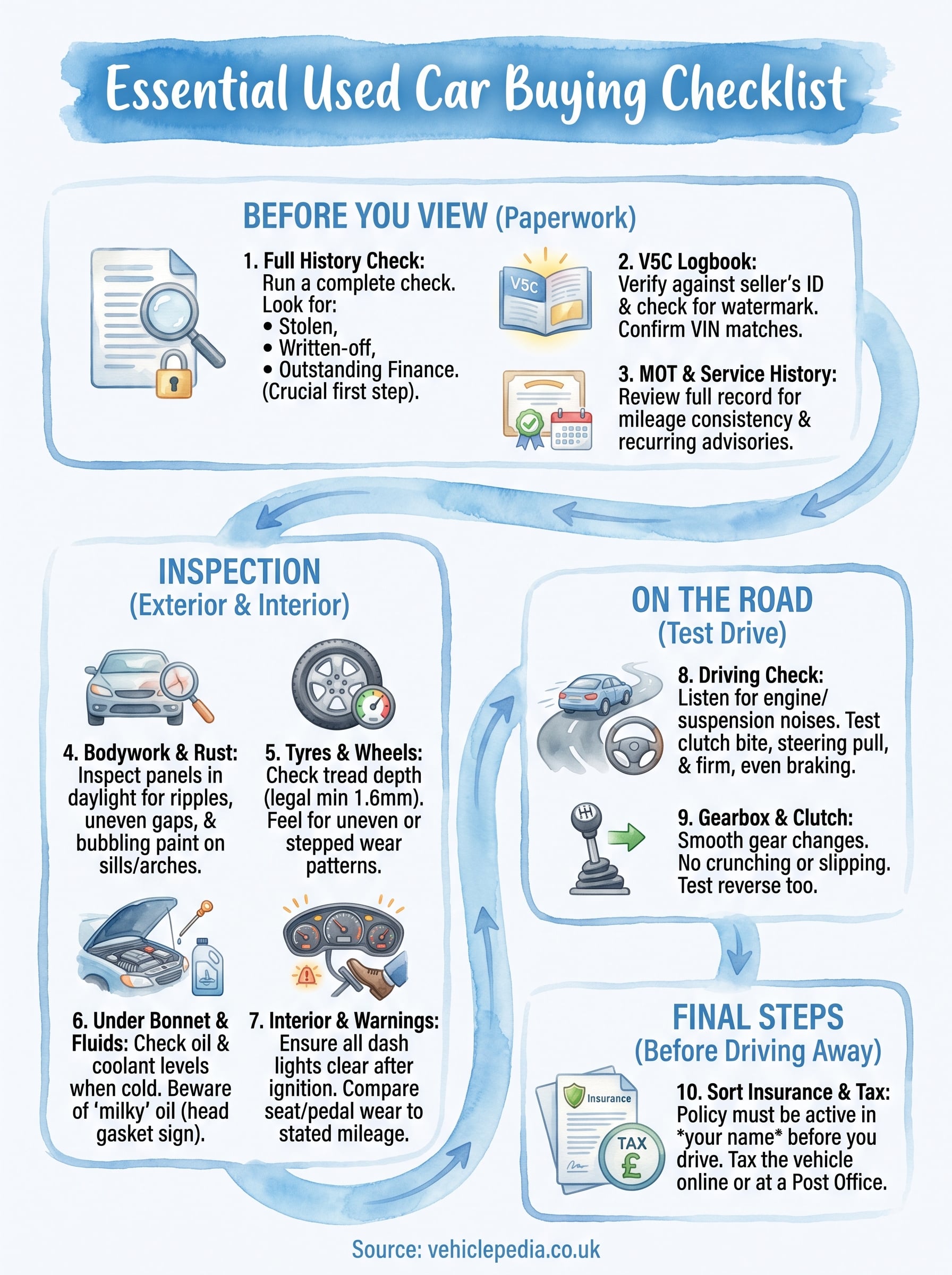
Making your final decision
Run through these 20 checks and you'll know more about a used car in twenty minutes than most buyers ever bother to find out. Nothing here replaces a proper history check and a careful walk-round, but together they turn guesswork into a decision you can actually stand behind. If a seller resists any of this, refuses documents, or rushes you through the viewing, treat that as your answer and move on to the next car.
Good buyers aren't lucky, they're just thorough. Trust the checklist over your excitement about the price, and you'll avoid the vast majority of problem cars circulating right now.
Before you view anything, run the registration plate and see exactly what a full report covers. You can preview a sample report to see the level of detail you're getting, then decide whether the free check is enough or whether the outstanding finance and write-off checks are worth the small cost for peace of mind.