How To Check A Used Car Before Buying: UK Checklist
Follow our UK checklist to learn how to check a used car before buying. Verify V5C logs, spot faults, and negotiate a fair price with total confidence.

How To Check A Used Car Before Buying: UK Checklist
Buying a used car is one of the bigger financial decisions most people make, and one where a single oversight can cost you thousands. Whether it's hidden mechanical damage, outstanding finance, or a dodgy service history, the risks are real. Knowing how to check a used car before buying can be the difference between driving away with a solid deal and inheriting someone else's expensive problem. The good news? Most issues are avoidable if you know exactly what to look for.
This guide walks you through a complete UK checklist covering everything from the physical inspection and test drive to document verification and legal checks. We've built it around the questions that actually matter, the ones that protect your money and keep you on the right side of the law. Each section gives you practical steps you can follow whether you're buying from a dealer, a private seller, or an online marketplace.
At Vehiclepedia, we help UK car buyers make informed decisions by providing detailed vehicle history checks using official data from the DVLA, police databases, and insurance registers. Running a registration plate check before you even view a car is one of the smartest first steps you can take, and it's free to start. Combined with the hands-on inspection advice in this guide, you'll have everything you need to buy with confidence.
What you need before you start
Preparation separates careful buyers from buyers who get burned. Before you travel to see any car, spending 30 minutes gathering the right tools, running a few background checks, and setting a clear budget puts you in a much stronger position. Showing up unprepared hands the seller a significant advantage, and in the used car market, that almost always costs you money.
Tools and equipment to bring
Arriving with the right kit means you can carry out a thorough physical inspection rather than relying on the seller's word. You do not need specialist equipment, but a few basic items will help you spot issues that are easy to miss at a glance. Pack the following before you leave home:
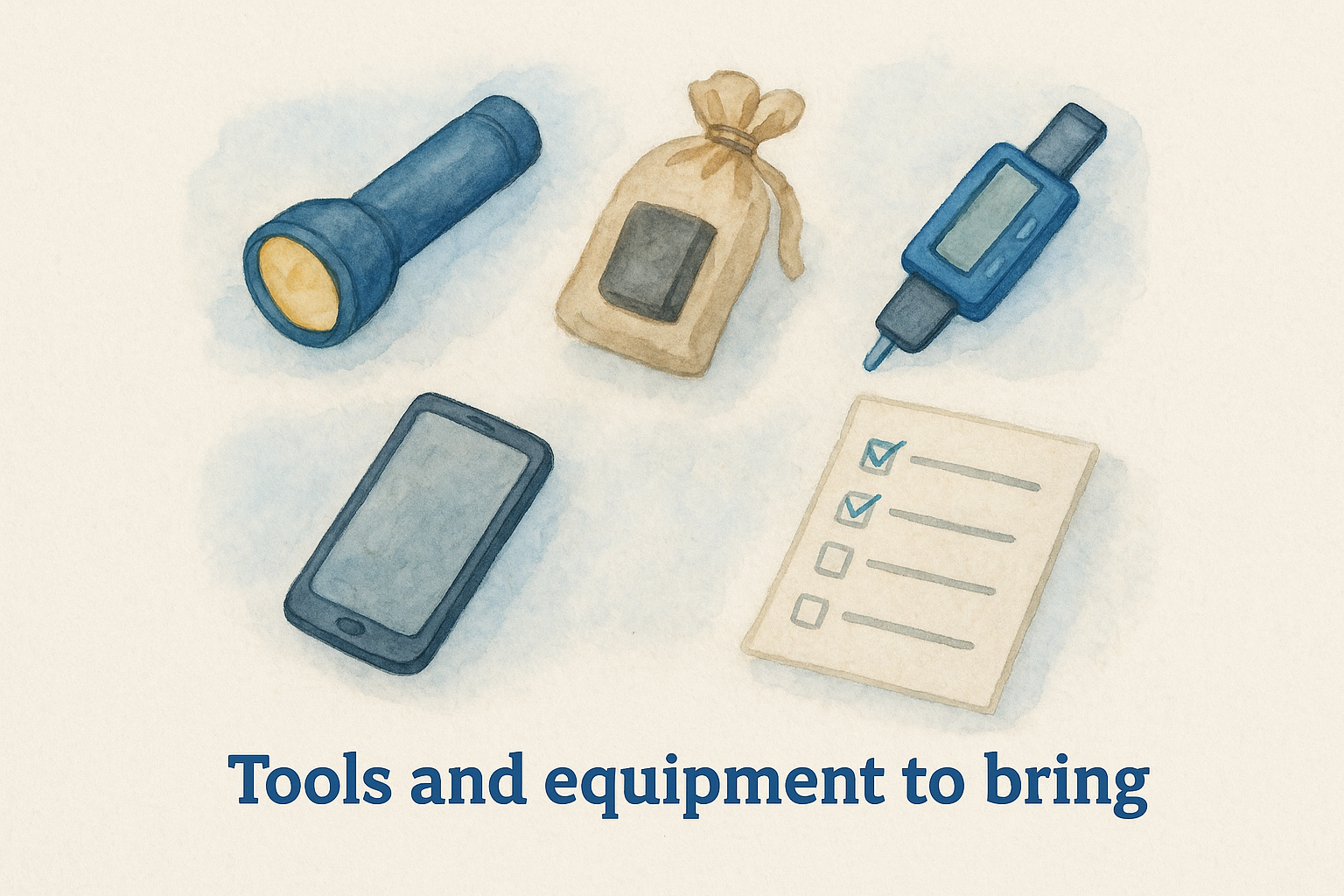
- A torch to check wheel arches, under the seats, and the underside of the car for corrosion or signs of accident repair
- A magnet wrapped in cloth (to avoid scratching the paintwork) to detect body filler used to hide previous damage
- A tread depth gauge, which is cheap to buy and far more accurate than a visual estimate on tyre wear
- Your smartphone to photograph anything suspicious and to run a registration plate check on the spot if something feels off
- A printed checklist or notes app to record your findings as you go, so nothing gets forgotten during the inspection
Never inspect a used car in poor light or heavy rain. Sellers who rush viewings or only offer evening appointments are counting on you missing things.
Know your budget before you arrive
Setting a firm upper limit before you speak to any seller is one of the most important steps in how to check a used car before buying. Standing in front of a car you like makes it easy to stretch your number, and that kind of impulse decision is how buyers end up overpaying or committing to a vehicle with a hidden repair bill already waiting for them.
Your budget needs to cover more than the asking price. Build in road tax, insurance, an MOT if one is due soon, and a buffer for any immediate repairs the car needs. A car listed at £5,000 with four worn tyres and a recent advisory-heavy MOT history could realistically cost you closer to £5,600 before it is roadworthy and insured. Calculate the full cost of ownership from day one, not just what the seller is asking.
Research the seller and listing before you visit
Verifying the seller's details before you travel saves you from wasted journeys and protects you from some of the most common scams in the private market. If you are buying from a private individual, confirm their address matches the address shown on the V5C logbook. A seller who asks you to meet at a car park or a location other than the registered address is flagging a problem worth investigating before you go any further.
For dealer purchases, check that the business has a verifiable physical address and look for any reviews or complaints before you commit to a visit. A legitimate dealer will have clear contact details and a proper premises. Before travelling to see any car, confirm the vehicle matches its online listing exactly, including the colour, mileage, and registration plate. Any discrepancy between the advert and the actual car can point to problems with the vehicle's identity or undisclosed history, and only a proper vehicle history check using the registration plate will tell you what has actually been hidden.
Step 1. Do online checks with the reg
Running online checks before you even think about viewing a car is one of the most effective steps in how to check a used car before buying. A registration plate search can reveal information the seller has no reason to share willingly, including outstanding finance, insurance write-off markers, stolen vehicle flags, and a full MOT history. Doing this step properly costs you very little time and can save you from travelling across the country to view a car that is legally compromised or financially encumbered.
Run a free registration plate check first
Before you contact the seller, enter the vehicle's registration number into a vehicle history check service. Vehiclepedia's free check pulls data directly from the DVLA and other official UK databases, giving you an immediate picture of the car's registered details, MOT status, road tax status, and basic vehicle information. Compare everything in the report against what the advert claims, including the make, model, colour, and engine size.
You can also check the car's full MOT history for free through the official GOV.UK MOT history tool. This shows every recorded MOT test result since 2005, including pass and fail reasons, and any advisories noted by the tester. A pattern of recurring advisories on the same components is a reliable indicator of an underlying mechanical issue the owner has repeatedly chosen not to fix.
If the MOT history shows a significant mileage drop between two consecutive tests, treat this as a strong warning sign of odometer tampering and do not proceed without a satisfactory explanation.
What to check against the advert
Once you have your report, run a direct comparison against the online listing before arranging a viewing. Working through the following checks systematically takes around ten minutes and filters out the most common problem vehicles before you commit any time or travel costs.
| What to check | Where to verify |
|---|---|
| Registered colour matches the advert | DVLA data in vehicle history report |
| Engine size and fuel type are correct | Vehicle history report |
| Recorded mileage aligns with the listing | MOT history via GOV.UK |
| MOT expiry date matches seller's claim | GOV.UK MOT checker |
| Road tax is currently valid | DVLA vehicle enquiry |
| No outstanding finance recorded | Premium vehicle history check |
| Not flagged as stolen | Premium vehicle history check |
| Not recorded as a write-off | Premium vehicle history check |
Any discrepancy between official records and the advert is a reason to ask direct questions before you travel, or to rule the car out entirely. A seller with nothing to hide will answer those questions without hesitation.
Step 2. Verify the V5C and identity
The V5C logbook is the official registration document for any UK-registered vehicle, and checking it thoroughly is one of the most important steps in how to check a used car before buying. A mismatched or fraudulent V5C is a serious red flag, since the document confirms who the car is registered to, its full specification, and its legal identity. Never buy a car without seeing the original V5C in person, and never accept a seller's claim that it is in the post or has been sent to the DVLA. If there is no V5C, there is no way to confirm the car is legitimately for sale.
What to examine in the V5C
The V5C contains a significant amount of information, and every detail in it should match both the car in front of you and the seller's identity. Work through the document section by section rather than scanning it quickly, because discrepancies often appear in small details that are easy to overlook under the pressure of a viewing.
Check each of the following before you go any further:
- Registered keeper's name and address must match the seller's details exactly, including the postcode
- Registration number should match the plates physically fitted to the car
- Make, model, colour, and engine size should align with the advert and what you can see
- Number of previous keepers is worth noting, since a high number for the car's age raises questions
- Document quality matters: genuine V5Cs use specific paper with a watermark and cannot be convincingly printed at home
- Corrections or alterations of any kind are a reason to stop and investigate further
If the address on the V5C differs from where you are viewing the car, ask the seller to explain before you proceed with any part of the inspection.
Match the VIN to the car
The Vehicle Identification Number, or VIN, is a 17-character code that functions as the car's unique fingerprint. You will find it in several places: on a plate visible through the windscreen on the driver's side dashboard, in the engine bay, and sometimes stamped into the chassis or door pillar. The VIN recorded in the V5C must match the number physically present on the car, with no signs of re-stamping, grinding, or re-attachment around the plate.
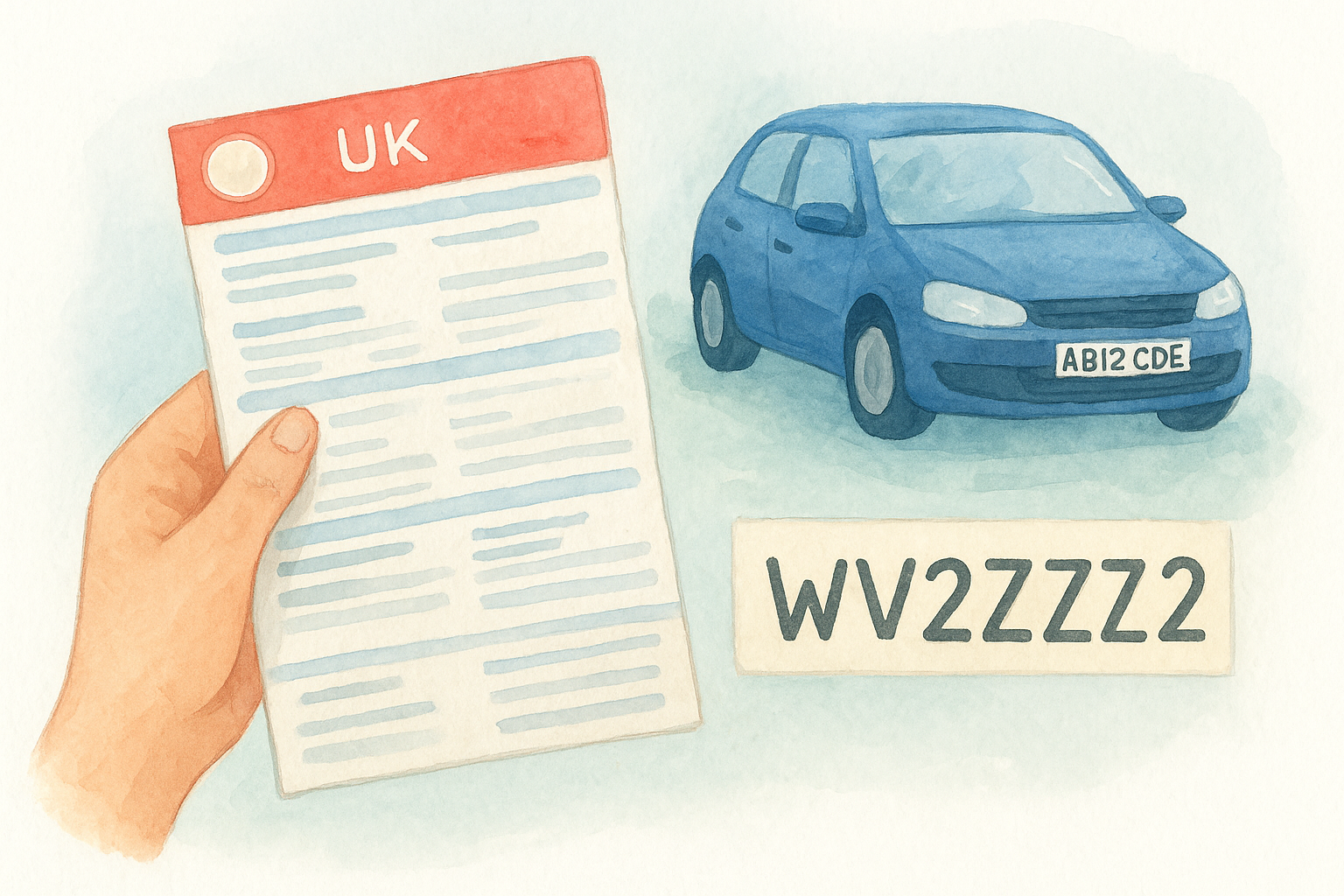
Cloned vehicles are cars fitted with the identity of a legitimate vehicle to disguise a stolen or written-off history. Spotting a VIN mismatch is one of the clearest ways to identify a clone before you hand over any money. Cross-referencing the VIN against your vehicle history report adds a further layer of independent confirmation that the car is exactly what the seller claims it to be.
Step 3. Inspect exterior and tyres
The exterior inspection is one area where taking your time pays off directly. Start by walking a full circuit of the car slowly, looking along each panel from a low angle with the light behind you. This technique catches ripples, dips, and mismatched paint that are invisible when you look straight at a panel from standing height. Do this check in daylight and in a well-lit area, and never accept a viewing that rushes or limits you.
Check the bodywork for damage and repairs
Spotting previous accident repairs is one of the most important parts of how to check a used car before buying, because poorly repaired damage can point to structural issues that affect both safety and resale value. Panel gaps are one of the clearest indicators: open all four doors, the boot, and the bonnet, then check that the gaps between panels are consistent and even all the way around. An uneven gap, a door that sits slightly proud, or a panel that does not align at the corners all point to a previous replacement or realignment.
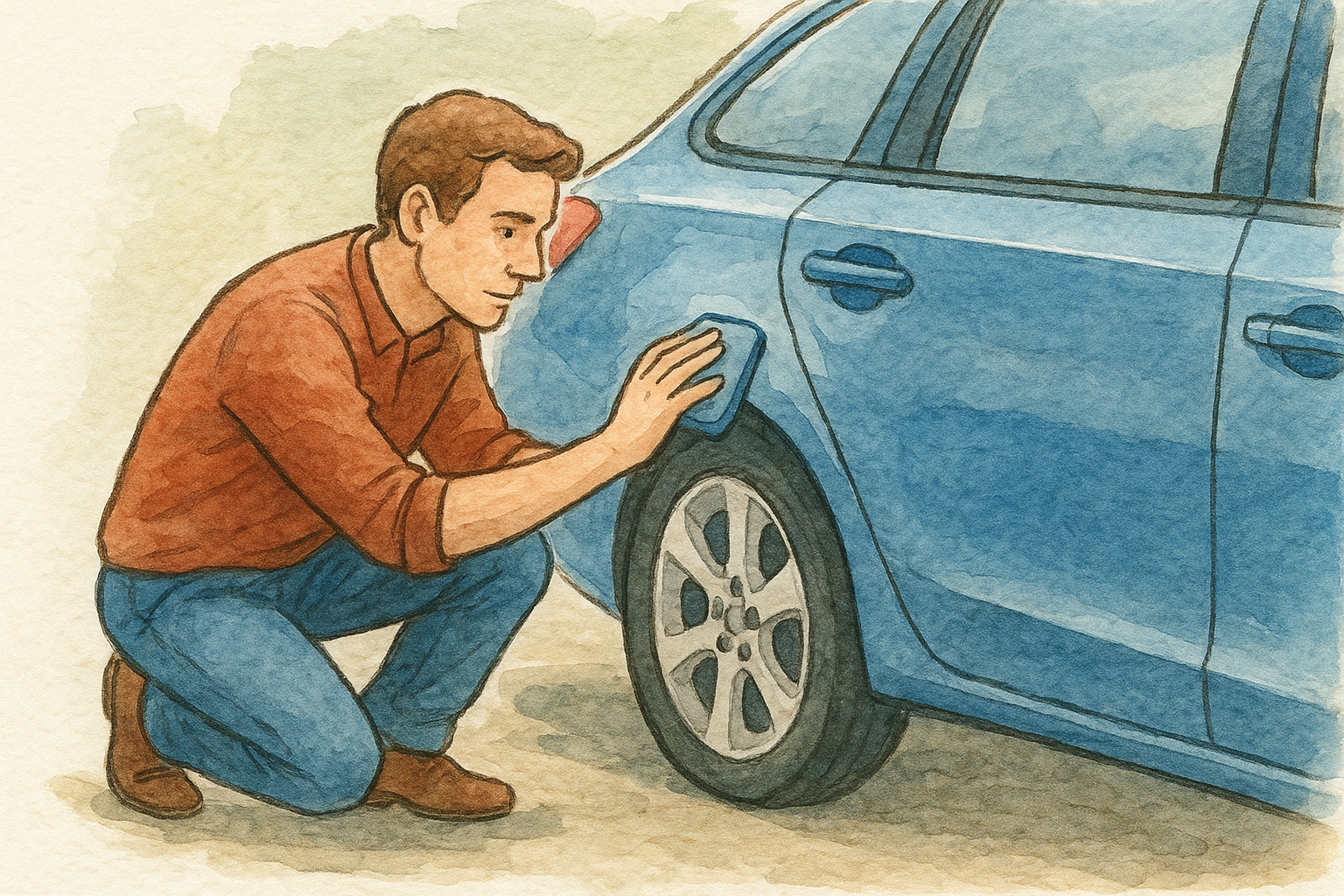
Use your cloth-wrapped magnet and move it slowly across each body panel. A genuine steel panel attracts the magnet firmly, while a panel filled with body filler shows noticeably weaker attraction. Pay particular attention to lower door sills, wheel arches, and the corners of the boot lid, where repairs are most commonly hidden.
If you find evidence of significant bodywork repair on one side of the car only, ask the seller for a full accident history and cross-reference their answer against your vehicle history report.
Run your eye along the roofline and window rubbers as well. Water ingress and rust frequently start at seals that have lifted or degraded, particularly on older vehicles, and catching this early saves you from expensive interior damage down the line.
Assess tyre condition and wheel damage
Tyre safety is non-negotiable, and checking all four takes less than five minutes. The legal minimum tread depth in the UK is 1.6mm across the central three-quarters of the tyre, but any tyre below 3mm is close enough to replacement that you should factor the cost into your offer. Use your tread depth gauge rather than estimating by eye.
Check each tyre for the following:
- Uneven wear across the width, which often points to alignment or suspension problems
- Cracks or bulges in the sidewall, which make the tyre unsafe regardless of remaining tread
- Kerbing damage on the alloy rim, which indicates careless driving and is a reasonable point to negotiate on
- Mismatched tyre brands across the same axle, which can affect handling under braking
Step 4. Check interior and electrics
The interior tells you a lot about how a car has been used and maintained. A high-mileage car with a pristine cabin is worth a second look, but worn seat bolsters, cracked trim, and a shiny steering wheel on a supposedly low-mileage car are strong indicators that the odometer reading does not reflect reality. This part of knowing how to check a used car before buying takes around 15 minutes and requires nothing more than your eyes and a smartphone.
Inspect seats, trim, and structure
Sit in every seat, including the rear. Check each seat for tears, excessive wear, and staining that points to heavy use or poor care. Fold the rear seats down if the car allows it and check the boot floor beneath the carpet for signs of water pooling, rust staining, or damp, which often indicates a leak from the boot seal or rear lights.
Run your hand along the door cards and headlining to check for damp or swelling, particularly in the roof lining above the doors. Water ingress is one of the costliest faults to fix on a used car, and sellers frequently disguise it with air fresheners or a quick valet before a viewing.
If the car smells strongly of air freshener or cleaning products, take extra time to check under the carpet and in the boot for moisture before going any further.
Test every electrical component
Work through every electrical function systematically and without rushing. A seller who tries to hurry you through this part of the inspection is worth treating with caution. Use the checklist below and record anything that does not work:
- Windows and mirrors: operate all four electric windows and both electric mirrors fully, checking for slow or jerky movement
- Lights: test headlights, full beam, fog lights, reversing lights, and all indicators including the hazard lights
- Climate control: run the air conditioning and heater at full output, and check that the blower works on every speed setting
- Infotainment: pair your phone via Bluetooth and test the touchscreen if fitted, noting any lag or freezing
- Dashboard warning lights: start the engine and confirm that all warning lights extinguish within a few seconds of startup
Any warning light that stays on after the engine has started requires a direct, documented explanation from the seller before you proceed with any offer.
Step 5. Look under the bonnet
You do not need to be a mechanic to carry out a useful engine bay inspection, but knowing what to look for is a central part of how to check a used car before buying. Open the bonnet with the engine cold if possible, since a warm engine can hide oil leaks that only appear once the oil thins out, and a seller who has just run the engine before your arrival may be doing exactly that. Take your time, use your torch, and look at the whole bay rather than focusing only on the obvious components.
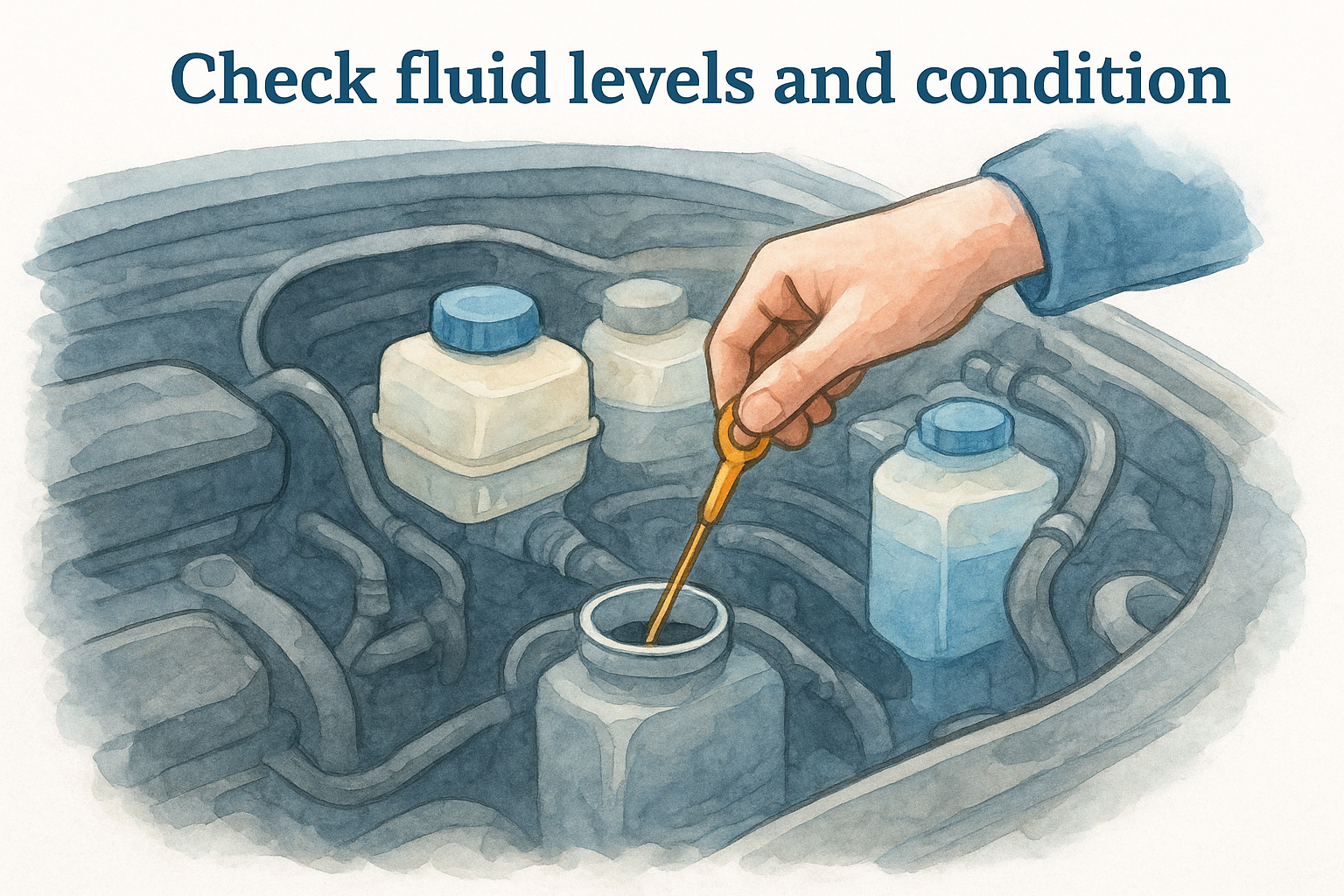
Check fluid levels and condition
Every key fluid in the engine bay has a clearly marked reservoir with minimum and maximum level indicators. Work through each one in turn and note both the level and the condition of the fluid itself, since both tell you something about how the car has been maintained.
| Fluid | What to check |
|---|---|
| Engine oil | Level between min and max on dipstick; oil should be amber to dark brown, not black or milky |
| Coolant | Level within the marked range; should be clear or coloured, not rusty or oily |
| Brake fluid | Level within range; dark or contaminated fluid suggests it has not been changed in years |
| Power steering fluid | Level correct; low level points to a possible leak in the system |
| Windscreen washer | Not a mechanical concern, but an empty reservoir on a used car suggests general neglect |
Milky or creamy engine oil is one of the most serious findings you can make, because it typically indicates a head gasket failure that allows coolant to mix with the oil. This is an expensive repair and a firm reason to walk away unless the price reflects it.
If the engine oil is extremely clean and fresh on a high-mileage car, ask when it was last changed and ask for proof, since a very recent change can also be used to hide the colour of a coolant leak.
Spot signs of leaks and wear
Look along the bottom edges of the engine block, hoses, and connections for any staining, discolouration, or residue that points to an active or past leak. Oil leaks leave dark brown or black deposits, while coolant leaks often leave a white or crystalline residue around the affected area. Check rubber hoses by squeezing them gently to confirm they are supple rather than brittle, since cracked hoses are a cheap fix in parts but an expensive breakdown waiting to happen on the road.
Examine the battery terminals for heavy corrosion or poor connections, which can cause unreliable starting and electrical faults that are easy to miss during a standard inspection. A battery that looks original on a car over five years old is also worth flagging, since replacement costs vary significantly by vehicle and is a reasonable item to factor into your offer.
Step 6. Spot accident, flood and clocking signs
Knowing how to check a used car before buying means going beyond what is immediately visible. Accident damage, flood exposure, and odometer tampering are three of the most common ways sellers misrepresent a vehicle, and each one leaves behind physical evidence if you know where to look. This step ties together several observations you may have already noted during the exterior and interior checks and asks you to draw conclusions from patterns rather than individual findings.
Look for hidden flood and water damage
Flood-damaged vehicles are frequently repaired, revalued, and relisted without any disclosure, particularly after significant weather events. The signs are consistent once you know what to look for: check the base of the door sills, under the seats, and beneath the boot carpet for a tide mark, rust staining, or a smell of damp that no valet has fully removed. Mud or grit in crevices around the seat runners and beneath the dashboard trim is another reliable indicator.
If you notice a strong smell of mildew or find sand in the seatbelt mechanisms, treat this as a flood indicator and do not proceed without a full vehicle history report to check for insurance write-off markers.
Check the condition of electrical connectors under the dashboard by shining your torch into the footwell. Corroded or discoloured connectors in a car that appears otherwise clean point to water exposure, and the electrical problems that follow can be both unpredictable and expensive to diagnose.
Detect odometer tampering
Clocking, which means winding back the recorded mileage on a vehicle, is illegal in the UK but remains common enough that it warrants a specific check during every used car inspection. The most reliable method is to compare the physical condition of the car against the claimed mileage and cross-reference it against the MOT history you pulled in Step 1.
Use the following checklist to identify a car whose mileage does not add up:
- Steering wheel and gear knob wear that looks heavy for the stated mileage
- Pedal rubber worn through to metal on a car allegedly under 60,000 miles
- Service stamps with inconsistent recorded mileages in the history booklet
- A discrepancy between any two consecutive MOT test mileage readings and the car's current dashboard figure
- Seatbelt buckles and door handles that show significant wear beyond what the odometer suggests
Any single item on this list warrants further investigation. Several together are reason enough to walk away entirely.
Step 7. Test drive like you mean it
A test drive is not a formality, and treating it as one is one of the most expensive mistakes buyers make. This is your opportunity to assess every mechanical system under real conditions, and it is a core part of how to check a used car before buying. Insist on driving for at least 20 minutes across a mix of road types, including a dual carriageway if possible. A seller who limits you to a short loop around the block is limiting your ability to find faults, and that should concern you.
What to test before you pull away
Before you move the car, run through a set of static checks while the engine is running and the car is stationary. These take under two minutes and catch several common faults that only show up once the engine is warm and under light load.
Work through the following before pulling onto the road:
- Handbrake hold: apply it fully and try to pull away gently to confirm it holds the car on a slope
- Clutch biting point (manual cars): check it is not extremely high, which points to a worn clutch close to replacement
- Steering column movement: turn the wheel lock to lock and check for any roughness or knocking in the column
- Heating and ventilation: run both hot and cold air at full fan speed to confirm the blower motor is working at every setting
- Reversing: back the car up to test reverse gear engages cleanly and the reversing camera or sensors function if fitted
What to listen and feel for on the road
Once you are moving, give the car enough time and variety to reveal issues that a short drive conceals. Accelerate firmly to motorway speed if conditions allow, and note any hesitation, pulling, or vibration that appears at higher speeds. A car that drives smoothly at 30mph can show significant vibration or instability above 60mph, which points to wheel balancing issues, worn suspension components, or tyre damage.
Brake firmly in a safe location to confirm the car stops in a straight line without pulling to one side. Any pulling under braking points to a brake caliper or disc issue on the affected side, and correcting it is rarely cheap.
Pay attention to any warning light that appears during the drive and extinguishes before you return, since some vehicles are set to clear stored fault codes temporarily once the engine reaches operating temperature.
Step 8. Agree the deal and pay safely
Knowing how to check a used car before buying puts you in a far stronger negotiating position than most buyers ever reach. Every fault you have documented during the inspection and test drive is a legitimate reason to adjust your offer, and presenting your findings clearly and calmly gives you credibility as a serious buyer. Do not apologise for negotiating; this is a significant financial transaction and the seller expects it.
Negotiate on the facts you have recorded
The checks you have run throughout this process give you concrete, documented reasons to justify a lower offer rather than simply haggling on price. If you found worn tyres that need replacing, calculate the replacement cost and deduct it from the asking price. An MOT advisory that keeps recurring, a minor oil leak, or a fault with an electrical component all translate directly into repair costs that you should present to the seller with a specific number attached.
A useful structure for making your offer:
- State the asking price from the advert
- List each specific fault you found with an estimated repair cost against each one
- Subtract the total repair estimate from the asking price and present that as your opening figure
- Give the seller a clear and reasonable timeframe to respond
Never accept a verbal agreement as a final deal. Get everything discussed and agreed in writing before any money changes hands.
Pay safely and protect yourself
Bank transfer is the safest payment method for used car purchases in the UK, as it creates a clear paper trail and gives you recourse if something goes wrong after the sale. Avoid paying in cash for any significant amount, and never transfer money in advance of receiving the keys and completing all paperwork in person.
For private sales, use a written receipt that captures the key details of the transaction. The template below covers everything you need:
| Field | What to include |
|---|---|
| Buyer and seller names | Full legal names and home addresses |
| Vehicle details | Registration number and VIN |
| Sale price | Agreed final figure in numbers and words |
| Date of sale | Day, month, and year |
| Legal confirmation | Written statement that the seller has the legal right to sell |
| Signatures | Both parties sign and keep a copy |
For dealer purchases, confirm you have received a full written invoice from the business before you leave the forecourt, and check that it includes the dealer's registered business address and VAT number if applicable.
Step 9. Tax, insure, and take ownership
The final step in knowing how to check a used car before buying extends beyond the handshake. Once the deal is done and payment is confirmed, you have three tasks to complete before the car legally belongs to you and before you are allowed to drive it on a public road. Skipping or delaying any of them leaves you exposed to fines, penalties, or insurance complications that are entirely avoidable.
Tax the vehicle before you drive it
Road tax does not transfer between sellers and buyers in the UK. The moment a vehicle changes hands, the previous owner's tax is automatically cancelled and they receive a refund for any remaining full months. That means the car is untaxed from the point of sale, even if the seller's tax was valid that morning.
Tax the vehicle online through the GOV.UK vehicle tax service before you drive it away. You will need the V5C reference number to complete the process, which takes under five minutes. Keep a record of your transaction confirmation in case you are stopped before the DVLA database updates, which typically takes 24 to 48 hours.
Get insurance in place before you move
You must have valid insurance to drive the car away from the seller's location. If you already have a policy that covers you to drive any vehicle, confirm with your insurer that it applies before you collect the car. Most comprehensive policies include third-party cover on other vehicles, but this is not universal, and checking costs nothing.
If you need a new policy, get quotes in advance so you can activate cover on the day you collect. Many insurers allow you to set a specific start date and time, which means you can have cover confirmed and active before you hand over payment.
Do not assume the seller's insurance covers you for a test drive unless they have confirmed this explicitly with their own insurer beforehand.
Register yourself as the new keeper
Notify the DVLA that you are the new registered keeper by completing Section 6 of the V5C and posting it to the address printed on the form. The seller retains their portion, and you will receive a new V5C in your name within five working days. Keep the green new keeper slip in the car as temporary proof of ownership while you wait for the updated document to arrive.
A quick recap before you buy
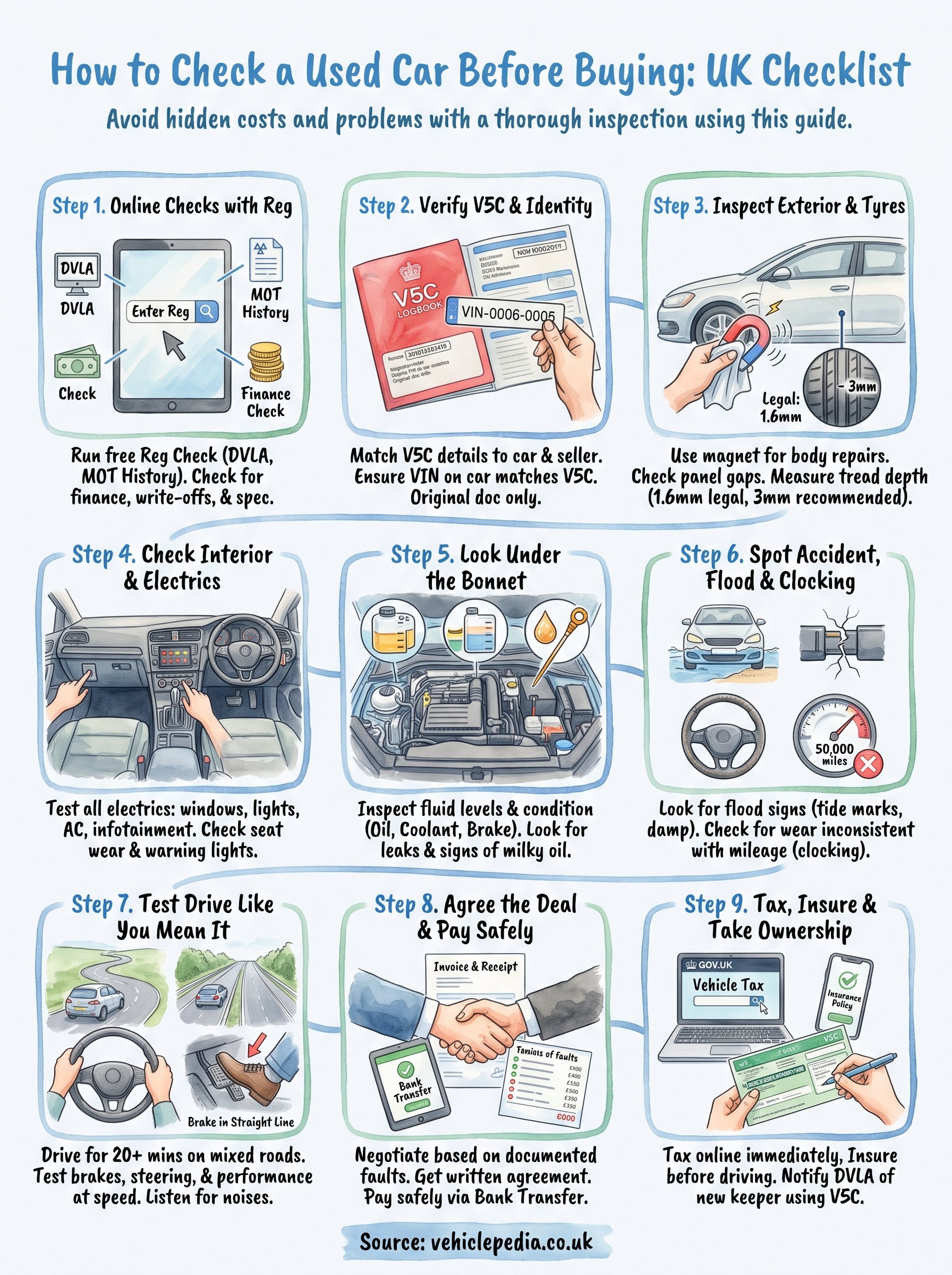
Knowing how to check a used car before buying comes down to one principle: verify everything independently before you hand over any money. Run your registration plate check first, confirm the V5C matches the car and the seller, inspect the bodywork and tyres in daylight, test every electrical component, and check under the bonnet for leaks and fluid condition. Look for flood damage and clocking signs, take a proper test drive across a range of road types, and negotiate using the specific faults you documented rather than guessing at a discount.
Each step in this guide protects a different part of your money and your safety. Skipping even one of them is where most bad purchases begin. Before you visit any car, run a free vehicle history check on Vehiclepedia to see what the official records say. You can also view a sample premium report to understand exactly what a full check reveals.