15 Things to Check When Buying a Used Car Privately
Learn what to check when buying a used car privately in the UK: 15 checks covering the seller, V5C, MOT, finance, write-offs, test drive and payment.
15 Things to Check When Buying a Used Car Privately
The short answer to what to check when buying a used car privately is this. Verify the car's identity and history from its registration before you travel. Check the seller and the V5C logbook at the viewing, then inspect and test drive the car in daylight. Finally, pay by a traceable method and keep a receipt. If you only have time for three checks, make them the V5C, the finance and write-off record, and the mileage against the MOT history. If you know little about cars, bring a friend who does, or pay for an independent inspection.
A private sale puts the risk on you. There is no dealer warranty, no preparation work and far fewer legal protections than a trader owes you, so a problem you miss usually becomes your bill. Most sellers are honest. Even so, a clocked mileage, a finance agreement or a hidden write-off can cost thousands, and none of them show when you walk round the car.
This guide gives you 15 checks in the order you will meet them, from the first advert to the day you tax and insure the car. Each one says what to check, how to check it and which red flags mean you should walk away. Vehiclepedia is a UK vehicle history service, so we show where a registration lookup saves you time and where only your own eyes and hands will do.
1. Run a free reg check before you travel
A free reg check gives you instant, official data on the car before you contact the seller. Use it to confirm the advert tells the truth and to decide whether the car deserves a viewing at all.
What to check
Enter the registration from the advert and compare the result with the listing. The make, model, age and engine size must match what the seller wrote. Then look at the MOT status, tax status, export status and any outstanding recall, all of which appear in the Vehiclepedia Free Check. The premium report adds the records you cannot see by eye.
| Report | Price | What it covers |
|---|---|---|
| Free Check | Free | MOT status, history and expiry; tax status and yearly cost; registration and age; make and model; outstanding recall; export status; CO2 emissions; engine size |
| Premium Check | £6 | Everything in the Free Check, plus finance, written-off, stolen and police checks, scrapped status, import and export records, colour changes, number of owners and mileage history |
How to check it
Type the plate into the Free Check and read the result against the advert, line by line. A different colour or engine size is not always fraud, but it is a question the seller must answer. Vehiclepedia also raises warnings for mileage trends, sudden drops and DVLA discrepancies, so look for those first. You can compare the basics with DVLA's vehicle information service too.
Decide on the premium report before you view. Finance, write-off and theft records cannot be seen on a driveway, and £6 is small next to the price of any car. Premium reports also carry a data guarantee of up to £30,000 for non-trade users.
A reg check cannot replace a viewing, but it can cancel a wasted one.
Red flags
- Make, colour, engine size or age differ from the advert.
- The MOT history shows long gaps or repeated failures.
- The record shows the car as exported when it is sold as a UK car.
- Mileage warnings appear in the result.
- The seller hides the plate in photos and will not give it to you.
2. Read the advert and price it against the market
A good private advert gives you enough detail to spot gaps, and a fair price tells you the seller is realistic. Compare both before you view, because a car priced far below the market is nearly always cheap for a reason.
What to check
Look for full details and clear photos of every side, the interior, the dashboard and the engine bay. A complete advert states:
- make, model, engine size and trim level
- plate year and number of previous owners
- MOT expiry and last service date
- the asking price and a phone number, not just a message form
- the general area where you can view the car
How to check it
Find at least five similar cars by age, mileage and trim, and note the spread of prices. Say the comparable cars sit between £5,400 and £6,100 and yours is advertised at £4,200. That is £1,200 below the cheapest, so expect a catch and ask hard questions. Reverse image search the photos with Google Lens or Google Images, because photos lifted from another advert are a classic scam sign.
Send the seller one specific question about the car before you travel. A vague or evasive reply tells you something before you have spent any fuel.
A price that looks too good is a question, not a bargain.
Red flags
- A price well under every comparable car.
- Few details, one or two photos, or photos that hide one side.
- A deposit requested before you have seen the car.
- The same phone number on several cars, which suggests a trader.
- "Selling for a friend" with no clear owner.
3. Judge the seller and the viewing address
Meet the seller at the address on the V5C, in daylight, and treat the conversation as part of the inspection. Most scams and traders posing as private sellers give themselves away at this stage.
What to check
The seller should live at the address printed on the V5C, and the car should be parked there. The name on the logbook should be the person you are dealing with. Ask how long they have owned the car, why they are selling and whether it is their only car. A genuine owner answers easily and knows the car's quirks.
How to check it
Tell someone where you are going, and take a friend if you can. Ask your questions early, then compare the answers with the V5C and the MOT history later. Ask about accidents, warning lights and, if the engine has a belt rather than a chain, when the cambelt was last changed.
A trader posing as a private seller breaks consumer rules and leaves you without the protections a trader owes you. Be suspicious of a seller who knows little about the car or has several for sale.
If the seller's story and the paperwork disagree, believe the paperwork and walk away.
Red flags
- An offer to meet in a car park, a service station or the roadside.
- The car is "at a friend's" or "in storage".
- The seller is not the registered keeper and the explanation is vague.
- Pressure such as "another buyer is on the way".
- A refusal to let you look under mats or take a test drive.
4. Match the V5C logbook to the car
Never buy without seeing the V5C logbook, and match every detail on it to the car in front of you. The V5C names the registered keeper, but it is not proof of ownership.
What to check
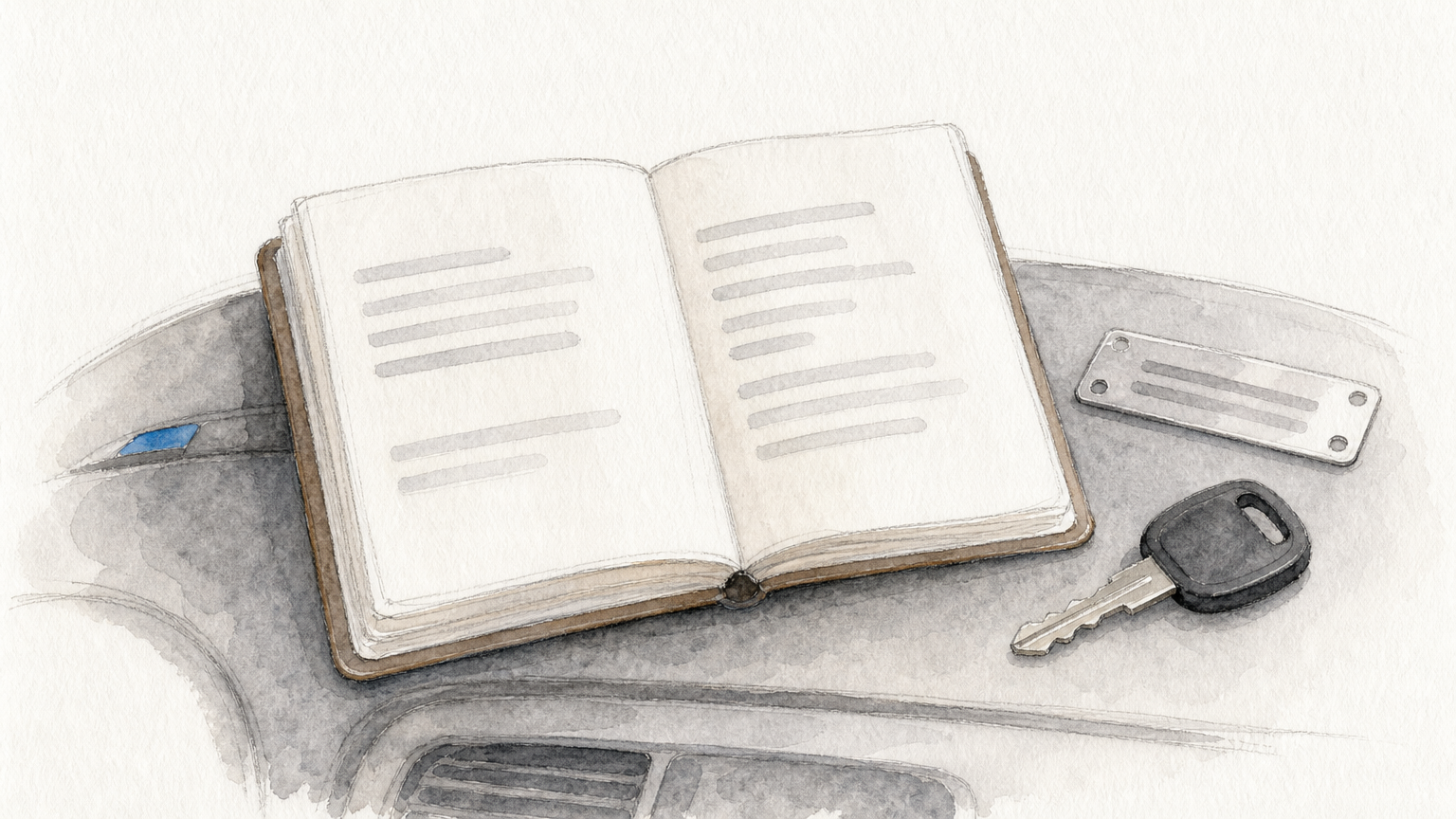
Read the V5C beside the car. Check these details:
- the registration number, make, model, colour and engine size
- the keeper's name and address against the seller
- the date of first registration
- the number of previous keepers
- the VIN, which must match the car
The VIN is usually visible at the base of the windscreen, and on older cars it may be under the bonnet or stamped on the bodywork.
How to check it
Put the logbook on the dashboard and compare the VIN on the V5C, the windscreen and the VIN plate. Look closely at the plate for scratches, odd rivets or a sticker over the number. Then ask for proof of ownership, such as a purchase receipt or invoice in the seller's name.
If the logbook is missing, the seller can apply to DVLA for a replacement, which GOV.UK lists at £25. Pause the sale until it arrives. A photocopy is not good enough.
No logbook, no sale, whatever reason the seller gives.
Red flags
- The keeper's name or address differs from the seller's.
- The V5C is "in the post" or "applied for".
- The VIN differs between the paperwork and the car, or looks altered.
- The colour on the V5C does not match the car.
- Many keepers in a short time with no good explanation.
5. Study the MOT history and advisories
Check the MOT history on GOV.UK or through a reg lookup, and read the failures and advisories, not just the pass. A car over three years old needs an MOT every year, so the history is a free record of how it has been looked after.
What to check
Use the GOV.UK MOT history service to see the current expiry date, past failures and advisories and the mileage at every test. You can also read the same MOT history in the Vehiclepedia Free Check. Note any gaps between tests and any advisory that returns year after year.
| What you see | What it suggests |
|---|---|
| The same advisory repeated each year (brakes, corrosion, suspension) | Neglect. Ask what has been fixed and ask for invoices |
| A failure followed by a pass the next day | Usually a quick repair. Ask for the invoice |
| Mileage that stalls or falls between tests | Possible clocking. Treat it as a serious warning |
| A long gap between tests | The car may have been off the road, or driven without an MOT |
| Tyre and bulb advisories only | Minor wear. Use it to negotiate |
How to check it
Read the history before the viewing, then check on the day whether each advisory was fixed. Some are easy to see, such as a worn tyre. Others, such as underbody corrosion, need a proper look from a ramp or a mechanic.
Remember that an MOT is a snapshot of the day of the test. A pass from eight months ago does not prove the car is roadworthy today.
The MOT history tells you how the car was treated between tests, not just whether it passed.
Red flags
- Corrosion advisories on structural areas.
- A current MOT that is about to expire, which means a test and possible repair bill soon.
- A seller who promises to "get it MOT'd" after you pay.
- Mileage readings that rise unevenly.
- A paper certificate that does not match the online record.
6. Test the mileage against the car's wear
Compare the odometer with the MOT readings, the service book and the wear on the car. Mileage should tell one consistent story, and a figure that breaks it is one of the costliest problems a buyer can miss.
What to check
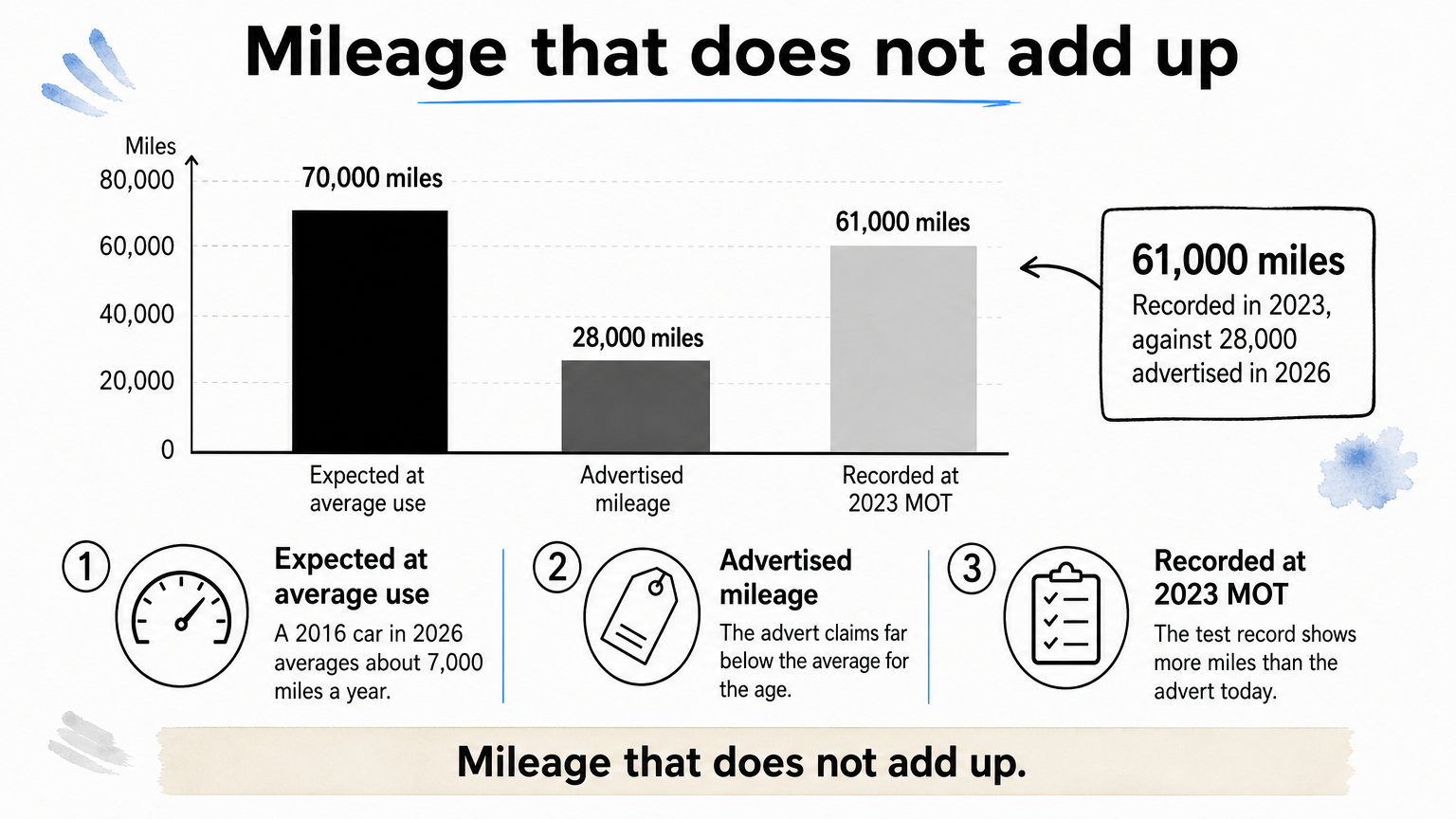
The average UK car covers around 7,000 miles a year, which makes a handy rule of thumb. Compare the odometer with the MOT readings and the service stamps. Then look at the parts that wear with use: the driver's seat bolster, steering wheel, pedal rubbers and gear knob.
How to check it
Take a worked example. A car registered in 2016 is ten years old in 2026, so average use would be about 70,000 miles. An advert showing 28,000 miles is far below that, so you need proof. If an MOT in 2023 recorded 61,000 miles, the car has been clocked.
Vehiclepedia's Genuine Mileage Check compares the recorded mileage with DVLA and MOT history records to detect discrepancies. It is worth running when the figure looks low for the age. High mileage with a full service history is often a better buy than low mileage with none.
Mileage is only believable when the MOT, the service book and the seat agree.
Red flags
- A shiny steering wheel and worn pedals on a low-mileage car.
- Mileage falling between MOT tests.
- New seat covers or pedal rubbers on a car with a very low reading.
- Missing service stamps on a car that claims low mileage.
- A seller who cannot explain a sudden jump or drop in miles.
7. Rule out outstanding finance
Check for outstanding finance before you pay anything, because a financed car may legally belong to the lender until the last payment. If you buy one, you may end up in a long dispute or without the car, even though you paid the seller.
What to check
A finance check shows whether the car is under an agreement, the type of agreement, the lender and how much is still owed. Vehiclepedia's Car Finance Check covers this using only the registration, and it is included in the £6 Premium report. Also ask the seller directly whether the car is on finance, and when it was last settled.
How to check it
Run the check before you view, then ask for a written settlement letter from the lender if any finance appears. The sale should only go ahead once the lender confirms in writing that the debt is cleared.
Consider the numbers. If £2,400 is owed on a £7,000 car and you pay the seller in full, you are trusting a stranger to settle £2,400 afterwards. Insist the finance is cleared first, with proof.
No database promises a complete record of every agreement. Vehiclepedia states that the buyer remains responsible for making sure the finance is clear, so use the check and the direct question together.
If the lender is owed money, the car is not fully the seller's to sell.
Red flags
- "It's paid off" with no letter to prove it.
- A seller who suggests settling the finance from your payment without contacting the lender.
- Reluctance to let you run a check.
- A very low price for the car's age and mileage.
- A recent change of keeper with no clear reason.
8. Check for write-off and stolen records
Check the registration against insurance write-off and stolen vehicle records. A damaged car can be repaired to look perfect, and a stolen car can look completely normal.
What to check
Insurers classify written-off cars into four categories. Vehiclepedia's premium report searches the MIAFTR insurance database for write-off records, and checks the UK Police Database and MIAFTR for theft.
| Category | Meaning | Back on the road? |
|---|---|---|
| A | Scrap only | No, must be crushed |
| B | Break only, parts can be reused | No, the shell must be crushed |
| S | Structurally damaged, repairable | Yes, once repaired |
| N | Non-structural damage, repairable | Yes, once repaired |
Older records may show Category C or D, which Category S and N replaced for cars written off from October 2017.
How to check it
Run the premium report and compare it with the seller's story. A Category S or N car is legal to buy, but the price should be lower and insurers may charge more or decline cover. Ask for repair invoices and photos, and have a mechanic look at the repair.
Also check that the VIN and plate match the records. A cloned plate puts a stolen car's identity on a different car.
A write-off record is not an automatic no, but it is always a price and an inspection question.
Red flags
- The seller denies an accident that the record shows.
- A Category A or B car advertised for use on the road.
- A stolen marker, or a VIN that does not match the registration.
- No repair evidence on a Category S car.
- A price well below similar cars, with no explanation.
9. Ask for the service history and recall status
A complete service history shows the car has been maintained, and a recall check shows whether a known safety fault is still unfixed. Ask for both, and verify them rather than trusting a book on its own.
What to check
Look for dated stamps and invoices with the mileage at every service, plus evidence of a cambelt change where the engine needs one. Vehiclepedia's free Service history check shows complete, partial or missing history from manufacturer and dealer networks, with brands such as Audi, BMW, Mercedes-Benz, Ford, Volkswagen and Kia covered. The Free Check also shows any outstanding recall.
How to check it
Match the mileage at each service with the MOT readings. A gap or a jump of thousands of miles needs an explanation. Invoices matter more than stamps, because anyone can stamp a book. If a garage is named, you can ring it and ask whether it serviced the car.
For the recall, use the GOV.UK vehicle recall check as a second source. A recall is usually repaired free by the manufacturer's dealer, but you need it to be done.
A service book without invoices is a claim, not evidence.
Red flags
- Every stamp in the same pen.
- Long gaps between services, or mileage that does not fit the MOT.
- "I lost the book" on a higher-value car.
- No proof of a cambelt change on an engine that needs one.
- An outstanding recall the seller does not know about.
10. Inspect the bodywork for accident repairs
Walk around the car slowly, in daylight and dry weather, and look for repaired accident damage. Small dents are a negotiating point, but uneven panels and mismatched paint suggest a crash.
What to check
Check that the gaps between panels are even and that the paint colour matches all over. Look for overspray on rubber seals and trim, ripples along the sides and mismatched headlight lenses. Inspect the sills, wheel arches and door bottoms for rust, and look at the windscreen for chips.
How to check it
Crouch and look along each side to see ripples in the reflection. Hold a small magnet, wrapped in cloth to protect the paint, against the lower panels, because it will not stick to body filler. Open the boot, lift the carpet and look for crinkled metal or fresh seam sealer on the floor.
A chip in the driver's eyeline can fail an MOT, so treat it as a repair cost. For a more expensive car, ask a mechanic or an independent inspection service to put the car on a ramp.
Even gaps and matching paint are the quickest sign that the car has never been hit hard.
Red flags
- Large or uneven panel gaps.
- A panel that is a slightly different shade.
- Overspray on rubbers or trim.
- A magnet that will not stick to part of a panel.
- A seller who insists on viewing in the dark, in rain or in a dim garage.
11. Check tyres, brakes and under the bonnet
Check the tyres, brakes and engine bay for wear and neglect, because these jobs add up quickly and show how the car has been treated. Tyres are the easiest to measure.
What to check
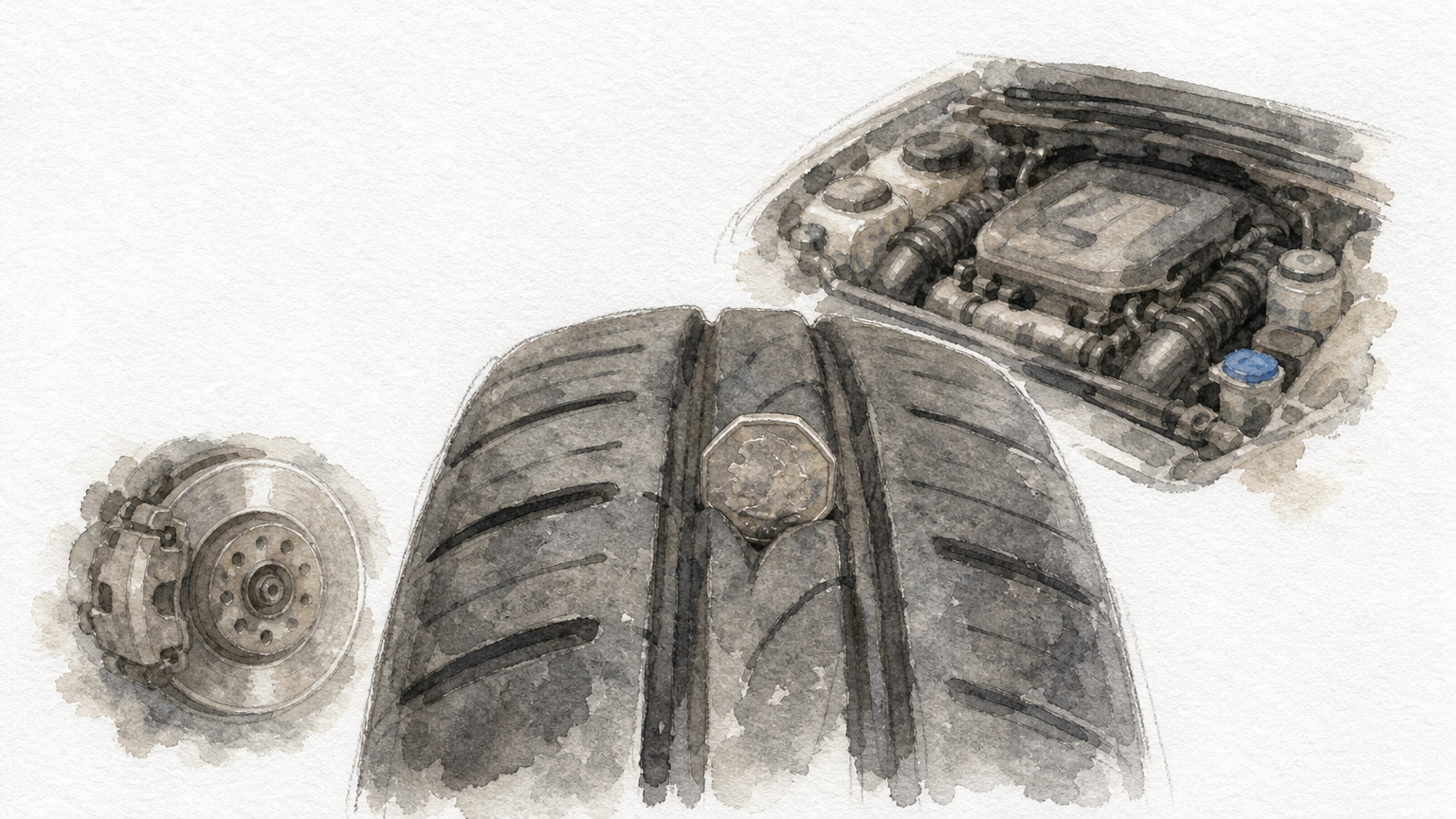
The legal minimum tread is 1.6mm across the central three quarters of the tyre, all the way round. Also check for cracked sidewalls, uneven wear and matching brands on each axle. Under the bonnet, check oil and coolant levels and look for leaks, and look under the oil cap for a white, mayonnaise-like residue.
| Tread depth | What it means |
|---|---|
| Under 1.6mm | Illegal. Walk away or insist on new tyres |
| 1.6mm to 3mm | Replacement due soon, so budget for it |
| Over 3mm | Fine for now |
How to check it
Push a 20p coin into the tread grooves. If the coin's outer band is hidden, you have more than 3mm left. Look at the brake discs for a heavy lip or rust and ask when the pads were last changed.
Use what you find to negotiate. Suppose a car at £5,000 needs two front tyres, and a fitter quotes £180 for the pair. A fair offer would take that off, not the whole asking price. Keep the engine cold when you arrive so you can judge how it starts.
Tyres and brakes are the cheapest checks to make and the most reliable bargaining chips.
Red flags
- Tyres below 1.6mm, or badly uneven wear.
- White residue under the oil cap, or milky coolant.
- Fresh oil on the ground where the car was parked.
- A freshly steam-cleaned engine on an old car.
- Low oil or coolant with no explanation.
12. Test the interior, electrics and warning lights
Sit in the car with the engine off, then on, and test every switch and feature. The interior shows real use, and electrical faults can be costly to trace.
What to check
When you turn the ignition on, every warning light should come on and then go out after starting. A light that never appears may have been disabled, and an airbag or engine light that stays on is a fault. Test the windows, mirrors, central locking, air conditioning, heated seats, infotainment and parking sensors.
How to check it
Go through the car in this order:
- Ignition on, then watch the dashboard lights.
- Start the engine and confirm the lights go out.
- Press every button, and run the air conditioning on cold.
- Pull the seatbelts out fully and check they retract.
- Lift the mats and boot carpet and look for damp or silt, the signs of flood damage.
- Ask for both keys, the spare wheel or repair kit, the jack and the locking wheel nut key.
Smell the cabin. A musty or damp smell, or condensation inside the headlights, points to water getting in. Wear should match the mileage you checked earlier.
The dashboard on start-up tells you in ten seconds what a seller may not mention.
Red flags
- Airbag, ABS or engine light that stays on.
- A warning light that never lights at all.
- Damp carpets, silt under the boot floor or a musty smell.
- Only one key, since replacements can be expensive.
- Features that work only when the seller operates them.
13. Take a proper test drive
Drive for at least 20 minutes on mixed roads, with the radio off and your insurance confirmed first. A short loop around the block hides far more than it shows.
What to check
Confirm who is insured before you move. Ask the seller to confirm their policy covers you, or arrange temporary cover, because driving without insurance is an offence. Never assume your own policy covers you in someone else's car. Then check these:
- the engine starts easily from cold
- the temperature gauge reaches normal within about 10 minutes
- the clutch bites cleanly and the gears select smoothly
- steering feels straight and brakes stop the car without pulling
- no clunks from the suspension and no knocking from the engine
- no smoke from the exhaust
How to check it
Ask the seller not to start the car before you arrive, and touch the bonnet to check it is cold. Drive through town, then on faster roads, and include a hill if you can. Test the brakes firmly only when the road behind is clear.
Turn the radio off and listen. A dishonest seller may play music to cover a noisy engine. For an expensive car, a paid independent inspection before you commit is a sensible step.
If the car only drives well on the seller's short route, drive it somewhere else.
Red flags
- The engine is already warm when you arrive.
- The seller refuses to let you drive, or insists on driving first.
- Clutch bites right at the top of the pedal, or gears crunch.
- Blue, black or persistent white exhaust smoke.
- The temperature gauge climbs or the car pulls to one side.
14. Pay safely and get a receipt
Pay by a traceable method, only after every check is done, and get a written receipt signed by both of you. Complete the payment at the seller's home, never in a car park.
What to check
Choose the payment method that suits the price:
| Method | Speed | Notes |
|---|---|---|
| Bank transfer | Usually fast | Traceable and best for most sales. Check the account holder's name matches the seller |
| Banker's draft | Fast to issue | Often carries a bank fee, and the seller may want to verify it with the bank |
| Cash | Instant | Untraceable, so keep it for small sums, and only at the seller's home |
| Cheque | Slow | The seller will wait for it to clear before releasing the car |
A small deposit of around £50 is usually enough to hold the car. Agree the date for the rest in writing.
How to check it
The receipt should list the date, price, make, model, registration, VIN, mileage and the seller's name and address. Both of you sign it, and you each keep a copy. Add a line that the car is "sold as described", plus anything the seller has promised to fix or include.
Screenshot the advert before you go and keep it. If the car is not as described, the original wording is your evidence.
A receipt costs nothing, and its absence is the first thing a dishonest seller wants.
Red flags
- A request to pay into a third party's account.
- Pressure to pay in cash on the spot.
- Refusal to sign a receipt.
- Gift cards or similar unusual payment methods.
- A request to pay more than agreed, with a promise of a refund.
15. Tax, insure and know your rights after buying
Before you drive away, you need insurance in your name and the car taxed, because vehicle tax does not transfer with the car. You should also know exactly what a private sale does and does not protect.
What to check
Make sure you get the new keeper's supplement (V5C/2) and that the seller has told DVLA about the sale. Arrange insurance before you collect the car. Tax it online at GOV.UK using the 12-digit reference number on the V5C/2, before you drive.
How to check it
Your new V5C usually arrives within a couple of weeks. If nothing has come after four weeks, contact DVLA. Keep the receipt, the advert screenshot and the supplement together.
Your rights are weaker than with a trader. A private seller must describe the car accurately and have the right to sell it, and the car must be roadworthy. But the 30-day right to reject that a trader owes you does not apply, and enforcing a claim often means the small claims court. That is why the earlier checks matter.
The GOV.UK step-by-step guide to buying a vehicle is a useful reference to keep open on the day.
After a private sale, your best protection is the checking you did before it.
Red flags
- The seller will not sign or hand over the new keeper's supplement.
- The seller says the old tax or insurance "carries over".
- No V5C arrives after four weeks.
- The seller stops answering calls once paid.
- A fault appears on the drive home that the advert said did not exist.
Putting the checks to work
The pattern behind all 15 checks is simple. Verify what you can from the registration first, then confirm it in person against the paperwork, then test the car itself. Your strongest position is evidence in hand, so a record that matches the seller's story is worth more than any promise.
You do not need to be a mechanic to buy well. You need to be methodical, unhurried and ready to leave. There is always another car, and walking away from one with a hidden problem is a win.
Start before you travel. Run the free check on the registration, and if the car passes, look at a sample premium report to see exactly what the finance, write-off and stolen checks show before you spend £6 on the car you want.