Second Hand Car Inspection Checklist: 15 Points to Check
Follow this second hand car inspection checklist covering 15 checks, from history reports to test drives, before you buy your next used car.

Second Hand Car Inspection Checklist: 15 Points to Check
Buying a used car without a proper inspection is how people end up with a £4,000 problem disguised as a bargain. A second hand car inspection checklist takes the guesswork out of viewing a vehicle, so you're not relying on the seller's word or a five-minute test drive to make a decision this big.
This guide walks you through the 15 points that actually matter, from checking the bodywork and tyres for signs of accidents or neglect, to inspecting the engine bay, interior wear, and paperwork that proves the car is legally sound. You'll know exactly what to look at, what questions to ask, and which red flags mean you should walk away.
We've built this checklist around the issues that catch buyers out most often: hidden finance and write-off history, clocked mileage, and MOT failures waiting to happen. Before you view any car, it's worth running the registration through a history check to confirm what the paperwork claims, then use this list on-site to verify everything with your own eyes.
1. Run a full vehicle history check
Before you even arrange a viewing, run the registration plate through a vehicle history check. This is the single most important item on any second hand car inspection checklist because it flags problems no amount of walking around the car will reveal. A quick free check on Vehiclepedia will tell you basic facts like MOT status and road tax, while a premium report digs into finance agreements, write-off markers, and stolen vehicle records held by the police.
What to check
Start with the basics and work up to the details that carry real financial risk. At minimum, confirm these before you agree to view the car:
- Mileage consistency across MOT records, service history, and what the seller tells you
- Number of previous owners and how long each one kept the car
- Outstanding finance that could mean the car isn't legally the seller's to sell
- Write-off category (Cat S or Cat N) that affects safety and resale value
- Stolen vehicle status via the police database
- Import or export history that can affect parts availability and warranty
Why it matters
A history check protects you from three of the costliest mistakes in used car buying: unknowingly taking on someone else's debt, buying a car that's structurally compromised, or ending up with a vehicle that gets seized because it's reported stolen. Vehiclepedia sources its data from the DVLA, insurance registers, and police databases, so you're checking against official records rather than trusting a private seller's memory or a dealer's sales pitch.
A five-minute history check can save you from a five-figure mistake.
Mileage fraud alone, often called clocking, affects hundreds of thousands of used cars in the UK every year according to the DVLA's own guidance on buying a used vehicle. A car showing 60,000 miles that actually has 100,000 on the clock isn't just misleading, it hides worn components that should have been replaced already.
Red flags to watch out for
Treat any of these as reasons to dig deeper or walk away entirely:
- The seller is reluctant to give you the full registration number before you view
- Mileage on the odometer doesn't match the last MOT certificate
- A finance marker appears despite the seller claiming the car is owned outright
- The report shows a write-off category the advert never mentioned
- The V5C document reference number doesn't match what the DVLA has on file
If a private seller pushes back on you running a check, that's often the clearest signal something doesn't add up.
2. Check the V5C logbook and registration details
The V5C logbook is the document that proves who the DVLA has on record as the registered keeper, and it's one of the easiest checks to skip when you're distracted by shiny paintwork. Ask to see it before you hand over any money, not after, and take a proper look rather than a quick glance.
What to check
Compare the details on the V5C against the car in front of you and the seller standing next to it:
- Registered keeper's name and address match the seller (private sales) or dealer details
- Vehicle Identification Number (VIN) on the V5C matches the plate on the chassis, usually stamped near the windscreen or door sill
- Engine number matches what's stamped under the bonnet
- Document reference number and watermark look genuine, not photocopied
- Date of first registration lines up with the car's actual age
Why it matters
A mismatched V5C is one of the strongest indicators of cloned or stolen vehicles, where a legitimate car's identity is copied onto a stolen one. It's also your proof that the person selling the car actually has the right to sell it. Buying from someone who isn't the registered keeper, without a clear explanation, leaves you exposed if ownership is disputed later.
If the V5C doesn't match the car and the seller, don't buy the car.
Red flags to watch out for
Walk away if you spot any of these:
- VIN or engine number doesn't match the V5C
- Seller's name isn't on the logbook and there's no plausible explanation
- The V5C looks new, freshly issued, or has visible alterations
- Seller offers to post the logbook after the sale rather than showing it now
Cross-reference these details against your Vehiclepedia history check, since the report will flag registration mismatches the DVLA already holds on file.
3. Verify the MOT history and current status
Every car over three years old needs a valid MOT certificate, and the full history behind that certificate tells you far more than the current pass alone. You can pull this up for free using the registration number, and it should be one of the quickest checks on your second hand car inspection checklist.
What to check
Look beyond whether the car currently has a valid MOT and dig into the pattern behind it:
- Current MOT expiry date and how many months are left
- Advisory notes from the last few tests, especially repeated ones
- Failure history and what caused each failure
- Mileage recorded at each test, checked against the odometer today
- Testing station consistency, since wildly different locations each year can suggest a car that's changed hands more than the seller admits
Why it matters
Repeated advisories for the same fault, like a worn brake disc or a slow tyre leak, mean the seller has been ignoring a problem rather than fixing it. That's a maintenance habit, not a one-off. Checking mileage at each test against today's reading is also one of the simplest ways to catch clocking, since a gap that doesn't add up is hard to explain away.
An MOT history full of repeated advisories tells you how the seller actually treats the car, not just how it looks today.
Red flags to watch out for
Be cautious if you see any of these in the record:
- Mileage drops between tests instead of rising
- The same advisory appearing on three or more consecutive tests
- A gap in testing history longer than a year without explanation
- MOT expiring within days of the sale, with no service booked to renew it
Cross-check this against the results from your Vehiclepedia history check, which pulls MOT data directly from official records.
4. Review the service history and maintenance records
A thick stack of receipts tells you more about a car's future reliability than a fresh valet ever will. Service records show whether the previous owner treated the car as a long-term investment or ran it into the ground and hoped a quick clean would cover the tracks. Ask for the service book, invoices, or digital records before you get distracted by how the car looks on the driveway.
What to check
Go through the paperwork methodically rather than accepting a vague "it's all been serviced":
- Timing belt or chain replacement at the manufacturer's recommended interval
- Oil and filter changes roughly every 10,000 to 12,000 miles, or annually
- Brake pads, discs, and fluid replacement dates
- Garage stamps or invoices that match the mileage on record at each visit
- Recall work completed, which you can check against the manufacturer or DVSA
Why it matters
Cars that skip scheduled servicing wear out faster, and some failures, like a snapped timing belt, can destroy an engine outright. Consistent records from a main dealer or reputable independent garage suggest an owner who cared about the car's condition, not just its appearance for sale.
A full service history is the closest thing to a guarantee you'll get from a used car.
Red flags to watch out for
Question any of these before you commit:
- Gaps of two years or more between recorded services
- Invoices with mileage that doesn't match the odometer or MOT history
- A service book with entries that look handwritten all at once
- Seller claiming "full history" but unable to produce a single invoice
If the seller can't produce paperwork, treat the sale price as a used car with an unknown maintenance history, not a well-kept one.
5. Inspect the tyres and tread depth
Tyres take a beating on every journey, and they're one of the few parts of a used car inspection checklist you can properly assess in under two minutes. Walk around the car and check all four tyres, not just the two you can see from the driver's seat, since sellers sometimes rotate a decent spare tyre onto the most visible corner before a viewing.
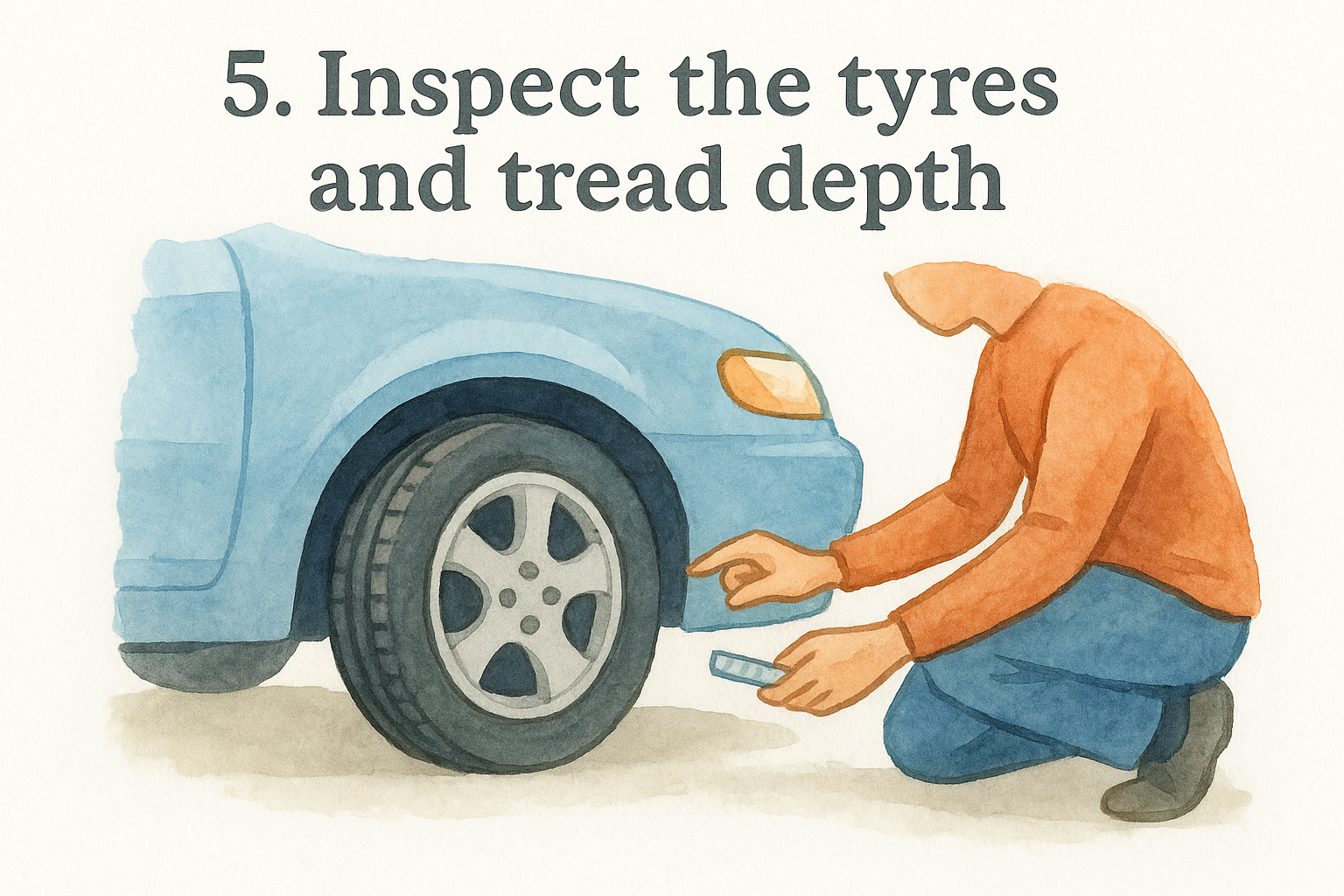
What to check
Run through this quickly at every viewing:
- Tread depth across the full width of each tyre, not just the centre
- Matching tyre brands and sizes on the same axle
- Uneven wear patterns, such as one edge wearing faster than the other
- Sidewall condition, checking for cracks, bulges, or repair patches
- Manufacture date stamped on the sidewall, since tyres degrade even with low mileage
Why it matters
The legal minimum tread depth in the UK is 1.6mm across the central three-quarters of the tyre, and driving below that risks a fine plus points on your licence, according to GOV.UK's guidance on tyre safety. Uneven wear often points to a deeper issue, like poor wheel alignment or worn suspension components, rather than just tyre choice. Mismatched tyres across an axle can also affect handling and grip in wet conditions.
Tyres with uneven wear are often the first visible clue that something else, like suspension or alignment, needs attention.
Red flags to watch out for
Treat these as reasons to negotiate the price down or ask further questions:
- Tread depth close to or below the legal 1.6mm limit
- Bulges, cracks, or exposed wire in the sidewall
- Tyres of different brands or tread patterns fitted to the same axle
- Wear concentrated heavily on one edge, suggesting alignment problems
Budget for a full set of replacement tyres if more than one shows heavy wear, since that cost adds up fast and should factor into any negotiation.
6. Examine the bodywork for dents, scratches and rust
Walk around the car in daylight, ideally not under artificial showroom lighting that hides imperfections. Bodywork condition tells you how a car has been parked, driven, and stored over its life, and it's one of the few checks on any second hand car inspection checklist that costs nothing but a few minutes and a decent look.
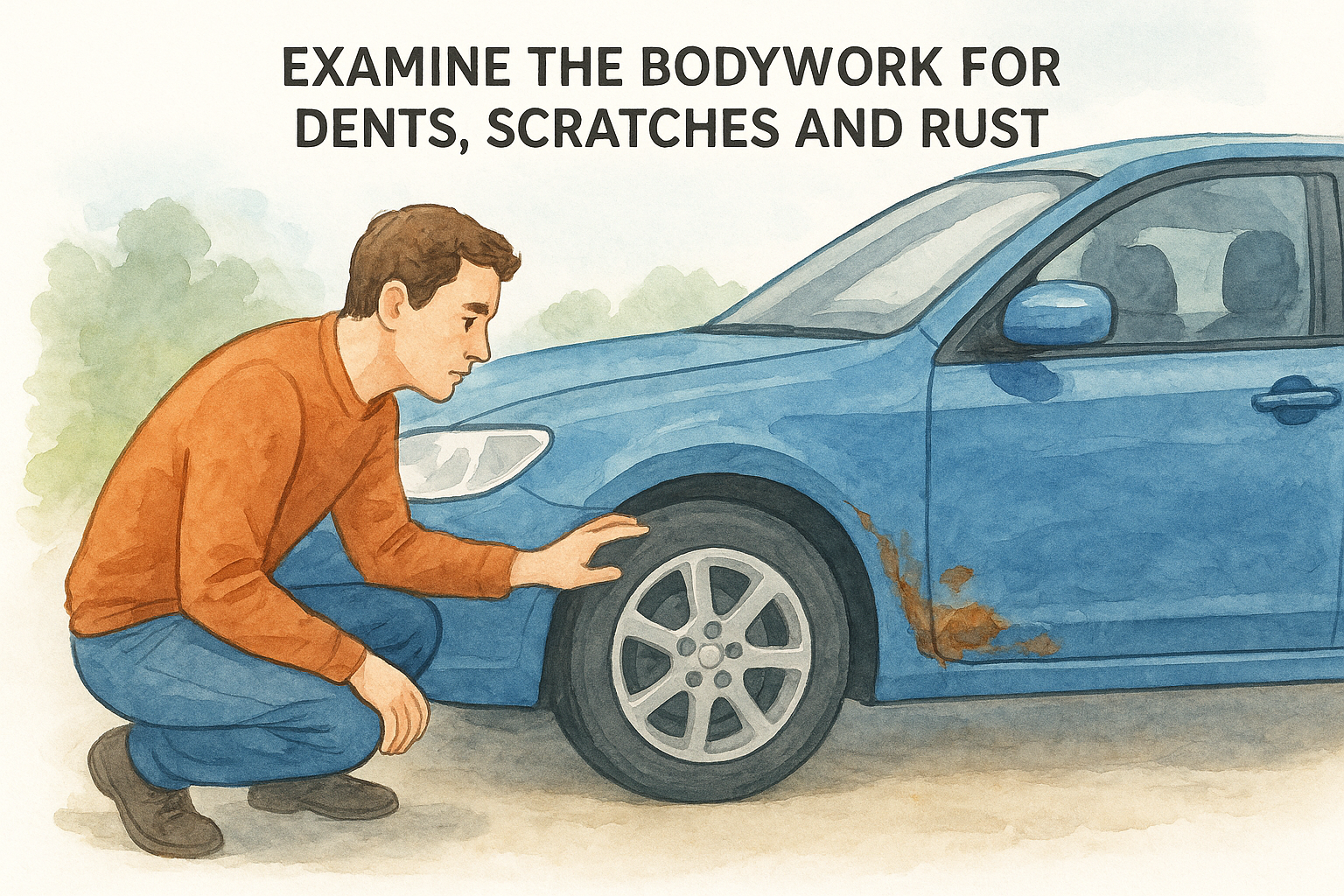
What to check
Get low and check reflections along each panel rather than staring straight on:
- Dents and scratches on doors, bumpers, and wing panels
- Rust patches, especially around wheel arches, sills, and the underside of doors
- Paint colour matching between panels, checked in bright light
- Bubbling paint, which often signals rust forming underneath
- Underbody condition, checked by looking underneath if you can safely get a view
Why it matters
Minor cosmetic damage is normal on any car over a couple of years old, but rust and corrosion are structural problems that only get worse. Once rust takes hold on a sill or arch, it spreads, and repairing it properly costs far more than a quick touch-up job disguises. Bodywork condition also gives you leverage. A car covered in scrapes and stone chips is a car you can reasonably negotiate down on price.
Cosmetic damage is a negotiating point, but rust is a structural warning sign.
Red flags to watch out for
Be wary of any of these:
- Rust bubbling through paint on sills, arches, or door bottoms
- Colour mismatches between adjacent panels, suggesting a respray
- Fresh underseal applied only in patches, often used to mask corrosion
- Filler visible where a panel has clearly been reshaped rather than replaced
If rust appears on a car under seven years old, ask the seller directly how it happened, since that's earlier than normal wear would suggest.
7. Check panel gaps and paint for signs of accident repair
Panel gaps and paint consistency reveal accident history that a seller might not mention, even if the repair was done well. This step goes hand in hand with the bodywork check, but it deserves its own place on a second hand car inspection checklist because it catches problems a quick walk-around can miss. Take your time comparing each panel against its neighbour rather than glancing at the car as a whole.
What to check
Look closely at the seams between panels and the paint finish across the whole car:
- Panel gap width and alignment between doors, bonnet, boot, and wings
- Paint texture and sheen, comparing each panel under the same light
- Overspray on rubber seals, badges, or trim, which suggests a respray done without proper masking
- Bonnet and boot alignment when opened and closed
- Sound when tapping panels, since filler-heavy repairs sound duller than untouched metal
Why it matters
Uneven panel gaps almost always mean a panel has been removed, replaced, or reshaped after damage. That's not automatically a dealbreaker, but it changes what you're buying and what you should pay. A car repaired to a poor standard can have hidden structural weaknesses that only show up in a future accident.
Uneven panel gaps are usually the clearest sign a car has been in a crash, no matter how good the respray looks.
Red flags to watch out for
Treat these as serious warning signs:
- Gaps that widen or narrow unevenly along one edge
- Paint that doesn't quite match in colour or texture between adjacent panels
- Masking tape lines or overspray on seals and trim
- A boot or bonnet that doesn't sit flush when closed
Cross-check any suspected repair against your Vehiclepedia history check, since a genuine write-off or insurance claim often shows up there even when the bodywork looks convincing.
8. Inspect the glass, lights and mirrors
Windscreens, lights and mirrors get overlooked because they seem too minor to matter, yet they're a cheap, fast check that can flag both roadworthiness issues and past damage. This step belongs on any thorough used car inspection checklist because a chipped windscreen or cracked lens is often the first sign of a stone strike, a minor knock, or neglected maintenance that a seller hasn't bothered to fix.
What to check
Work around the car methodically rather than glancing through the windscreen from the driver's seat:
- Windscreen chips or cracks, particularly in the driver's line of sight
- Headlight and taillight condition, checking for cracks, moisture inside the housing, or mismatched units
- Indicator and fog light function, tested with the engine running
- Wing mirror glass and housings for cracks or non-matching replacements
- Window operation, including electric windows on every door
Why it matters
A windscreen crack that sits within the swept area of the wipers, particularly near the driver's sightline, can fail an MOT outright, and the DVSA's MOT inspection manual sets out exactly where the limits fall. Moisture inside a light housing usually means a failed seal, which lets water damage the electrics over time.
A cracked light lens or foggy headlight housing often points to a repair the seller never got around to finishing properly.
Red flags to watch out for
Be cautious if you spot any of these during your check:
- A windscreen chip larger than 10mm sitting in the driver's sightline
- Headlight or taillight units that don't match in age, colour or clarity
- Moisture or condensation visible inside any light housing
- Electric windows that operate slowly or make grinding noises
Mismatched light units are worth asking about directly, since they often trace back to accident repairs the seller hasn't disclosed.
9. Check fluid levels and look under the oil cap
Popping the bonnet and checking fluid levels takes two minutes but tells you things a service book won't. This is one of the few checks on a second hand car inspection checklist you can do with your bare hands, and it catches neglect that a fresh valet is designed to hide. Ask the seller to let the engine sit cold before you start, since a warm engine can mask problems you'd otherwise spot straight away.
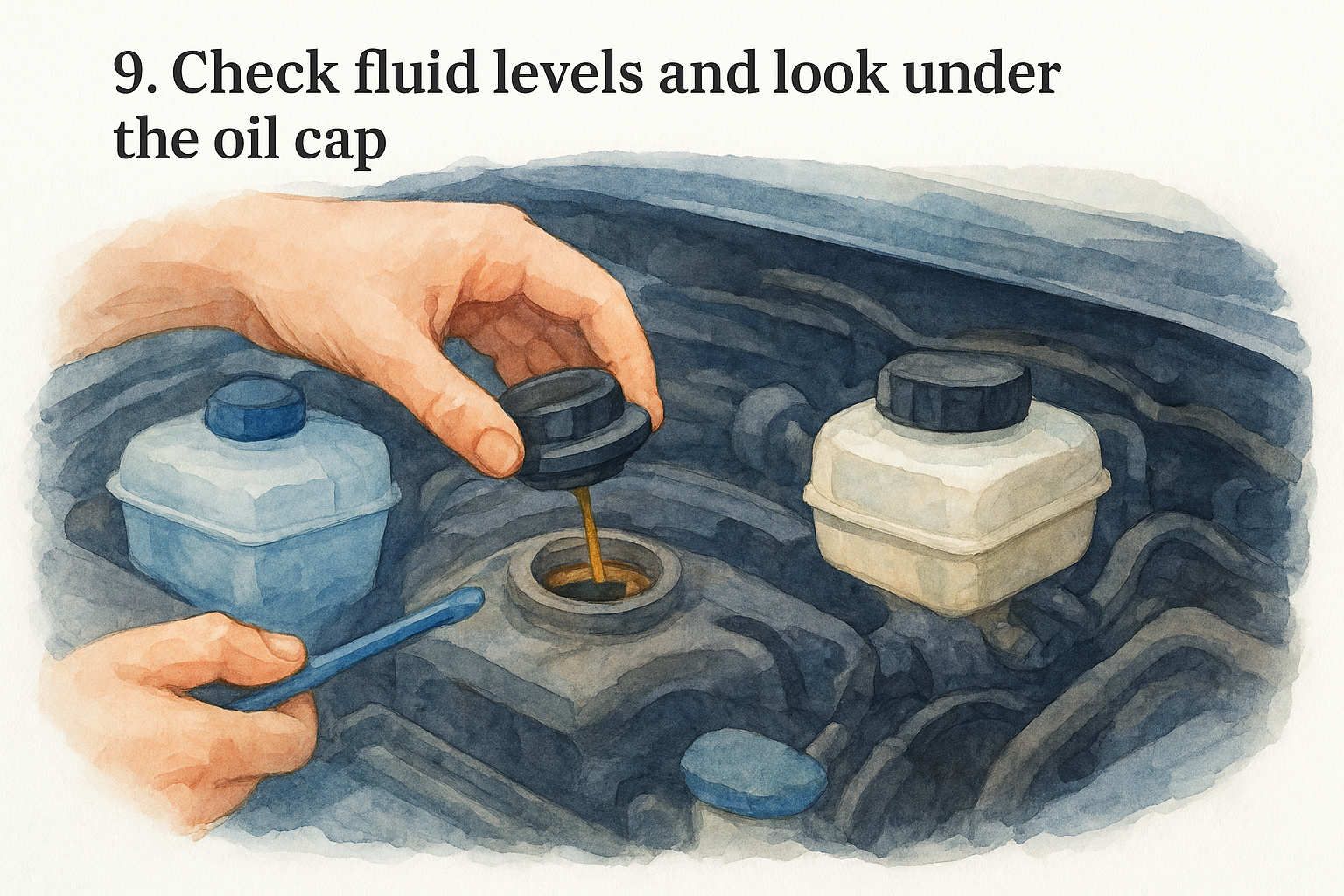
What to check
Go through each fluid reservoir in turn rather than glancing at the engine bay as a whole:
- Oil level and colour on the dipstick, checking it's not overfilled or running low
- Underneath the oil cap for a thick, pale, mayonnaise-like residue
- Coolant level and colour in the expansion tank, checked when the engine is cold
- Brake and clutch fluid levels against the minimum and maximum markers
- Screenwash reservoir, which shows whether basic upkeep has been ignored
Why it matters
A mayonnaise-like residue under the oil cap usually points to condensation mixing with oil, often caused by a blown head gasket or a car that's only ever done short journeys. Either way, it's a warning sign worth taking seriously. Low or dirty oil suggests the seller has skipped routine changes, and that shortens the life of everything the oil is meant to protect.
Gunk under the oil cap is one of the cheapest checks that can save you from the most expensive repair bill.
Red flags to watch out for
Treat any of these as reasons to ask more questions before you commit:
- Milky residue under the oil cap or in the coolant reservoir
- Oil that's black, gritty, or well below the minimum mark
- Coolant that looks rusty, oily, or has a strong sweet smell
- Reservoirs that are bone dry, suggesting the car's been prepped just for viewing
10. Look for leaks, corrosion and wear under the bonnet
With the fluids checked, spend another few minutes looking at the engine bay as a whole. Leaks and corrosion under the bonnet often sit hidden behind plastic covers, so don't be afraid to peer around hoses and brackets rather than just glancing at the top of the engine. This step rounds out the mechanical side of any second hand car inspection checklist before you move on to the electrics.
What to check
Work through the engine bay methodically, checking both the obvious surfaces and the areas tucked further back:
- Oil or coolant staining on the engine block, subframe, or driveway underneath the car
- Perished or cracked hoses, especially around the radiator and turbo pipework
- Battery condition, checking terminals for corrosion and the casing for bulging
- Drive belts for cracking, fraying, or a glazed shine
- General cleanliness, since an engine bay that's suspiciously spotless can be hiding a leak just as much as one that's filthy
Why it matters
A small leak now often becomes a roadside breakdown later, and coolant or oil loss that goes unnoticed can lead to serious engine damage. Corrosion on battery terminals points to a battery nearing the end of its life, which is a cost you'll want factored into your offer rather than discovering a week after buying the car.
An engine bay that's been jet-washed the morning of the viewing is usually hiding something worth finding.
Red flags to watch out for
Be wary if you notice:
- Fresh oil or coolant staining anywhere in the engine bay
- Hoses that feel brittle or crack when gently squeezed
- A battery casing that's swollen, cracked, or heavily corroded at the terminals
- An engine bay cleaned to an unusual standard just before your viewing
11. Test the electrics and dashboard warning lights
Sit in the driver's seat with the key in the ignition, or the engine running if the car has keyless start, and work through every electrical function before you even think about the test drive. Dashboard warning lights are the car's own diagnostic system talking to you directly, and ignoring them is one of the most avoidable mistakes on any second hand car inspection checklist.
What to check
Go through each system methodically rather than assuming everything works because the dash looks fine at a glance:
- Warning lights on startup, checking they illuminate briefly then switch off
- Air conditioning and heating, tested on both hot and cold settings
- Infotainment screen and controls, including Bluetooth pairing and reversing camera if fitted
- Central locking and electric windows on every door
- Wipers, washers and horn, all tested with the engine running
Why it matters
A warning light that stays on, particularly the engine management or ABS light, signals a fault that could be minor or could be an expensive sensor or wiring problem. Air conditioning that's stopped working often means a costly regas or compressor repair, not just a quick top-up. Electrical faults have a habit of multiplying rather than staying isolated, so what looks like one dead switch can point to a wider wiring issue.
A warning light that's been taped over or ignored tells you more about the seller than the fault itself.
Red flags to watch out for
Treat any of these as reasons to ask direct questions before you commit:
- Engine management or ABS light staying lit after startup
- A dashboard bulb removed or a warning light covered with tape
- Air conditioning that blows warm air on the coldest setting
- Electric windows or central locking that work intermittently or not at all
12. Inspect the interior, seats and seatbelts
Open every door and sit in each seat, not just the driver's, before you judge the interior on looks alone. Interior condition on a used car tells you how it's actually been lived in day to day, and it's a check that's easy to rush through when you're keen to get on with the test drive. Give yourself five minutes here rather than a quick glance as you climb in.
What to check
Work through the cabin methodically, checking wear points as well as safety equipment:
- Seat upholstery and bolsters for excessive wear relative to the mileage shown
- Seatbelt operation, pulling each one fully out and checking for fraying or locking properly
- Seatbelt pretensioners, listening for a firm click rather than a loose or delayed catch
- Pedal rubbers and door sills, since these wear in proportion to genuine mileage
- Odours, particularly damp, mould or heavy air freshener masking a leak
Why it matters
Worn pedal rubbers and a sagging driver's seat on a car claiming low mileage is a classic mismatch, and it's one of the simplest ways to sanity-check the odometer reading against real-world use. A seatbelt that doesn't lock properly is a safety issue that needs fixing before the car goes anywhere near the road, not an afterthought.
Worn pedal rubbers on a low-mileage car are one of the easiest tells that the odometer doesn't match reality.
Red flags to watch out for
Question the seller directly if you notice any of these:
- Heavy seat and pedal wear on a car advertised with low mileage
- Seatbelts that don't retract, lock, or click properly
- Strong odours suggesting a hidden leak or previous flood damage
- Mismatched seat trim suggesting parts have been swapped from another car
13. Check the spare wheel, tools and accessories
Pop the boot and lift the carpet before you get distracted by legroom or boot space. The spare wheel and toolkit rarely feature on a buyer's mental checklist, yet a missing jack or a flat spare can leave you stranded on the hard shoulder within weeks of picking up the car. This is a quick check, but it's one that many buyers skip entirely because it's tucked out of sight.
What to check
Go through the boot compartment methodically rather than assuming everything's present because the boot looks tidy:
- Spare wheel or run-flat repair kit, checking it's present and usable
- Jack and wheel brace, confirming both are the correct fit for the car
- Locking wheel nut key, since replacements cost more than most buyers expect
- Original toolkit and manuals, including the service book if separate from the folder
- Charging cables, parcel shelf and boot liner, all of which get lost or sold separately over time
Why it matters
A missing locking wheel nut key means you can't remove any wheel in an emergency, and ordering a replacement from the manufacturer often takes days and costs upwards of £50. A flat or perished spare tyre is just as useless as no spare at all, so check the tread and pressure rather than assuming it's ready to go.
A car without its locking wheel key isn't fully roadworthy, no matter how good the paintwork looks.
Red flags to watch out for
Ask direct questions if you notice any of these missing or damaged:
- No locking wheel nut key anywhere in the car
- Spare wheel that's flat, cracked, or the wrong size for the car
- Toolkit missing entirely, suggesting parts have been sold separately
- Boot liner or parcel shelf absent, which knocks resale value later on
14. Start the engine from cold and listen for problems
Ask to see the car before the seller has warmed the engine up, ideally first thing in the morning or after it's sat untouched for a few hours. Starting from cold exposes problems that vanish once an engine reaches operating temperature, which is exactly why some sellers have the car running and toasty before you arrive. If the engine's already warm when you turn up, that alone is worth asking about.
What to check
Listen and watch closely during those first thirty seconds after the key turns:
- Starting time, checking the engine fires within a second or two rather than cranking repeatedly
- Exhaust smoke colour, watching for blue, black or thick white smoke on startup
- Idle stability, checking the engine settles into a smooth, even idle rather than surging or hunting
- Unusual noises, including knocking, ticking, or a rattle that fades as the engine warms
- Dashboard behaviour, confirming warning lights clear once the engine's running
Why it matters
A cold start reveals wear that a warm engine hides completely. Blue smoke points to oil burning past worn piston rings or valve seals, while thick white smoke that doesn't clear after a minute can signal a head gasket issue rather than just condensation. A knock that's loudest on startup and fades as oil circulates often means worn bearings, a repair that can run into thousands of pounds.
An engine that struggles to start cold tells you more than one that's already warm and idling smoothly.
Red flags to watch out for
Treat any of these as reasons to pause before handing over money:
- Extended cranking before the engine catches
- Smoke that doesn't clear within a minute of running
- A knocking or tapping noise that's loudest at startup
- The seller insisting on starting the car before you arrive
15. Test drive the steering, brakes, suspension and gearbox
No second hand car inspection checklist is complete without a proper test drive, and fifteen minutes around the block isn't enough. Push for at least twenty minutes covering a mix of roads: a motorway or dual carriageway for speed, a roundabout for steering feel, and a rough back street for suspension. This is where every earlier check gets confirmed or contradicted by how the car actually behaves.
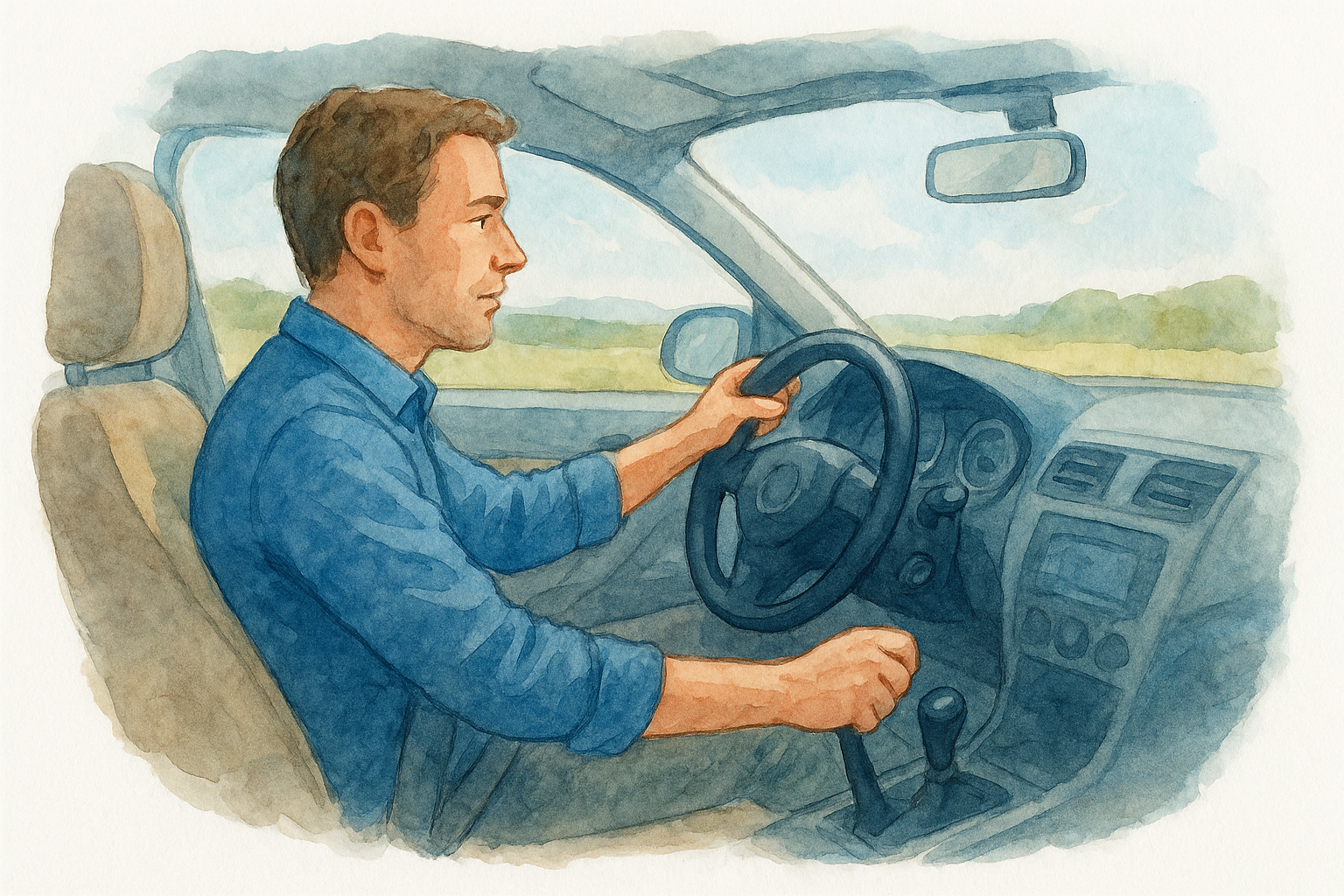
What to check
Work through each system deliberately rather than just enjoying the drive:
- Steering feel, checking for pulling to one side or vibration through the wheel
- Braking performance, testing a firm stop from 30mph for pulling, grinding or a soft pedal
- Suspension response over speed bumps and potholes, listening for knocks or clunks
- Gearbox smoothness, checking every gear engages cleanly with no grinding or slipping
- Clutch biting point, confirming it engages consistently rather than high or low each time
Why it matters
A car pulling to one side under braking often means uneven pad wear or a sticking caliper, both costly repairs if left unchecked. Clunks over bumps point to worn bushes or dampers, which affect handling and MOT results alike. Gearbox hesitation, particularly on an automatic, can signal a transmission fault that's far more expensive to fix than anything found under the bonnet.
The test drive is where every other check on this list gets confirmed or contradicted.
Red flags to watch out for
Treat any of these as reasons to renegotiate or reconsider entirely:
- Steering that pulls or vibrates at speed
- Brakes that feel spongy, grind, or pull unevenly
- Clunking or knocking over rough surfaces
- Gears that slip, grind, or hesitate to engage
If the seller resists a proper test drive on varied roads, that reluctance is itself a red flag worth taking seriously.
Buying your next car with confidence
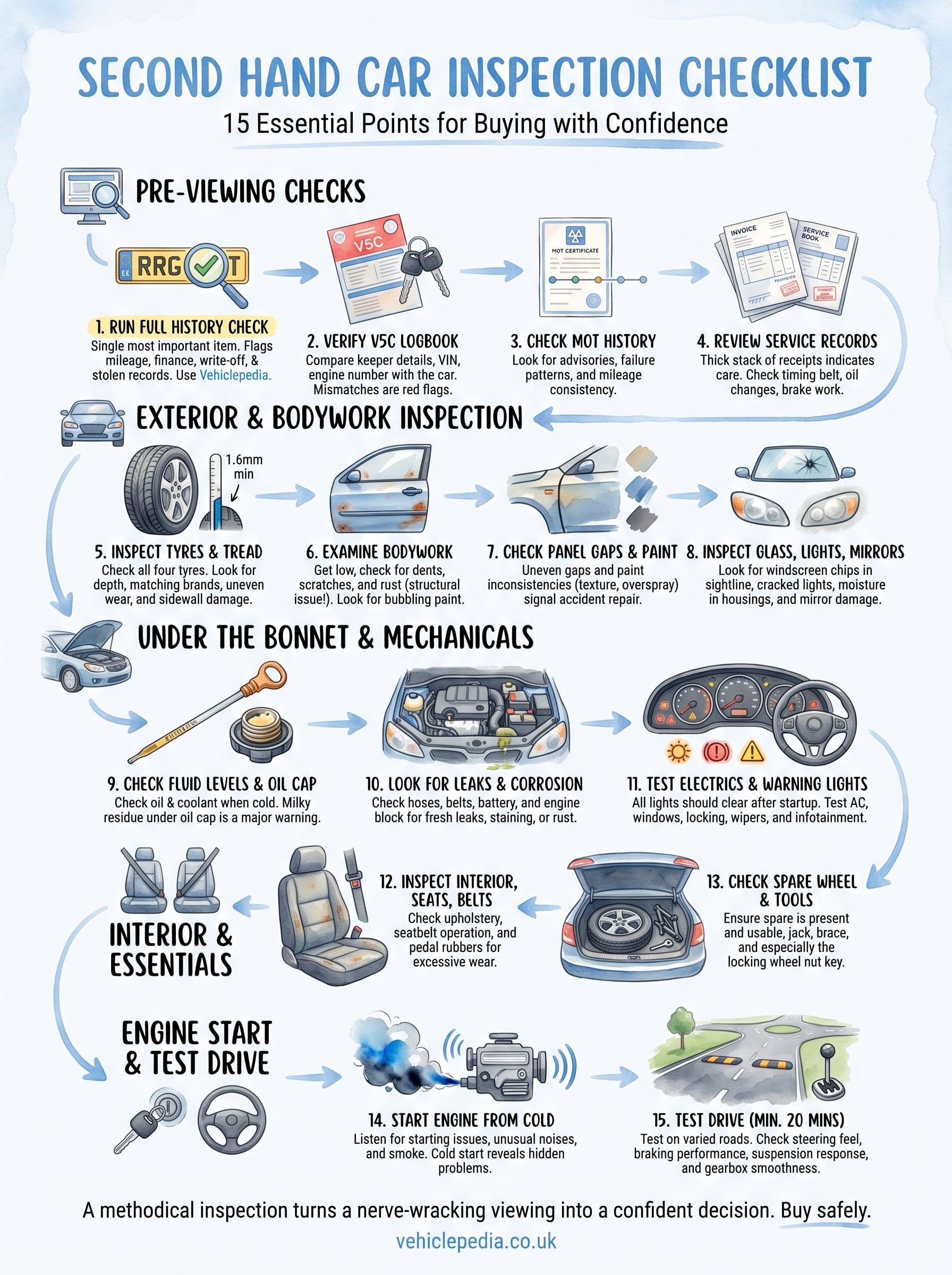
Working through all fifteen points takes an hour, maybe two if you're thorough with the test drive. That's a small price against the risk of buying a car with hidden finance, a written-off history, or an engine that's about to fail. A proper second hand car inspection checklist turns a nerve-wracking viewing into a methodical process, one where you're checking facts rather than trusting a sales pitch.
Paperwork and paperwork alone won't tell you everything, and neither will a walk around the car without the history behind it. Use both together. Run the registration through a check before you view, then confirm what you find with your own eyes and ears on the day.
If you want to see exactly what a full report covers before you commit to buying one, take a look at a sample premium report and check it against the car you're considering.