How to Buy a Used Car in the UK: Step-by-Step Guide
Learn how to buy a used car UK buyers can trust: budgeting, scams to avoid, inspections, negotiating, and running a history check before you pay.
How to Buy a Used Car in the UK: Step-by-Step Guide
Buying a used car can turn into an expensive mistake if you skip the wrong step. Learning how to buy a used car in the UK properly means more than haggling on price. It means knowing which documents to demand, which checks to run, and which warning signs mean you should walk away before you hand over a deposit.
This guide walks you through the entire process in order, from working out your budget and finance options to the final handover of keys and paperwork. You'll get a practical checklist for viewing a car, the right questions to ask a seller, and a clear rundown of the legal checks that separate a safe purchase from a costly one, including outstanding finance, mileage discrepancies, and write-off history.
We built this guide from the same principle behind our own checks: use official data, not guesswork. Along the way, you'll see exactly where a free vehicle history check fits into your process and when it's worth paying for a fuller report before you commit your money to a car you've never seen the full story on.
What to know before you start buying a used car
Before you scroll through a single advert, it helps to understand the ground rules that shape every used car purchase in the UK. Private sales and dealer sales are governed by different laws, the paperwork you'll be handed varies wildly in quality, and sellers range from honest owners moving on to organised fraudsters running cloned vehicles. Knowing this upfront stops you from assuming a friendly seller means a safe deal, or that a flashy dealer forecourt means everything's above board.
Dealer sales versus private sales
Where you buy determines your legal protection. Buy from a registered dealer and you're covered by the Consumer Rights Act 2015, which means the car must be as described, of satisfactory quality, and fit for purpose. Buying from a private seller in the UK means the phrase "caveat emptor" (buyer beware) applies almost entirely, and your only real protection is that the car matches its description and the seller has the legal right to sell it.
| Seller type | Legal protection | Typical price | Comeback if it goes wrong |
|---|---|---|---|
| Registered dealer | Consumer Rights Act 2015 | Higher | Repair, replacement, refund |
| Private seller | Description and title only | Lower | Small claims court only |
| Auction | Usually "sold as seen" | Variable | Very limited |
A private sale price looks cheaper until something breaks and you realise you've got nowhere to turn.
Understand what "sold as seen" really means
Many private ads and some trade listings use the phrase "sold as seen", and it's worth knowing this doesn't override your basic legal rights. A seller still can't lie about the car's condition, mileage, or history, and misrepresenting these facts is fraud, not just poor customer service. That said, proving a private seller knowingly hid a fault is far harder than getting a dealer to honour a warranty, so the practical lesson is simple: do your own due diligence rather than relying on legal recourse after the fact.
Common scams to watch out for early
Fraud in the used car market is common enough that you should treat every advert with a healthy dose of scepticism until you've verified it yourself. Some of the most frequent tricks include:
- Clocking: winding back the odometer to hide high mileage and inflate the price, which leaves telltale signs a car has been clocked
- Cloning: fitting a stolen car with the plates of a legitimate one to hide its true identity
- Cut and shut: welding two crash-damaged cars together to disguise structural damage
- Hidden finance: selling a car that still has an outstanding loan against it, which technically still belongs to the finance company
- Ghost adverts: fake listings using stolen photos, often priced suspiciously low to lure a quick deposit
Each of these leaves a trace in official records, which is exactly why what a vehicle history check reveals about a registration plate matters before you get emotionally invested in a specific car. Running one takes a couple of minutes and can rule out the worst-case scenarios before you even arrange a viewing.
Getting familiar with these basics now means every step that follows, from budgeting to negotiating, happens with your eyes open rather than relying purely on gut feeling about a seller you've just met.
Step 1. Set your budget and finance options
Before you look at a single car, work out exactly what you can afford, not just to buy but to run. Too many buyers fixate on the purchase price and forget insurance, road tax, MOT, servicing, and fuel costs, all of which vary hugely between makes and models. Set a realistic total budget that covers the first year of ownership, not just the number on the advert, so you're not caught out a month after driving home.
Work out the true cost of ownership
Spreading your research across the whole cost picture stops a cheap-looking car from becoming an expensive one. Before you commit to a figure, factor in:
- Insurance group and premium for your specific age and postcode
- Road tax band, which depends on emissions and registration date
- MOT and servicing history, since older cars often need more frequent work
- Fuel type and efficiency, particularly relevant if you do high mileage
- Depreciation, as some models hold value far better than others, so it pays to know how to calculate car depreciation
A car that's cheap to buy but expensive to run isn't a bargain, it's a slow-moving cost.
Compare your finance options
Getting your finance sorted before you view anything gives you a firm ceiling and stops you overstretching under pressure from a keen seller. Whether you're paying cash, using a personal loan, or taking dealer finance like HP or PCP, each option carries different risks and total costs.
| Finance type | How it works | Best for |
|---|---|---|
| Cash | Pay upfront, own outright immediately | Buyers avoiding interest and monthly commitments |
| Personal loan | Borrow from a bank, own the car outright | Buyers wanting ownership plus flexibility to shop anywhere |
| Hire Purchase (HP) | Pay in instalments, own it after final payment | Buyers wanting fixed payments without a large deposit |
| PCP | Lower monthly payments, optional balloon payment | Buyers wanting flexibility to hand the car back |
Independent guidance from MoneyHelper is worth reading before signing anything, since it breaks down APR and total repayable amounts without a dealer trying to upsell you.
Check for existing finance before you pay
Setting a budget also means protecting it, and that includes confirming the car you eventually choose isn't still tied to somebody else's loan. If a seller defaults on outstanding finance, the finance company can legally reclaim the car even after you've paid for it, so checking a car for finance before you pay is as important as agreeing the price itself.
Step 2. Decide where to buy your car
Once your budget is locked in, the next decision shapes everything else: where you actually shop. Dealer forecourts, online marketplaces, and car auctions each come with a different mix of price, convenience, and risk, and picking the wrong venue for your circumstances is how people end up with an unwanted headache before the deal is even done. Match the source to how much protection you want and how much legwork you're willing to put in yourself.
Franchised and independent dealers
Dealers cost more, but you're paying for accountability. A franchised dealer sells cars backed by a manufacturer warranty and multi-point checks, while an independent dealer usually offers a shorter warranty, so it's worth knowing what a used car warranty actually covers before you weigh one against the other on price. Both fall under the Consumer Rights Act 2015, so if a fault appears within the first six months, the burden is on the dealer to prove it wasn't there at sale, not on you to prove it was.
Online marketplaces and private classifieds
Marketplaces give you the widest choice and usually the sharpest prices, since you're often buying directly from an owner with no dealer margin built in. Reduced protection is the trade-off here, so every check you'd normally lean on a dealer to have already done becomes your own responsibility. Treat listings on sites like Auto Trader, eBay Motors, or Facebook Marketplace as a starting point for research, not a guarantee of accuracy, and verify everything independently before you arrange a viewing.
Cheaper upfront only counts as a saving if the car turns out to be exactly what the advert claimed.
Car auctions
Auctions can produce genuine bargains, but they're the least forgiving route for a first-time or nervous buyer. Cars are typically sold "as seen" with minimal inspection time, no test drive, and payment expected almost immediately if you win the bid, so mistakes are expensive and irreversible.
| Buying source | Price level | Protection | Best suited to |
|---|---|---|
| Franchised dealer | Highest | Strongest | Buyers wanting warranty and peace of mind |
| Independent dealer | Mid-range | Consumer Rights Act applies | Buyers balancing price and legal cover |
| Online marketplace/private seller | Lower | Minimal | Confident buyers doing their own checks |
| Auction | Variable, often lowest | Very limited | Experienced buyers comfortable with risk |
Wherever you decide to look, running a quick vehicle check on any registration plate that catches your eye costs nothing and takes minutes, letting you filter out problem cars before you waste a Saturday viewing one in person.
Step 3. Shortlist adverts and check the car's history
With your budget fixed and a buying source chosen, narrow down the search to a shortlist of realistic candidates before you contact a single seller. Casting too wide a net wastes evenings on cars you'll never buy, so filter by make, model, mileage, and price band first, then use the registration plate to do the heavy lifting on background checks before you pick up the phone.
Build a shortlist that's actually worth your time
Aim for five or six adverts rather than one, since comparing similar cars side by side quickly reveals which price is fair and which seller is overreaching. Look closely at the photos for consistency, check that the mileage matches the car's age and service history, and note whether the seller answers basic questions in the listing itself or leaves everything vague. A well-written advert with clear photos and an honest description is usually a better sign than a rock-bottom price with grainy pictures and no history mentioned at all.
Run a free vehicle history check before you view
Once you've got a shortlist, run each registration plate through a free history check by reg plate before arranging any viewings. This pulls DVLA-backed data on the car's tax and MOT status, registration date, and recorded mileage history, letting you spot obvious red flags like a car that's been off the road for years or a mileage figure that's dropped between MOT tests. It costs nothing and takes a couple of minutes, so there's no excuse for skipping it, especially when it can rule out a wasted trip entirely.
Ruling out a bad car from your sofa beats discovering it's a bad car in someone's driveway.
Decide when a premium report earns its price
A free check answers the basic questions, but a car ticking every box on paper still deserves a deeper look before real money changes hands. A premium vehicle check adds outstanding finance, insurance write-off status and its category codes, and a stolen vehicle check against police records, three things that never show up in a free lookup but can wipe out your entire purchase if ignored. It's a small cost against the risk, and you can see what a premium report costs before you buy, with Vehiclepedia backing every one with a £30,000 data guarantee for exactly that reason.
Once a car clears both checks, it earns a spot on your final shortlist and a genuine viewing, saving your time and travel for cars that already look legitimate on paper.
Step 4. Inspect the car and its paperwork
Once a car clears its history checks, arrange a viewing in daylight and go in with a plan rather than a vague sense of hope. Physical inspection catches faults no database can flag, from bodged bodywork to a clutch that's on its last legs, so give yourself at least 30 minutes before you even think about a test drive. Bring a torch, a magnet, and someone else's opinion if you can, since a second pair of eyes rarely agrees with your excitement about a car you've already half decided to buy.
Work through a structured walkaround
Start at one corner of the car and work through a second hand car inspection checklist systematically rather than jumping between panels at random. Check for:
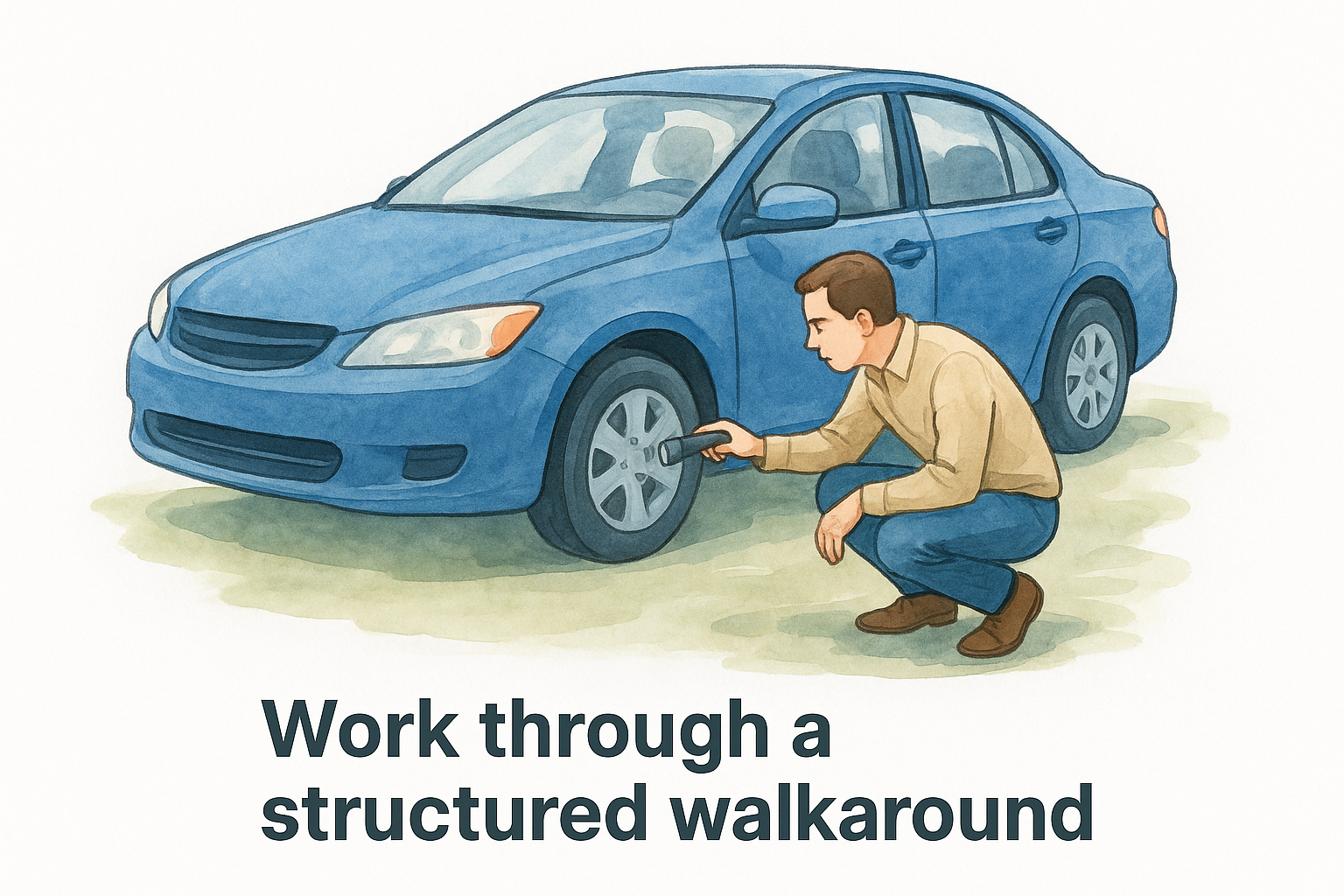
- Panel gaps and paint colour matches between adjoining panels, which can reveal accident repairs
- Rust around wheel arches, sills, and the boot floor, especially on cars over eight years old
- Tyre wear and tread depth, checking all four match evenly rather than showing one-sided wear
- Fluid leaks under the car after it's been parked for a few minutes
- Interior wear against the mileage claimed, since a worn steering wheel on a "low mileage" car is a red flag
A car that looks perfect from three feet away can still be hiding a repaired write-off underneath the paint.
Cross-check the paperwork against the car itself
Matching documents to the actual metal in front of you matters just as much as the visual inspection. Confirm the VIN stamped on the chassis matches the one on the V5C logbook, looking up the VIN number online as well, and check the registration plate matches too, since any mismatch suggests cloning or a car that's been rebuilt from parts. The V5C should list the current keeper's name and address, and if the seller's name doesn't match, ask why before you go any further.
Review the service history and MOT record
Before paperwork gets waved away as "somewhere at home", insist on seeing it in person. A full service history, ideally stamped by a main dealer or reputable garage, tells you the car's been looked after, and verifying a car's service record matters just as much as reading a string of advisories on past MOT certificates that hint at problems the seller hasn't fixed. If anything doesn't add up, checking the MOT history online by registration plate against the physical documents in front of you settles the question on the spot, before you've committed a penny.
Step 5. Take the car for a test drive
Once the paperwork checks out, insist on a proper test drive rather than a five-minute trip around the block, working through a 15-point test drive checklist as you go. A short crawl at 20mph tells you almost nothing about how a car actually behaves, so aim for at least 15 to 20 minutes covering a mix of road types before you make any decision. Never let a seller talk you out of driving the car yourself, and never hand over money before you've had the wheel in your own hands.
Plan a route that actually tests the car
Getting a real feel for the car means choosing a route that mimics how you'll actually use it day to day. Try to include:
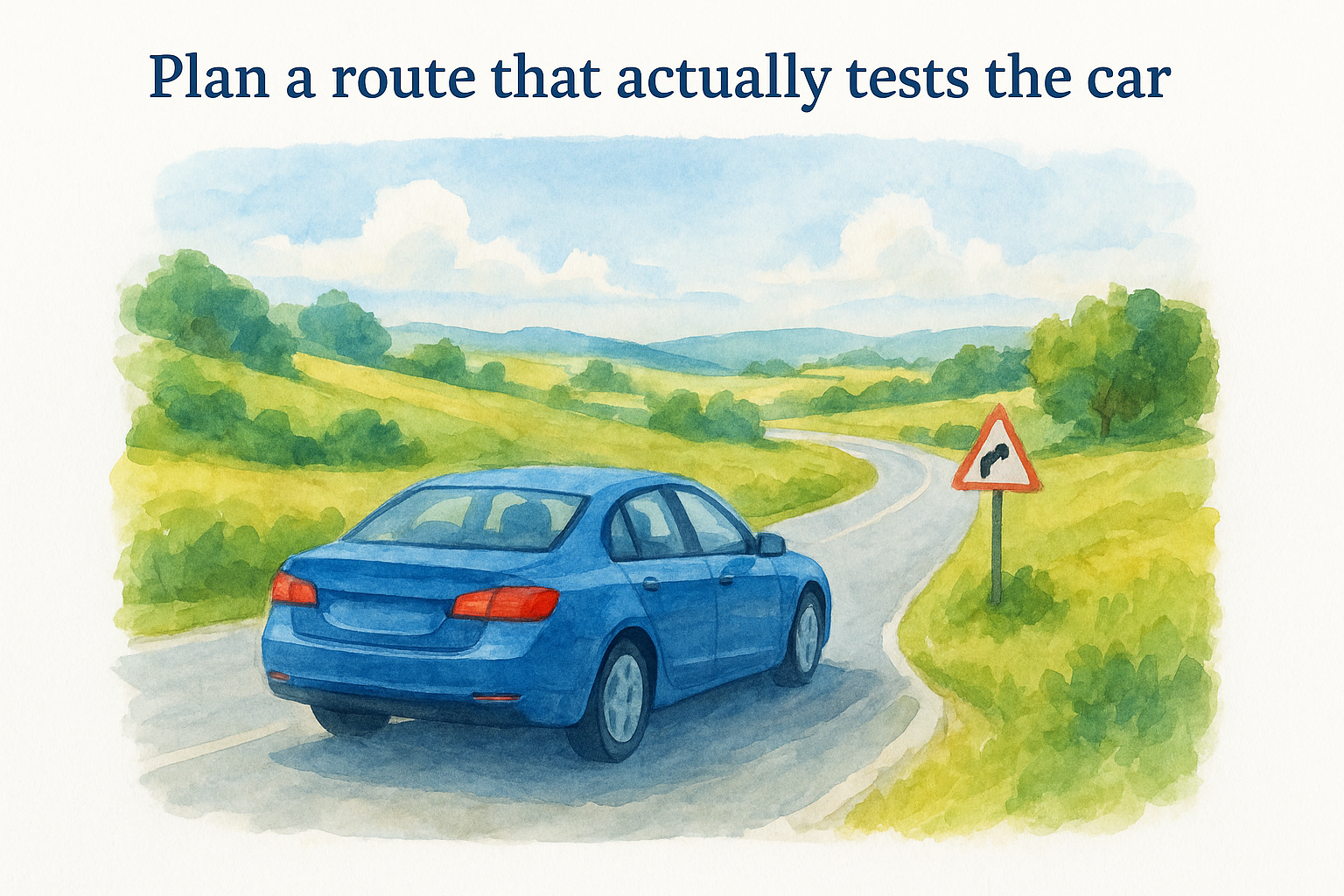
- A stretch of dual carriageway or faster A-road to check for vibrations, wandering, or engine strain at higher speeds
- Some stop-start town driving to test the clutch, brakes, and low-speed gear changes
- A few sharp turns and a roundabout to listen for suspension knocks or steering play
- A steep hill if one's nearby, since a struggling engine or slipping clutch shows up fastest under load
If a seller hesitates over letting you take a proper test drive, that hesitation is the answer.
Listen, feel, and watch the dashboard
Beyond how the car handles, pay close attention to what it's telling you mechanically. Switch the radio off, listen for knocks, whines, or grinding noises, and check the brakes pull the car up straight without pulling to one side. Watch the dashboard for warning lights that flicker on and off, since a seller may have cleared a fault code just before your viewing, and check the temperature gauge settles at a normal reading rather than climbing steadily.
Confirm you're covered before you drive
Before you even sit in the driver's seat, make sure you're legally allowed to be there. Whether you're test driving a used car on a dealer's insurance or your own, confirm cover explicitly with the seller beforehand rather than assuming it's sorted. Most dealers carry trade insurance that covers any driver, but private sellers often don't, so you'll need either day insurance of your own or written confirmation that their policy extends to you. Driving uninsured, even for ten minutes around the block, carries the same legal risk as driving uninsured on any other day, so don't skip this step because the seller seems relaxed about it.
Step 6. Negotiate the price and agree the deal
Once the test drive confirms the car drives as well as it looked on paper, it's time to talk money. Negotiating a used car price works best when you've done the groundwork already, since a seller who realises you've checked comparable adverts and spotted every flaw has far less room to argue their asking price is fair. Walk into the conversation with a number in mind and a reason to justify it, not just a hopeful lowball guess.
Build your case before you name a figure
Gathering evidence turns a vague haggle into a factual discussion the seller can't easily dismiss. Before you open negotiations, note down:
- Comparable adverts for the same make, model, and mileage, printed or saved so you can reference them directly, alongside a free valuation of what the car is worth
- Any faults found during inspection, from worn tyres to overdue servicing, each with a rough repair cost attached
- Advisories from the last MOT that haven't been addressed, since these represent near-term costs for you
- Time the car's been listed, since a stale advert often means a seller more open to movement on price
A seller who won't move on price when you've listed three genuine faults probably isn't the seller you want to buy from anyway.
Negotiate calmly and know your walk-away point
Staying calm during the conversation puts you in a stronger position than a seller who senses you've already fallen in love with the car. State your offer clearly, explain briefly why you've landed on that figure, and then stop talking, since an awkward silence often does more work than a follow-up argument. Decide your absolute ceiling before you start, and stick to it even if the seller pushes back with a sob story or a
Step 7. Pay safely and get proof of purchase
Once you've agreed a figure, how you actually pay for the car matters almost as much as the price itself. Never hand over cash for a car worth more than a few hundred pounds, and never let a seller pressure you into transferring money before you've seen the car in person and checked its paperwork matches. A bank transfer from your own account, done in person once you're both satisfied, gives you a traceable record that cash simply can't provide.
Choose a safe payment method
Sorting your payment method out before you agree the sale stops you scrambling for a solution under pressure at the seller's kitchen table. Weigh up the options below against the value of the car and how much of a paper trail you want.
| Payment method | Traceability | Risk level | Notes |
|---|---|---|---|
| Bank transfer | High | Low | Fastest and safest for most private sales |
| Banker's draft | High | Low | Good for large amounts, verify with the issuing bank first |
| Debit or credit card | High | Low | Section 75 protection on credit for dealer purchases |
| Cash | None | High | Avoid for anything beyond a small deposit |
A payment you can trace is a payment you can prove, and that matters far more than it feels like it will on the day.
Get a written receipt every time
Regardless of how you pay, insist on a signed receipt before the money leaves your account. Keeping a paper trail protects both parties if a dispute ever arises over the sale, and a proper receipt takes two minutes to write out by hand. Use something along these lines as a template:
Receipt for sale of vehicle

Registration: AB12 CDE
Make/model: [Make and model]
Mileage at sale: [mileage]
Price paid: £[amount]
Date of sale: [date]
Seller name and address: [details]
Buyer name and address: [details]
Signed (seller): ___________
Signed (buyer): ___________
Finalise the V5C and other paperwork
Before you drive away, make sure the seller fills in the yellow "new keeper" section of the logbook and gives it to you, while they post the green section to the DVLA themselves, so it helps to understand how the V5C logbook works. Ask for the MOT certificate, any service history, and both sets of keys at the same time, since chasing these down afterwards from a private seller rarely goes well once the money's changed hands.
Step 8. Tax and insure your car before driving
Owning the car legally isn't the same as being legally allowed to drive it. Before you turn the key on your own driveway, you need valid insurance in your name and road tax applied to the vehicle, since driving without either carries fines, points, and even seizure of the car by police. Sort both of these before the handover rather than on the drive home, because the moment the seller hands you the keys, any cover they had stops applying to you.
Insure the car before you turn the key
Getting a quote takes minutes once you know the registration and a few personal details, so there's no reason to leave this until the last moment. Have the following ready before you contact an insurer:
- Registration plate and full make/model from the V5C
- Estimated annual mileage and where the car will be parked overnight
- Your driving licence details and no claims history, if you have any
- Start date and time matching exactly when you plan to collect the car
Buy the policy so it's active from the minute you take possession, not the following morning, since a gap of even a few hours is enough to leave you uninsured on the drive home.
Insurance that starts tomorrow doesn't cover a crash today.
Tax the car the moment you own it
Road tax doesn't transfer with the car under current DVLA rules, so the previous keeper's tax ends the moment the sale is recorded, and you must tax it fresh in your own name before driving away. You can do this by taxing the car online, by phone, or at a Post Office using the 11-digit reference from the V5C, or the 12-digit code from a new keeper slip if the full logbook hasn't arrived yet. Run a car tax check by registration during your earlier history check too, since it confirms the tax band and cost you'll be paying going forward, which is worth knowing before you agree a price rather than after.
Confirm you're covered from the moment of handover
Double check both insurance and tax are active before you physically drive off, not just applied for. A quick call to your insurer to confirm the policy is live, and a look at the Check the MOT status or vehicle tax service on GOV.UK, takes two minutes and removes any doubt. Skipping this step over a bank holiday weekend, when phone lines are quiet and confirmations lag, is exactly how well-prepared buyers end up driving home uninsured by accident.
Red flags that signal a problem used car
Most bad deals give off warning signs long before you hand over any money, and learning to spot them early saves you from a costly mistake. Recognising a problem used car often comes down to noticing small inconsistencies rather than one obvious disaster, so treat any single red flag as a reason to slow down and dig deeper rather than walk away immediately.
Seller behaviour worth questioning
Watch how a seller responds under pressure, since genuine owners rarely mind the questions worth asking a private car seller. Be wary if someone refuses a test drive, insists on meeting somewhere other than their home address, or pushes hard for a quick cash deal before you've seen the paperwork. A seller who can't explain gaps in the service history, or who gets vague the moment you mention a vehicle history check, is telling you something even if they never say it outright.
A seller in a hurry to sell is sometimes hiding a reason you haven't found yet.
Paperwork inconsistencies
Documents rarely lie as convincingly as people do, so cross-check everything rather than taking a folder of paperwork at face value. Common signs worth chasing down include:
- V5C printed on plain paper rather than the DVLA's watermarked document, which is why it pays to verify a logbook online
- Mismatched addresses between the seller and the V5C keeper details
- Missing MOT history that a free check would normally show in full
- Service stamps that look identical across supposedly different garages
Physical and mechanical warning signs
Certain faults tend to cluster together, and spotting one often means it's worth checking for the others rather than assuming it's an isolated issue.
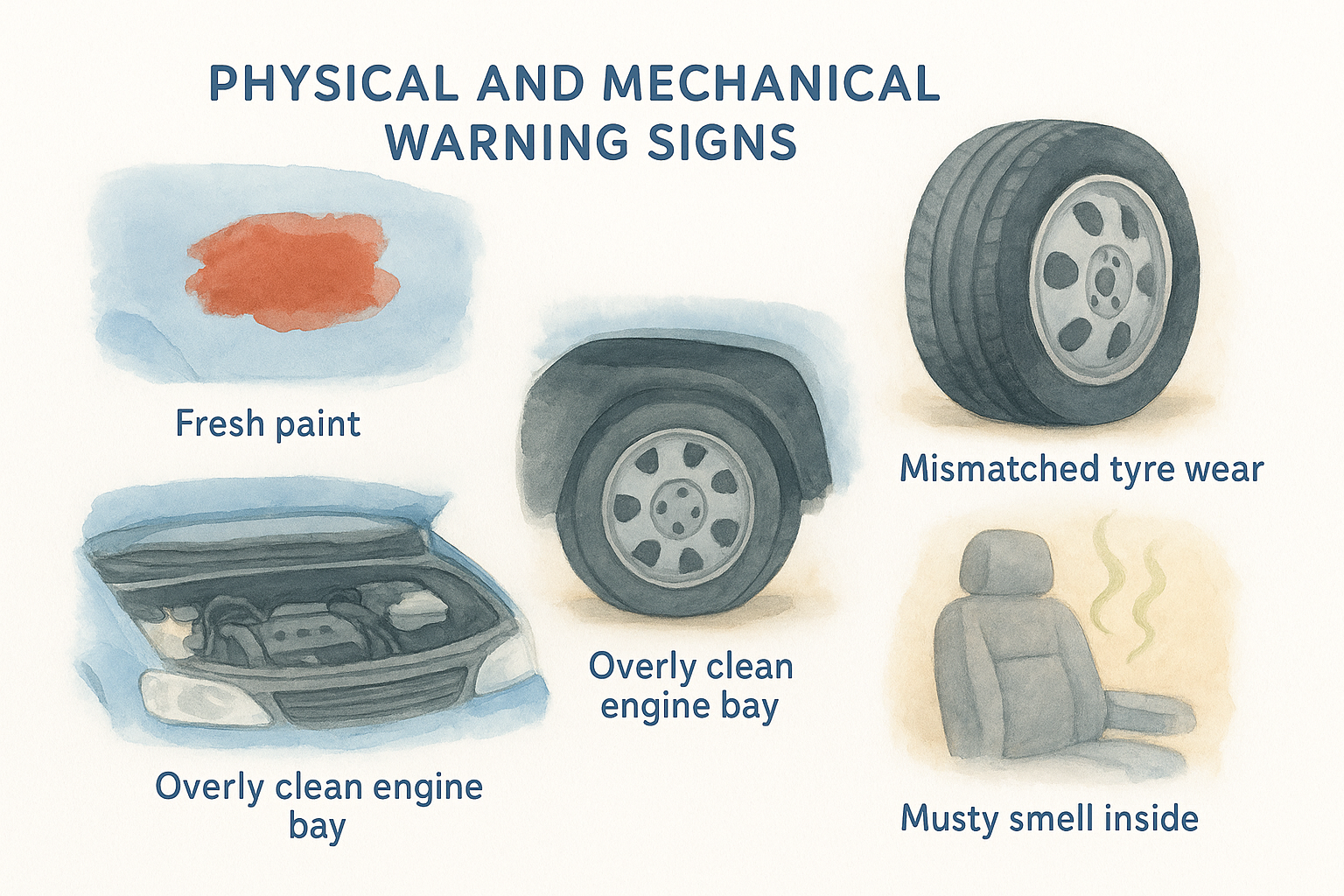
| Red flag | What it might mean |
|---|---|
| Fresh paint on one panel only | Hidden accident repair |
| Mismatched tyre wear | Suspension or alignment fault |
| Overly clean engine bay | Concealed oil leak |
| Odometer stickers or loose dash trim | Possible clocking |
| Musty smell inside | Past flood or water damage |
Checking whether a car is stolen by reg or VIN alongside a finance check closes the gap that a walkaround alone can't cover, since cloned and stolen cars often look completely normal in person. If two or more items on this list show up together, treat that as your cue to walk away rather than talk yourself into ignoring it because the price looked good.
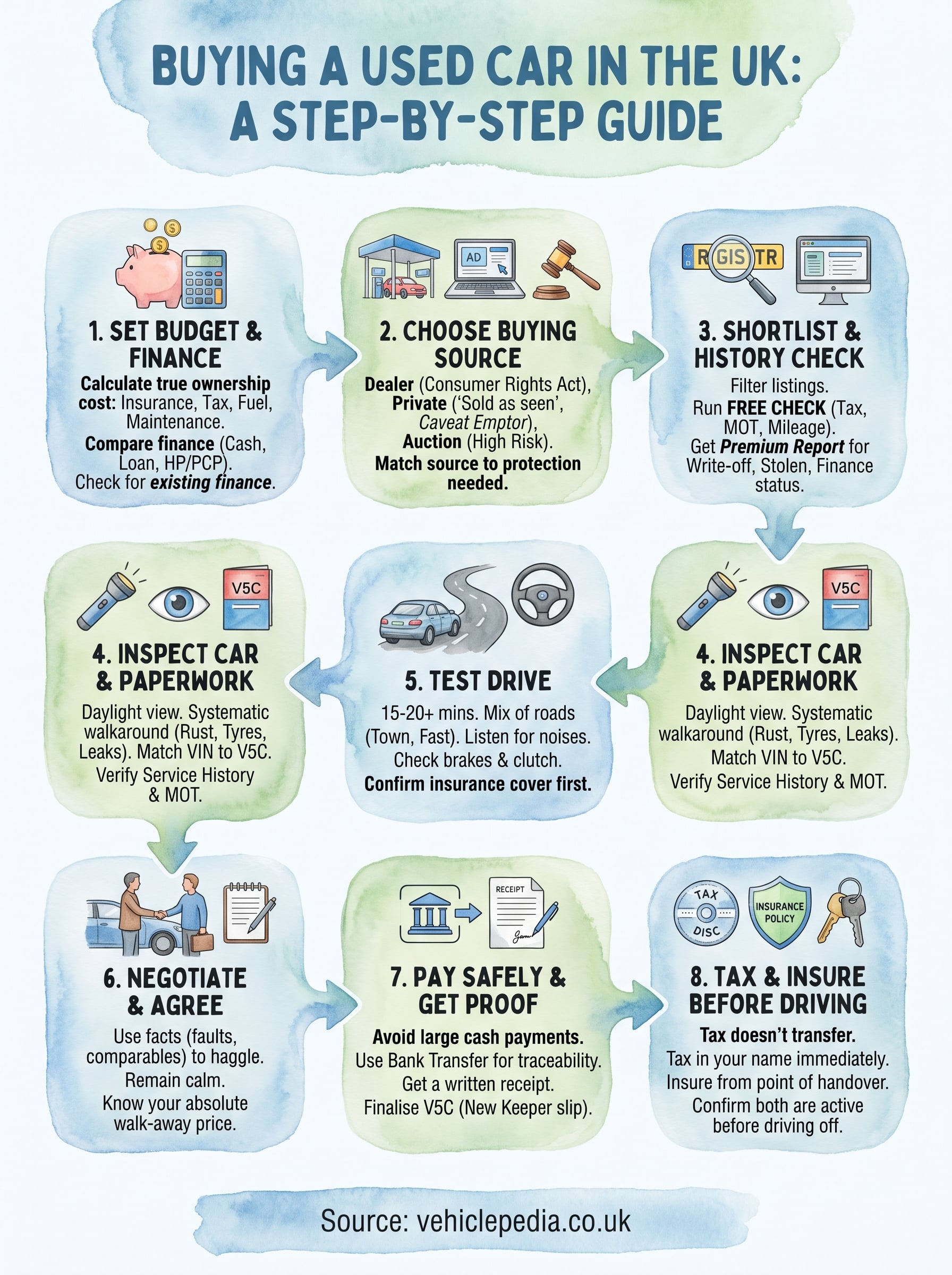
Driving off with confidence
Buying a used car in the UK doesn't need to feel like a gamble. Follow the steps in order, budget honestly, choose your buying source deliberately, verify the paperwork against the car itself, and you'll catch most problems long before they cost you money. Patience is your biggest asset here. A car that's still for sale next week was never the only option, and a seller who pressures you to skip a check is telling you exactly why you shouldn't.
Getting the process right comes down to combining your own eyes with official data, not just trusting a friendly seller's word. Every step in this guide points back to that principle, from the free history check before a viewing to the finance and write-off checks before you pay.
Before you commit to any car, see what a full Vehiclepedia report reveals, so you know precisely what you're paying for.